Monday, March 07, 2011

Plans for the 2011 Jane Austen Festival Ensemble

I plan to attend the Jane Austen Festival in Louisville for a third year. I'll go with friends, same as always, and hope to meet other online friends and acquaintances there too!
Have been planning the ensembles since Christmastime. They are both based on garments I have already: it's the details that will make these fun to wear. Here's a preview.
Plate 8, March 1795, Luxus.
"Eine junge teutche Dame in
Englischer Tracht."

Morning Toilette

Given last year's phenomenal heat -- 95 degrees in the shade and muggy! -- I am going for coooool, breathy, breezy wear.

Back in the day, a chemise dress would have been a common natural choice for hot weather in the Southern sections of the New World or the Caribbean. The wrapfront dress was a new take on the chemise dress and it was very popular indeed, In England, Europe, and the New World.

My basic ensemble is taken directly from Journal des Luxus und der Moden, Plate 8, from March 1795. The plate shows a young German lady wearing an English-style Tracht, or usual day dress. In another post I'll offer the full translation of the description that came with the plate...and especially of a special item worn under the outer dress.

Note that the reporter in the March issue wrote from London and says that this is an English style. Indeed, a quick comparison last evening of plates from English and European publications, courtesy Collection Maciet and Google, added support to the idea of an "English look". Ooh, research fodder for a comparative study that may bring back to common knowledge the names and sources of contemporary stylistic themes! That has to wait, though. Back to business.

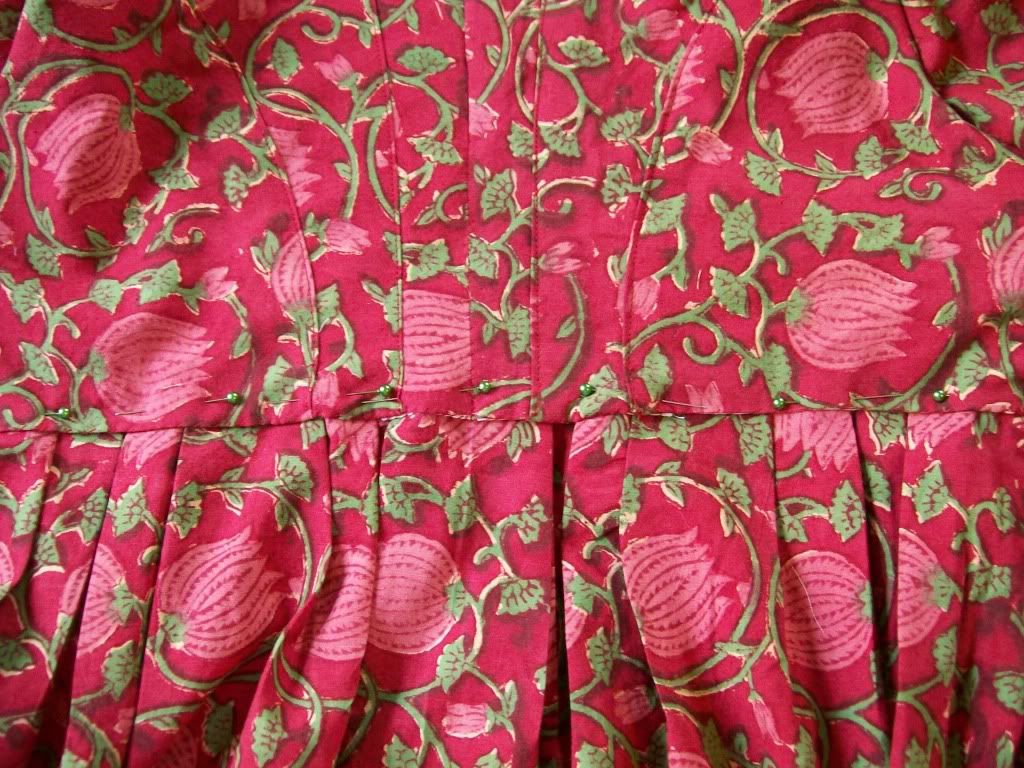
I have the dress already, a voile wrapfront dress commissioned from the lovely Geneece Arnold early last fall (As you know, lately I've been unable to do much sewing myself). On request, she left all hems and trim off, so I will add the ruffle along with a tuck above the hem ruffle. Tucks are so handy: I can regulate the dress train in back this way, as need requires. Mmm. Need to consult some plates, prints, and paintings to get the right combination, since I am adding to the design here.

A tiny attached bumroll will fluff out the back. Will make it out of three giant pom-poms of cotton sugar-'n-cream yarn, after an extant example...I've mislaid the picture and source, worse luck. :}

I will wear a sage green underdress in plain habotai silk (from the stash), using the same bodice as for the dress, but fixed to a waistband, not wrapped. Will make this and am considering ripping it out by machine rather than handsewing it. Mmm, time to consult Janet Arnold and Sarah Jane...she has a new vee-front dress with separate bodice.
My wiglet: it needs extending
across the top and sides to
fill it out.

The underpinnings: chemise, Sarah Jane Meister's embroidered stays, and a strapped muslin underpetticoat, all in possession already.

The sash will be in green silk satin, with matching armbands. Need to purchase about two yards fabric, cut, and treat the fabric edges with gum arabic, a period solution to the problem of fraying. Mental note: get gum arabic, which I can use in cooking, too. Sure wish I had real ribbon, but have not run into adequate lengths of antique ribbon I feel safe using.

The modified turban will be in green and white silk gauze. I have mounds of gauze and will paint the stripes with dye and fringe the ends.

Jewelry: the necklace will be double stranded, but of coral. Ditto earrings. Have materials, need to make up.

Hair: I have a wiglet I made last fall but will need to extend it a bit. Have plenty of hair in the stash already, so no cost there.

Green fan -- already in possession, and green or cream silk pointed-toe slippers, most likely modified Indian Khussa shoes. I need inexpensive summer shoes anyway, so boom.

No reticule: I am making pockets to hold my needs. Fabric and twill tape already in hand.

Shawl of embroidered Indian cotton, edged with a narrow whipped frill. Fabric located, need to purchase and make up. With the heat, may not need it, and with expense...may probably toss plans.

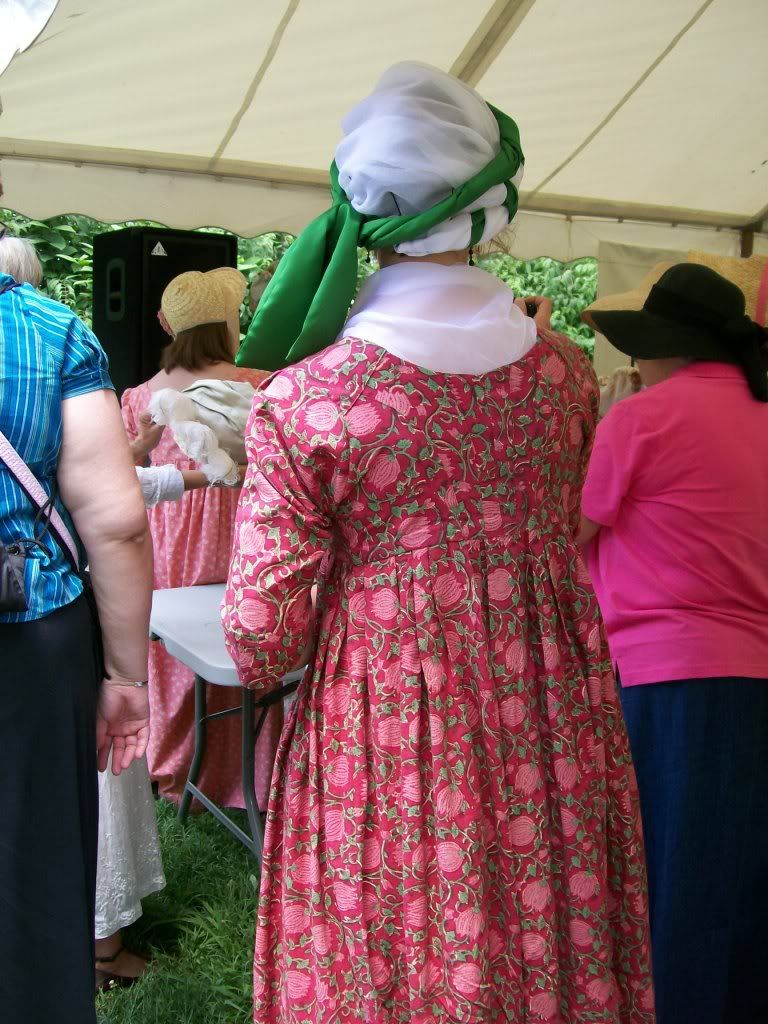
The robe from the back, as
worn last year.
Ball Toilette

You'll see the white silk open robe again, but it's been heavily remade since last year and fits far better.

The petticoat is the big change. If all works out, I will wear a cotton gauze petticoat, spangled in metal sequins and embroidered per the November 1795 Luxus issue. None of the other original patterns I have seen hold a candle to it.

If the embroidery project falls flat -- which it very well may since it's the epitome of a Grand Plan, then a silk voile petticoat, again spangled. Spangled skirts were popular fashion magazine items in 1795-1796. Was it the Kyoto Institute or the Met that that has the famous picture of a a trio of manniquins, one in a gauze spangled robe? Have to check and get back with you. The spangles I will purchase from a specialty supplier; they are handmade.

November 1795 afternoon dress in the English fashion,
from Luxus, "richly embroidered". 
The petticoat is dead simple to make, perhaps 1.5 hours of work; it's the embellishment that's probably the biggest project this year.

Underpinnings: cotton chemise, my fully boned transition stays, strapped petticoat, and second cream silk petticoat on which the gauze petticoat will lie. All made already.

The robe will be held by a blue silk satin belt and closed...well, that is a mystery right now. This calls for research. I will use some of the same satin batch for the belt as for the ribbons in the day dress.

Single strand of paste jewels,
The neckline tucker will be Edwardian lace that looks about right, from my collection. Needs tacking into the dress.

For jewelry, a double-strand necklace of baroque freshwater pearls, with cabochon pendant,and matching pearl hoop earrings, all in possession but not yet made up. Paste jewels would be appropriate, given the lighting of many ball rooms back then, but would be expensive and fiddly to make, although a single strand would be easy to find vintage. Such jewelry was by no means out of fashion at this date. See the paste necklace from the Victoria and Albert Museum, number M.66-1925. After all, the afternoon ensemble in Luxus called for brilliants and diamonds. Please register shock: so over the top, so ancien Regime! More practically speaking, the festival ball room is likely to be so highly lit that the results might be garish, so pearls are probably a better choice. 

My fan, in progress.
Hair in locks -- that wiglet again :) -- with a bandeau of blue habotai silk from the stash that I dye myself, the crown draped with silk gauze, and in front, an aigrette of small spiky plumes. Comb ornamented with freshwater pearls to hold the back hair. Have to cut the gauze, create the aigrette and design a clasp for it, and finish the comb, which is now in progress. This is where my friend Polly Singer comes in. She is teaching a class for us on turbans in June. Shameless plug: an FIT trained milliner, she designs for Ascot, the Derby, public figures, "hatty" events, and all kinds of occasions large and small, and I am in awe of her abilities.

Elbow length white gloves, cream silk slippers, again those Khussa shoes. The gloves are an issue: I have vintage elbow length ones, but our gloves these days are tight and I do not want mine to be.

Painted fan - in progress.

Potentially a silk reticule, with painted sprigs, or just spangled. Our sewing society is on schedule to make reticules in April.

This is going to be fun! Time is the biggest issue. The two hardest items to find time given my schedule for are the spangled/embroidered petticoat, the underdress, and hemming the shawl. The rest is little stuff that's fun to do of an evening, in small bits, as relaxation, or at our sewing society meetings. Perfect for a busy springtime, when the boys and I have adventures to venture out on, when the yard and garden need the most help, and while work is incredibly stressful and keeps spilling into non-work hours. I hope I can make these little projects a way to engage the brain and to unwind, not wind up.

What are your plans for events? Are you having fun dreaming and breaking down ensembles into their component tasks?

Saturday, March 05, 2011

A New Blog Name, a New Blog Look

I've been writing under the title of "Zip Zip's Vintage Sewing" since 2005, but not long after starting the blog, I started experimenting with period sewing projects, and they slowly took precedence. Now it's been years since I even thought of doing anything vintage, so the blog name really doesn't suit the subject.

Yet I couldn't bear to part with the Zip Zip part of the name, since it comes from my sweet kitty companion of many years, whom I still miss very often.

At last it's time to start fresh. Since for me period sewing is simply experimentation, essay, "just-seeing", and playing, it's a frolic. I've no ambitions to reenact, or to construct a living history impression. I just want to take my academic background in historical research that I don't use in professional life but that won't quit bugging me and put all those two-dimensional notes and essays and scribbles and apply them to three-dimensional fabric, to see what happens, and then to enjoy wearing the results, or to critique and learn from the flops. Then to share anything valuable -- or silly -- I've learned with you, for the love of sharing. It's pure hobby.

Right now the 1790s have center stage, but sometimes I still think of trying another Edwardian ensemble, in really streamlined, Poiret-style fashion, and there is the 1872 Dolly Varden dress that just won't leave me alone, along with the purely academic exercise in tracking and documenting that fad. Then there are the twins, making their own frolic through their childhood, and of whom I write occasionally.

So we have a new name, "A Frolic through Time". Over the next few weeks, I will be tweaking the design and adding some links to posts that focus on specific periods.

If you find any problems with the layout, please holler. I went in and fooled with the blog layout code. I can hack around in HTML okay, but I'm not very good, so fully expect some glitches.

Very best to you all,
Natalie

Thursday, March 03, 2011

1797 Linen Dress Alert!

Last post's fashion plate was for a linen dress. By chance, Lauren at American Duchess.(http://americanduchess.blogspot.com) has just featured a Danish 1797 white linen cambric dress in her latest installment of Costume Analytics.

I had forgotten about that dress. Every so often it pops up in costume blogs, in forums, and online magazines.

It's seriously handsome, and except for the embroidered hem, seriously plain. The sheer fabric, with the faint sheen that linen tends to have, the fabulous drape due to the way linen takes gathers, the embroidery of course, and the accessories that would have gone with it would have provided the punch.

If the wearer chose to include a colored underdress or petticoat, as is reported in some issues of Luxus, in Gallery of Fasshion, and elsewhere, the effect would have been even more complex.

If you haven't seen the American Duchess post, have a look! Sorry about the wacky link, by the way: my Blackberry won't code HTML too well :)

"New Things in Fashion": Fashion Plate No. 23, August 1795, a "Luxus" Translation

A Translation from Journal des Luxus und der Moden

Now, what you just may have been waiting for...the fashion plates and their descriptions from Luxus. So, what's the news for August? Because of the time lapse from reporting to publishing, the reporter dates his news the second of July. Here is the translation of the introduction to the two fashion plates for the month, and then the first fashion plate and its accompanying description.
Photo: Plate 23, August issue

As always, click on any image to see a larger version.

Page 394

2. Aus Teutschland
* * den 2. Jul. 1795

Zu meinem lezten Berichte vom 10. Jun. habe ich Thnen (???) noch beiliegende zwei Figuren nachzutragen, weil sie zwar keine auffallend neuen Moden enthalten, sondern, eben so wie meine vorigen Zeichnungen, nur Muster, wie unsre eleganten Damen sich anjezt kleiden, liefern.

Die erste Figur, (Taf. 23.) ist eine junge Dame in einer Chemise von Linon, mit kurzen Armeln, woran der Leib under der Schärpe mit gefalteten Spizen garnirt ist. Die Schärpe von blauem Bande ist vorn unter der rechten brust in eine Schliese gebunden davon die Enden herabhängen. Das Halstuch ist unter den Armen durchgezogen und unter den Schultern geknüpft. Um den Hals ein schmales Collier von weissen Spizen; das Haar geschlängelt-

page 395

raus und fliegend; der Aufsas ein Bandeau von weissem Linon mit zwey Schleifen, und Festons von Perlenschnuren, worin ein Puf von blauem Atlas steht, welches nach hinten-zugetheilt ist, vorn ein kleiner Federstuz -- vollenden das eleganten Negligee meiner Dame.

2. From Deutchland
the second of July 1795

To my last report from June 10, I have still the adjacent two Figures to add, because they indeed contain no fine, remarkable new fashions, but rather, as with my previous examples, they furnish only patterns of how our elegant Ladies are now clothing themselves.
The first Figure, (Plate 23), is a young Lady in a Chemise [dress] of linen, with short sleeves, whereof the body under the sash is garnished with folded lace. [See my note, below.] The sash of blue ribbon is tied in a bow right under the right breast, from which the ends hang. The fichu [literally, necktowel] is drawn through under the arms and tied under the shoulders. Around the neck a narrow collar of white lace; the hair curled [geschlaengelt-raus] and flying; the headdress [Aufsaz] a bandeau of white linen with two bows (?) and festoons of pearl strings, wherein a pouf of blue Atlas [satin] stands, which is distributed towards the back, in front a small feather aigrette -- completing the elegant Negligee of my lady.
Here's hoping that translation got things fairly right :} Any corrections or clarifications you wish to add? (March 4 note: thank you again, Sabine! What a kind help you are!)

Let's have a look at the text again, along with image details. First, the dress is made of linen. Not cotton. Many costumers have been leery of linen for chemise dresses, thinking that cotton would be the most fashionable choice. As we learn here, a fine linen was fashionable too,

The dress itself is quite plain: all the effect is in how it's worn and its accessories. The bottom hem is undecorated (see full plate, above) and the sleeve ends are plain (see detail image below). Also look at the neckline. I am fairly sure that the gathering string in the neckline is set down a bit so that you get a bit of ruffled header. If it were lace whipped on or a tucker, the text would say so, given the other fashion plate descriptions I've been reading in the same magazine. In linen this gathering would drape and fold very nicely.

Now, to that bit where the reporter says "whereof the body under the sash is garnished with folded lace". If we look at the plate in detail below, it would appear that there is a gathering of extra fabric just under the sash. Apparently this is at least in part lace? So that there is a sort of peplum effect. A Grecian-ish sort of styling I haven't seen much of elsewhere. Interesting.


Our fashionable lady's morning toilette does not include drawing her neckerchief over her decollettee chemisette-style. You can see this a number of times throughout Luxus, and you can also see it in some Gallery of Fashion plates, too. So, at least as reported in this issue, covering the neck and upper chest was not de rigeur for morning dress/daywear. Instead, the neckerchief, which must be a long one, decorates the shoulders and then is tied in back. In the drawing it appears that the fabric is a square, folded in half into a triangle so that the striped golden edging is doubled. Pretty.

A side note. In some Gallery of Fashion plates, you can see long shawl-like or fichu-like or neckerchief-like contraptions treated rather similarly; those are often ruffled. A further side note: this way of wearing a neckerchief/fichu was to become very popular in the late 1860s to early 1870s. At that period, the thing was labeled a fichu. See Frances Grimble's Reconstruction Fashions for numerous examples.


The sash is of blue ribbon, not particularly wide. I love that it's tied in what may be rosette-style or double bow. Note that the ends of the ribbon are dagged.

Plus, look at her gloves. Can you see the small tucks and/or topstitching over the back of the hand? The gloves are elbow length and not particularly tight. In fact, I'd call them a little baggy, wouldn't you?


We have talked about the pretty lace choker collar already in The 1790s Project: 1795-1800 Fashion Details. I've not seen any costumer try this effect yet.
 

The headdress is especially interesting, as it's multipart. The reporter describes the linen bandeau with its bows -- clearly rosettes -- and then how some blue Atlas fabric is set within it and atop the head, but not covering all the hair.

"Atlas", according to Neues und vollständiges deutsch-englisches Wörterbuch (1808), is satin, of silk, but in Germany also of wool or linen. I assume that the term is more about the satin weave than the fiber used. Here is the full dictionary term, from the dictionary:


2. der Atlass, des-sses, plur. die-sse, from the Persian; satin, made generally of silk, but the Germans say also wollene [woll] and leinene Atlasse [linen Atlas].
das Atlassband, satin-riband.
Atlassen, adj. and adv. of satin. Ein atlassenes Kleid, a satin coat, it (?) what is in imitation of satin. Ein atlassense Band, a satin riband.

The pearl strands are a rather ornate addition, and overkill in my opinion, especially when worn with big hoop earrings.

Look careully at the earrings. There is a small hoop at the earlobe, and then the big hoop is appended to it, or that's the way I read the image. Other fashion plate descriptions for 1795 describe the earrings in some detail and perhaps I will get to a sample for you.

Hope the above was helpful. It was for me! Next time, plate 24 from the same issue.

Resources
Translation resources. I have found that using multiple sources works best, because some words, expressions, and constructions are spelled or used in an archaic way, and some words have simply disappeared from the modern German lexicon. The best resource, though? The kindness of readers. Thank you all so much!

Sunday, February 27, 2011

Miss Blueberry Muffin Waits for Spring, and I Wait to Sew Once Again

Muffin asks me to open the window.
Below her, the spinning wheel.
Click the image to see it all larger.
Sometime last week, Miss Blueberry Muffin decided it was springtime, so she hopped onto the sill of the bank of windows that overlooks our back yard, splotchy green and brown, and sniffed and sniffed through the panes. She'd turn her head to look at me every little while and talk with her eyes and tail, telling me that the sights were worth seeing but the scents were missing and to open the window, please. I didn't. We didn't need a cat clawing around on the shingles or a splat cat on the ground below. Poor thing.

It will be a little while more before I can romp around with sewing the way she wants to romp around outside. The ensembles for spring picnics and the Jane Austen Festival are all in writing, all planned out, and some of the dresses sit waiting in their chests (my jokey term for a plastic bin), but I've not felt too well the last months, so all I've managed to do is to make a single pair of earrings, and those for a friend.

Still, if bodily energy is turned to the boys and husband, to home and work, I can still put mental energy into research, in bits and drabs. Hence these translations, hence months' worth of notes about jewelry, portrait miniatures, hair, fans, gloves, sashes, belts, bags, shawls, mantles, and ornaments, none of the latter written up for the blog, alas.

What, yes? I agree, the above sounds whiny, so quite right, let's quit that. Oh, you were asking something else, too. What's that in front of the settee? Why, yup, that's a spinning wheel all right. A realllly, really old one, perhaps older than the settee, which dates to the American Empire furniture period, somewhere between the late 1820s and 1850. Why is the wheel bi-colored? Well, Dad picked it up gratis at their church sale in coastal North Carolina. It was quite damaged, the wood so dried out that parts were just splitting. So he had a woodturner friend examine it and make new parts where needed, and being a careful man, he didn't color or finish any of the wood, new or old, and he returned me the old crumbly bits to save. Dad gave me the wheel for Christmas, and I was elated. The new wood will gather patina over time, and nothing will pretend to be what it isn't. So it's bi-colored.

One of these months -- years? --- I intend to learn to use it. Not to become good at spinning, just to get a feel for how wool can be made into yarn or thread.

Friday, February 25, 2011

The Painter Jens Juel: Warm Portraits, Useful Gauzy 18th Century Costume Details

If relaxed family portraits interest you, have a look at the pictures made by the Danish Jens Juel. The sitters generally seem at ease.

An added bonus? His treatment of fabric is such that when the sitters are wearing gauzy, transparent fabrics, he has painted and drawn them very clearly, and you can even see some seamlines. Such a help to a costumer thinking of using some of especially transparent silk gauzes now out there.

Thank you to the 18th Century Blog: Fashion and Culture from the 1700s for posting a selection of his works this January.

Photo: Danish Princess Louise Augusta, 1790s.

Sunday, February 20, 2011

"New Things in Fashion", July 1795: A Translation, Part 1

A Translation from Journal des Luxus und der Moden

In the last post I mentioned the August 1795 issue of the German magazine Journal des Luxus und der Moden.  Here is a translation I made of the first section of the August number (pages 389-390) that talked specifically about fashion. Subsequent sections follow in a few days; I am stretching out the posts for ease.

Being neither a native German speaker nor having experience with 18th century German, reading the journal was a bit of an adventure, and I couldn't make out all of the words. Still, the result may help those of you interested in this era to understand some of the finer details of then-current modes. So, here we go. For each section, first the German version as well as I could make it out in the Fraktur typface, then the English translation. I tried to stick closely to the original sentence construction, or as close as may be done in English, so as to preserve as much as possible the feel of how the author said what he or she did. Also, given that each page of the journal was typeset and printed by hand, sometimes characters did not print properly, leaving empty spaces. Readers of the day most probably had little trouble filling in these blanks, where I find them really perplexing.

A note: Thank you, Sabine, for your kind help and comments about the term "Tracht" and "seit einiger Zeit". Most appreciated, and they make me feel better to know I've done an okay job with the translation.

VI.
Moden-Neuigkeiten
Aus England
London den 3ten July 1795.
Eigentliche Neuigkeiten von Kleidermoden kann ich Ihnen durchaus nicht melden, da jeßt äusserst selten etwas zur allgemain herlichenden und wirtlich bermerkbaren Mode wird. Die Haupttheater, und mit ihnen die eigentlichen Sammel-plätze, wo neue Mode-Erfirdungen zur Schau getrugan under schnell verbreitet werden, sind in dieser Jahreszeit geschlossen. Nur Eine Bemerkung will ich hier anführen, die sich mir seit einiger Zeit ehr lebhaft aufgedrungen hat. Um sich ohne Affectation stark pudern lassen zu können, muß man hier zeßt in voller Kleidung, im Full dress seyn. Frauenzimmer, besonders die jugendichern (?), tragen in der weinger gepußten und streifen Kleidung, in der man sich gewöhnlich uch dem Publikum zeigt, die Haare nachläsig in Locken geshlagen, und fast gar nich gepudert, einige -- doch kommt dieß immer mehr ab -- auch ganz heriengeklämt. Eben dieß ist der Fall bey den Herren. Nun ist aber jeßt das gepuderte Haar ein Zeichen des loyalen Patriotismus geworden, weil es eine Taxe bezalt, die zur Fortseßung des Kriegs unentbehrlich war. Man sieht daher jeßt im Allgemeinen weit häufiger Personen beyder Geschlechte auch an solchen Orten unde bey solchen Gelegenheiten im vollen Anzuge, wo man sonst im Tracht oder einem zierlichen Negligee zu escheinen gewohnt war.

[the text moves on to other topics, such as literary works and the theater.]

VI.
New Things in Fashion
_____
From England
London the 3rd of July 1795.
Actually I cannot quite offer you anything new about fashion, since now there is [äusserst] seldom anything that rules and is truly worthy of notice. The central theater, and with it the actual gathering places, where new fashion inventions are shown and are quickly spread, are closed this time of year. I will make just one observation, which has recently forced itself upon me. In order without affection to be able to strongly powder [one's hair], one must be in full clothing, in Full Dress. Women, especially the younger ones, wear less polished/fussed over and stiff clothing, than which one normally shows to the public, the hair thrown carelessly in locks, and almost entirely unpowdered; a few -- indeed these appear ever more -- entirely uncombed. This is even the case among the gentlemen. Now powdered hair has become a sign of loyal patriotism, because it is taxed, this was for the continuation of the [unentbehrlich] war. So now one sees all across the land more frequently people at home and also in such places and in such occasions in full dress, where one was used to appear in normal dress or in a dainty Negligee (morning or traveling dress).

Fascinating, eh? Three points:
  • Fashions are spread by the upper class, who come up with new looks and display them at the theater and other gathering places, which in those days would have included London's pleasure parks.
  • The author believes that the tendency to go out in public "carelessly" put together was partly a result of the taxation of hair powder. So the young, even the men, go out barely powdered and combed, while those who stick to "strong" powder appear in full dress, and it's a sign of patriotism to do so. So here is one perception of what caused the decline in the use of powder.
  • The term "Tracht" appears quite often in these pages. I am taking the liberty of quoting Sabine from Kleidung um 1800, who explained the term this way: "'Tracht' is a very old German word, which - in its origin - simply meant 'what one wears'. That could be referred to work clothes for which most professions called, as well as for folk groups from different areas across Germany. It was simply the dress that a person usually wears. The 'negligee' back then meant casual daywear (morning dress, travelling clothes etc) in comparison to the official garments 'Parure' and 'Grand Parure'."


    Next time, a translation of the description of the August issue's first of two fashion plates.

Wednesday, February 16, 2011

The 1790s Project: 1795-1800 Fashion Details

Over the past while, during a hiatus from blogging and sewing, I've been reviewing and refining my understanding of mid to late 1790s fashion, this time looking for fashion details, such as embroidery, and for ensemble details such as hairstyles and accessories. Plus, I've been looking for new sorts of documentation beyond fashion plate images, large portraits, prints, and extant garments.

Photo: detail of portrait miniature of Mrs. Jeremiah Atwater, Metropolitan Museum of Art

Portrait miniatures have proven to be a rich source of detail. Miniatures were the photo keepsakes and memorials of their day, and I suspect were often painted naturalistically so the miniature's owner could see their beloved in their true "likeness". To paint the portrait too fancifully would defeat the purpose of memorialization. This is in contrast to full-length portraits, which art historians have long pointed out did include fanciful and/or symbolic elements. See the exhibition book Thomas Gainsborough and the Modern Woman for a current treatment, in the form of a series of essays, of this subject.

Miniatures were far more common than I had realized. In museums they are often not on view, or are stuck away in cabinets where looking at them is a chore for strong eyes. Nor are they run-of-the-mill items in our fine antiques shops, locally, anyway.

However, recently, what with powerful digital cameras and exploding online collections -- and specialty antiques dealer's sites -- they are far easier to find, and often easy to view in detail. I have examined several hundreds of them over time, and have cataloged a long list of them by level of detail, jewelry worn, hairstyles, and so forth. If you would like to browse several collections, try the examples of American miniatures at the Metropolitan Museum of Art, and miniatures for sale at Antiques and Uncommon Treasure and Aesthetic Engineering Fine Jewels and Antiques (just two among many dealers online).

At the same time, for fun I've been reading and translating several 1795 issues of the German fashion and cultural news magazine, Journal des Luxus und der Moden, which I shall call Luxus here for short. Some 15-20 years ago I studied German seriously, and then let it lapse when, well, when I fell in love with my husband, met through our mutual German teacher, and life moved on. Anyhow, have been aching to pick it back up. Awhile ago I stumbled upon a complete repository of the journal -- what fun! For the last four years I've been wanting to read a 1790s fashion magazine in full, and Nikolaus Heideloff's Gallery of Fashion frustratingly not being available online (with small children, I do not have the luxury to pore over a microfiche at the university nearby), have found Luxus a double luxury.

Photo: sample of the fashion report from the August 1795 issue of Journal des Luxus und der Moden. Note that the author's fashion report actually dates from early July, although the magazine came out in August.

Luxus was a German publication which reports on German fashion but also fashion elsewhere, such as London, along with cultural news. Now, let me here give the standard caveat about styles. Different regions within Europe, Britain, and the U.S. had their own stylistic takes on fashion appropriate to their local culture and geography, but at that date there were fashion norms that did cross national and geographic borders, and fashion-conscious women over the Western world did tend to follow the general norm, at least in outlines. Any examination of portrait miniatures will make this abundantly clear.

Anyhow, when I read the fashion news in Luxus, and look at plates from English fashion magazines, and then look at miniatures, prints, and paintings, I see the general outlines syncing up, while regional and cultural and age and individual and artistic differences make for fascinating analyses. What's delightful about having a full text available, is that we get so much more information about what was hot, and useful details for interpreting the construction of particular ensembles pictured.
 
Here then is an examination of one of these miniatures, in relation to some fashion plates and accompanying text from Luxus, plus a few notes from Gallery of Fashion. I have made some notes about what I believe may be the details we are looking at. Remember that what I write are attempts, essays, at understanding and are by no means the analysis of an expert.

Let's start. As always, click on the image for a larger version.

Mrs. Jeremiah Atwater, circa 1795
A portrait miniature at the Metropolitan Museum of Art


The full portrait. Mrs. Atwater is wearing some elements of what I take to be morning dress, also known as "undress", or "negligee", dress not associated with formal occasions, and some elements, like her open robe, typical of more formal dress.

Let's examine some details.

Mrs. Atwater is wearing a lace collar, which appears to be ruched in a double layer. Just this sort of collar, "Collier" in German, is described in detail in the August issue of Luxus, plate 23, described on pages 394-395. That plate is of a lady in "eleganter Negligee", or an elegant morning toilette.  In the journal the collar is described thus: "Um den Hals ein schmales Collier von weissen Spitzen" (a narrow collar of white lace). From the Luxus text, it's clear that the collar is a separate accessory, not the top part of a chemisette. So it appears to be in Mrs. Atwater's miniature.

Here below is a detail from plate 23 in Luxus.


The July Luxus issue names the plate 23 dress a chemise, of linen. Like Mrs. Atwater's dress, it too has a gathered front and a similar gathered neckline treatment, although the writer does not say the edging is lace. It probably is not, because when the trimming is lace in other plates, the writer tells us so explicitly. See how the collar and the neckline are similar and complement one another. Clever and if the wearer has nice skin, attractive.

In just a year or two after 1795, the use of lace at the neckline would go out of fashion for a bit, as the craze for severely classical plainness took hold.
The earrings here are gold pendants, which appear to be cone shaped and may have a small drop underneath the cone, and there may be more than one cone. It's hard to say. In Luxus and the Gallery of Fashion, gold hoops were most commonly illustrated this year, for instance the lady in plate 23, although there are a few button-style or bead loop styles. Hoops were hot. Gold was hot.

On to more details in Mrs. Atwater's ensemble.

Mrs. Atwater's belt, apparently of fabric close to that of the robe. A center clasp in two connecting halves, apparently of metal, perhaps gold or something mimicing it, and with some sort of vertical decoration, details unclear. The next image tells us something important about the belt.


Mrs. Atwater is wearing a long-sleeved robe over her chemise. It's of the type that does not close in front. There is a gorgeous example in brown silk of this sort of robe, from 1797, in Anne Bissonnette's Ohio and the Western Frontier: 1790-1840 book from Kent State University (and see a video of the exhibition, but sadly, not showing the robe. You have to have the book; as of this writing Kent State does not offer an image archive).

This robe is embroidered in what appear to be blues and pinks or reds along the edge. Some Heideloff fashion plates show this sort of edging, and the Met has a circa 1798 example of a faux robe over what it names a round gown that sports pretty multi-color embroidery. The way the paint is treated in the Atwater miniature, the belt appears to go over the robe to hold it in place. A robe, so far as I can tell from fashion plates, texts, and extant garment descriptions, was worn for more formal occasions. Have a look at the plates and text from the Gallery of Fashion preserved on Cathy Decker's old site, and you will see that robes are described for afternoon or evening dress, while dresses alone, or dresses with shawls or what look like long stoles, are worn instead for morning dress.

Mrs. Atwater is indoors. She is not wearing any headdress; I cannot tell if it's because this is a more formal occasion, or what. Her hair is dressed frizzed in front and with the back hair long, straightish, and "flying", as Luxus puts it, in locks, though it might be looped up in a sort of loose chignon, also a popular style. The Luxus plate 23 wears her hair "geschlangelt-kraus und fliegend", or roughly, "coiled and flying". I had some trouble with the "-kraus" word: the Fraktur typeface German text was printed in back then can be difficult to make out.

Well, thus ends the little analysis. It's not complete, and it leaves some questions, but this is what I love about comparing portrait miniatures with fashion plates, fashion texts, and extant clothing. Each bit of evidence has given us key information about ensembles worn in 1795 that individual types of evidence alone cannot.

Wednesday, December 29, 2010

A Hiatus, a Sabbatical, a Break

After five fairly continuous years of blogging, foruming, researching, dressmaking, and costuming, I am out of breath. It's time for a break.

Since early December, the Blackberry has been dark except for when it's needed for the office work, the Google Reader has incrementally filled until it's jammed with unread posts from the blogs I normally enjoy reading so very much, many of them yours. The costuming books are back on their shelves, the mannequin in storage, the period cookbooks and cooking histories in their boxes. One morning, the costumes were packed more or less carefully and sent to the basement.

Christmas was delightful, and restful, except for the inevitable oh-no-I-forgot moments, New Year's promises the same, except for the oh-no-I-still-need-to-write-cards moments.

I am contemplating taking out my German grammar, half-read German-language novels, dabbling with the antique Saxony spinning wheel my Dad and stepmother gave me, am thinking up Tinkertoy and Lego projects to work on with the boys, looking forward to a staycation with Curte, and listing out the painting and other house projects that need attention but not stress. Then there's a Regency-inspired amusement to plan with the little sewing group...one that won't involve any sewing.

The point is to rest and rejuvenate.

I've so much more to share. Goodness, the boys are growing and making life funny, frustrating and silly all at once. There's the last of the 1790s project: the white 1795 dress experiment, with all I learned about very late open robes...of a style found in museums but not in Janet Arnold, and Polly's light-as-air mull robe. There are all the examples of extant garments in my collection: the cap with embroidery so fine a strong magnifying glass is needed to see the stitching and the whipping, the original crinolines (plural!), the 1860s silk dress in damaged enough condition to fully understand the construction, the late Victorian belt buckles in cloisonne, imitation jet and cut steel, the several Edwardian workaday skirts, the very ornate mid-century chemise encrusted with fine embroideries and teeny-tiny puffings. There is the 2010 Antique Button Hoard, bought for a song, and full of early bone buttons, china buttons plain and fancy and large and small, button boot buttons, and a military button of great interest.

They are all waiting for me to come back, refreshed. I hope you will not mind waiting. I've so enjoyed your presence and your attention, and hope that you have learned bits and drabs here that you can use or tuck away. Your comments and sweet thoughts have certainly been appreciated.

When will the moment be? Predictions are dangerous, so let us say, "for the nonce".

Happy New Year, and very best, until we meet again.

Wednesday, December 08, 2010

Gingerbread Cookie Decorating with Friends

For most of my life gingersnaps or crisp-style gingerbread cookies have had little appeal, Spekulatius cookies being the exception. Either they were too dry, dense, and dusty-like, or too sharply spiced, with so much ginger and cloves as to become bitter.

Last Saturday, a change of heart. The "Holiday Gingerbread Cookies" Jenni baked for our morning of cookie-decorating with the tots were crisp, but with cracker-ish layers to keep them gentle in the biting, highly spiced but without bitterness, and no dustiness lurking anywhere. Really good cookies.

Did we have a good time. The tots always look forward to visits with Autumn Jane, and this morning was no exception. The cookies were merely icing on the cake. Bad pun, sorry folks, couldn't help it.

Read more in the Sweet Success post on Jenni's blog, Living with Jane.

The Christmas season has begun!

Wednesday, December 01, 2010

1790s Project: Fans -- Some History and a Painting Experiment

Fanology or the Ladies
Conversation Fan, a printed fan,
the leaf a hand-coloured engraving
in stipple and line.
1797. From Christie's
sale 7295, lot 86, 2001.

Until last week, if you had asked me about what sorts of fans women of the 1790s and later Regency era had carried, I would have said, oh, they probably were made of paper and were decorated with Classical motifs, or shepherds and shepherdesses a la the middle-eighteenth century. So doing, I’d have given you just a meager spoonful of the airy, colorful world of this trifling but so engaging accessory. Now that I have taken a bigger bite of the subject, I want to taste more, more! I hope you do too, for if there hasn’t lately been a really good exhibition of them mounted, there should be.

As always, click on each image to see a larger version.

Historical Tidbits and Some Personal Speculations about Fans

Most people who admire the Georgian period know that women used fans as a fashion prop and, supposedly, as a mode of silent communication during parties and public events, as much as they used them to air and cool themselves. Certainly the stiff hairdos and heavy dresses needed a little air, and the Georgian culture, so soaked in intrigue, repartee, and artifice would make it natural to point at one’s face with a fan – just so – to tell a significant other that “I’m soooo bored” or “visit me later, please”. (Learn more in The Language of the Fan on the So Faithful a Heart blog, and Ladies' Regency Fans on Jane Austen's World.)

It's a good bet, too, that said fan would feature Rococo curls, shells, swags, and shepherds and shepherdesses billing and cooing along with the doves in the trees around them. The décor and subject matter mirrored that popular in painting, in the decorative arts, and in fashion, just as it usually does.

So what were fans like in the 1790s and into the Regency? I took a look at fans in the Boston Museum of Fine Arts, the Metropolitan Museum of Art, the Philadelphia Museum of Art, the Victoria and Albert Museum, and the Costumer's Manifesto. Christie's auction house proved useful, too; for example, their 2001 Fine Fans auction. In most online collections, however, the images are too small to see many details well, or one must enlarge the image in a small window and pan left and right to see much detail, or the fans are partly folded up.

Most happily, I found the collection at the British Museum.  Here, the images are large enough to see crucial details. I searched for all unmounted fan leaves between 1780-1810, and after trying to view too many hundreds to look within the time I had, narrowed the search to 1795-1802.  Best of all, you can order a high-res image from them for many of the images for research purposes, so you can really see the details!

Evening dress, April 1796. The Gallery of Fashion magazine,
in the Collection Maciet, Bibliotheque des Arts Decoratifs.
This is what I found. Fans were just as popular. If you look at fashion plates of the Regency era, or paintings, or prints, fans pop up everywhere. I haven't looked at the attitudes the images put their holders in, but have a feeling that how the fan was held and used as a prop changed a bit to reflect changing fashions, mores and physical movement.

Purely decoratively speaking and in very broad strokes, by the 1780s fan designers had abandoned Rococo curls and shells for more regular, more Classical designs, designs that you might be familiar with from Sheraton furniture or architectural ornament by the Adams brothers. Light, airy, attenuated, packed with allusions to Classical myth, such designs went well with the light and frothy look of the 1780s and '90s fashions. As the nineteenth century rolled around, purely decorative designs became more bold, more "correctly" Greek or Roman, more serious, at least for awhile, until fluffy tendencies crept back in in the 18-teens, right as frills and furbelows crept back into dress.

What about subject matter? Here is where things, to me, anyhow, become so fascinating, for I was taken aback at the vast variety of subjects. Here is some idea of scope:
  • flirtation in a meadow (of course)
  • country dances, dining, and musicking (natch)
  • country life: picking apples, treading grapes (just like Toiles de jouy)
  • gods and goddesses frolicking, or fighting, depicting actual myths or symbolic ideas
  • sentimental scenes: mamas showing babies to friends, mama in a Klismos chair cradling her newborn, and the like. Drawn so as to touch the heart. (incipient Romanticism and Victorian sentimentality)
  • mourning a la Greque: bedraped lady droops over an urn while a willow weeps overhead (ditto)ere i
  • landscape scenes: Vesuvius, towns spread along rivers, ruins (travel mementos?)
  • royal portraits in cartouches (politic behavior in venues favored by the court?)
  • patriotic motifs such as the three sisters: England, Scotland, and Wales
  • patriotic motifs from across the channel (not made in England, that's for sure)
  • moral stories: the seven ages of man and more
  • satire: pre-marriage manly man/post-marriage bore, the shepherd's week, bad table manners on display (Gillray did fans, too, folks!)
  • parlour games: the fanology game, the oracle game, charades, rebuses, enigmas and other boredom chasers or conversation starters (brilliant)
  • dance instructions: steps and pictures (again, brilliant)
  • songs: lyrics and, if memory serves, scores (sneaky: she didn't really know the song by heart)
Neat, eh? These fans are multi-use props, used for far more than wordless communications.

I wonder if advances in printing, combined with cheaper paper, and an up-and-coming middle class, made for a big fan market with plenty of scope for printing fans for a whole variety of occasions and uses, from cheap memento or faddish toy, to the "young lady's first fan" to for-best wear. Given the variety of subjects, I can speculate fans and might very well have been sold at tourist venues, fairs, and as commemorative items.


Not all fans show the names of the maker, but some do, and there were English and Italian makers among those I saw, who employed designers to make series of fans or at least multiple fan designs in one style. Holler if you have found a good article covering this; it's on the to-do list but I haven't gotten there.

A few notes on construction:
  • Some paper fan leaves appear to have been left in black and white, as part of the design. Others were stipple painted in watercolor, or washed in watercolor. In some cases, the British Museum collection has both a black and white and color version of the same fan design.
  • Not all fans were made of paper. Some among the collections browsed were made of what is labeled "chicken skin" in museum notations. So the idea that fans were all paper before the nineteenth century may  not be correct, unless there is a type of paper known as chicken skin. In the Tidens Toj collection, there is a pretty fan with ivory ribs and covered with white gauze. Silk flowers and foliage are glued to it, and it also features sequins and embroidery in colored silk. (Moden i 1700-arene: Danske dragter, by Ellen Dorothea Johanna Brodersen Andersen, p. 294.)
  • Just like fans of the middle-eighteenth century, Regency fans did not open out flat, but only to roughly about 95 or 100 degrees.
Making Regency-Inspired Fans

There are a number of resources out there for making or decorating your own fans. The Costumer's Manifesto has a good tutorial called Copying Period Fans. Lauren, the Lady of Portland House, painted her own fans, and did a very pretty job of it, too. For those with cash and a desire for something quite real, Les Tresors d'Aurore by Aurora Walderhaug in Sweden offers gorgeous hand-painted fans mounted on recycled sticks. Thank you, Isis, for the recommendation.
Polly paints around her decoupaged image.

Our little sewing group chose to paint fans, too, just a few weeks ago. First, we browsed a small collection of fan leaves from the British Museum and discussed the themes we saw, and speculated on the fans sources and uses. Then several of us having ordered a high-re image or two and having printed it out, we began to play.

First all of us flattened our fans. We pulled them out to their fullest extent, and used our thumbnails to press down the folds so that we could draw, paint, or decoupage on them.

On the advice of Kathleen O'Brien, a working artist, we used Golden fluid acrylic paints (1 oz bottles), because, unlike watercolors, they will not soften the glue that holds the paper to the fan. We used Golden Fluid Matte Medium to extend the paints...one drop of color goes a long way.

Kathleen gave us a list of colors that she believes, based on an examination of paintings are compatible with or which the pigments for were used in the day:
  • hansa yellow medium
  • ultramarine blue
  • pyrole red light
  • quinacridone red
  • yellow ochre
  • titanium white (as highlight and to lighten colors)
  • green gold
  • raw umber
  • cobalt teal
  • permanent green light
  • cerulean blue
  • primary magenta
    Jenni paints her hand-drawn images.
I noted after ordering the paints, but before viewing the British Museum fans up close, that on individual fans, very rarely were more than a few colors used; it appears that the fan painters used the same basic colors over and over. It would be useful to print out a few colored examples, and match them as closely as you can (given variations in photo and printer quality) to your acrylic paints.

To affix designs taken from printouts, we used Golden's Fluid Matte Medium, since Kathleen said it works better for decoupage than Modpodge does, as it acts as a glue and is not as sticky when the fan is folded.

Polly decoupaged her fan leaf onto a cheap paper fan, painting around the edges to blend the image, which printed smaller than the real fan, in with the rest of the fan.
My fan, in progress.
I cut out and applied the central portion of an image, and decoupaged it on the fan. Then I looked at several other fan leaves and drew my own decor, using some of their fanciful bow and garland designs, to surround this central image as if the central image were in a cartouche.

Laura and Jenni went further. Each adapted images from fans into their own designs entirely.

Kathleen took another tack. She studied the colors used, selected similar colors, and painted abstract designs, resulting in two color-studded fans that remind me of the colors in a Heideloff fashion plate.

For more on our fan-painting morning, Jenni has written about the process in her blog post The Sewing Society Paints Fans.

At this point my fan sits on my bureau, pretty...but pretty unfinished. Only Kathleen finished hers during the meeting. Here's to completing them, so that we can enjoy fiddling with them at tea :}

A last note: This post is part of The 1790s Project, a research-and-sew-and-play project that our little group started in September 2009, over a year ago. Between Jenni over at Living with Jane and I, we have over well over 20 posts about what we have learned and what we have made. Read my 1790s Project posts.

Sunday, November 14, 2010

Renovation Tidbits, Part 3


Noah spots the moon, while the house
windows glow brightly
behind him.
Praise the Lord and pass the paintbrush...for we're almost done with the windows! The last two windows received their protective paint coating yesterday afternoon in such a breeze that I thought the paint would dry on the brush before going on its intended surfaces. All that's left is scraping and some touch-ups, and putting the storm windows back on.

In the kitchen, the cabinets are up, the counters on, the doorways cased and the baseboards on. We await the plumber for water and gas, and the floor men for one last coat, and ourselves to install the wall tiling, but the main parts are done. I may be able to put away the electric frying pan before long and take the discloths and towels out of the bathroom. Oh, bliss, bliss, bliss.

The kitchen hutch wall, safe behind plastic
sheeting while the ceiling is worked on again.
The kitchen: stove hood, counters, and sink.

Friday, November 12, 2010

Dress Diary: Laura's 1795-1797 Robe and Petticoat, Part 2

Laura wears her open robe at the Jane Austen
Festival Ball. She is on the far right.
When last I wrote about Laura's open robe for the now long-past Jane Austen festival -- back in early summer, oh my! -- it was not completed.

Now it's time to do so. Over the last few days the original post (Part 1) has been seriously expanded, with a great number of details about construction.

This post will finish the robe's construction.

A reminder note: this was a dress that Jenni and I designed and figured out the construction methods for together, but that Jenni constructed. Our deal was that she'd do the initial reporting on the dress on her blog, Living with Jane, but that I would complete a detailed post on it here later.

It's mostly machine sewn, but with hand-sewn details. The construction methods were taken from Costume Close-Up, Costume in Detail, and Fitting and Proper. The conceit on this robe is that it is quite the transition gown, showing the high waist and flowing silhouette of the mid to late 1790s, but constructed using methods already in use for many years.

As always, please click the image to see a larger version.

The Sleeves
The elbow-length sleeve pattern came from the Sense and Sensibility ELC pattern. It's in one piece, with a small dart right over the elbow to curve the sleeve into the typical lightly bent shape of the eighteenth century. By the way, this cut leaves fewer wrinkles when the arm is bent.

Jenni fitted the sleeve toile rather tightly to Laura's arm so that there was little ease, for sleeves during the period we designed for usually were worn tight.

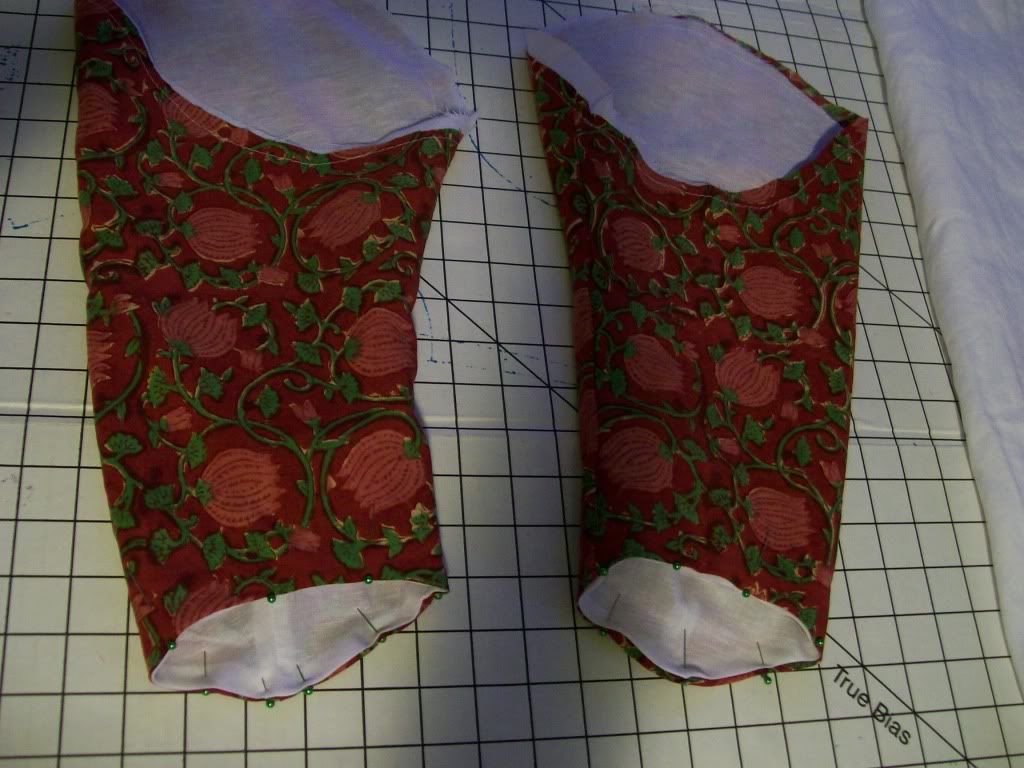
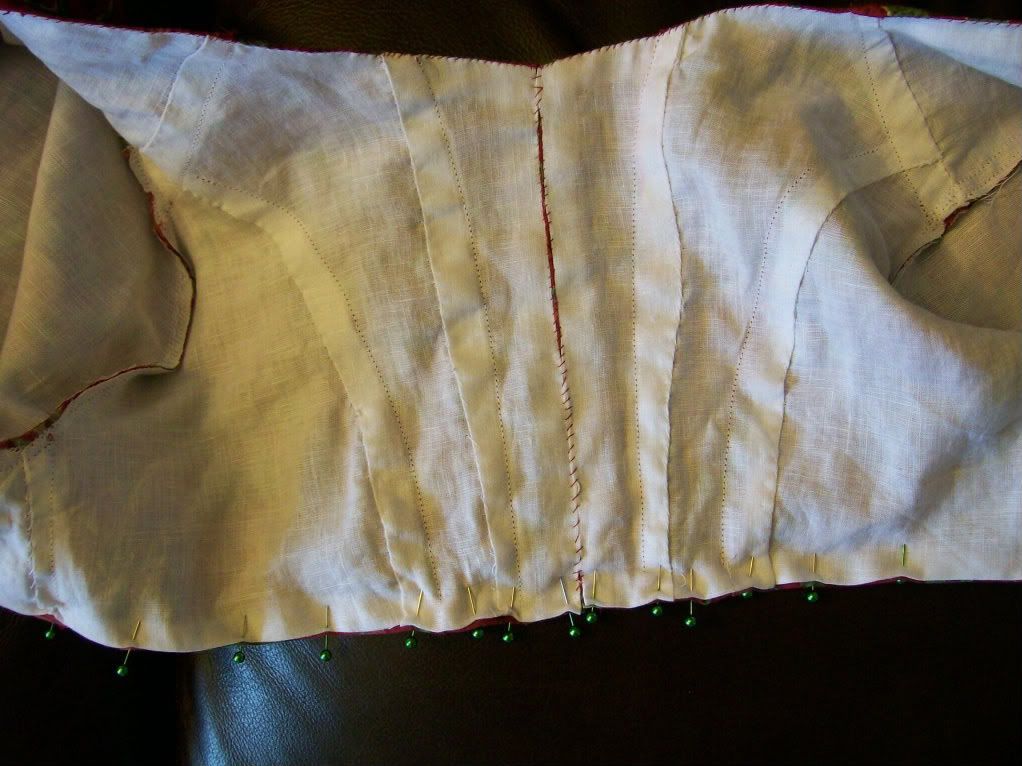
The sleeves are lined with linen, just like the bodice. To construct them, the darts are sewn. Then the lining and fashion fabric are treated separated. First, the lining piece is seamed up, such that the seam allowances are on the outside, away from the skin. Second, the fashion fabric piece is seamed up, right sides together, and then turned right sides out. The lining sleve is slipped inside the fashion sleeve, the seams matched up, and the seam allowances turned inwards, as below.


She could have folded the lining in a little bit more so that from the inside, a narrow band of fashion fabric would show and from the outside no lining could ever show, but we did not know this at the time.

I cannot recall how she finished the wrist edges -- perhaps with a small running stitch. I have since learned a special stitch, called in French le point a rabattre sous le main, which is a nifty top-stitch-cum-hemming stitch all in one. Clever needlewomen...one stitch performs two functions and saves a step! More on this stitch in another post, for I have prepared photos for a tutorial.

The sleeves were fitted into the armscye such that the sleeve seam is on the inside of the arm, perhaps a little above midway through the arm's thickness. Jenni then sewed them in place as you would a sleeve today, but leaving the inner seam allowance edges raw. This was common.

Finishing the Bodice
Finishing the bottom edge of the bodice was straightforward: turn the raw edges in, and whip stitch.


Again, a common treatment, and clever. The skirt could be taken off and renovated or redone without mussing up the bodice.

The Robe Skirts
The robe skirts are straight two panels of unlined fabric, seamed up the center back, and hand-hemmed at the edges: the edges turned under about half an inch, then turned again and hemmed down. Unlined, the robe flutters when she walks. Here is Jenni hemming the skirts while Laura looks on, at a sewing meeting morning at our friend Caroline's house, this spring. It was one of the first warm days. Funny that I should look at the photo on the evening of what is probably the last balmy, Indian-summer day this year.

Jenni cut the skirt such that there is no real train, for Laura wished ease in walking.

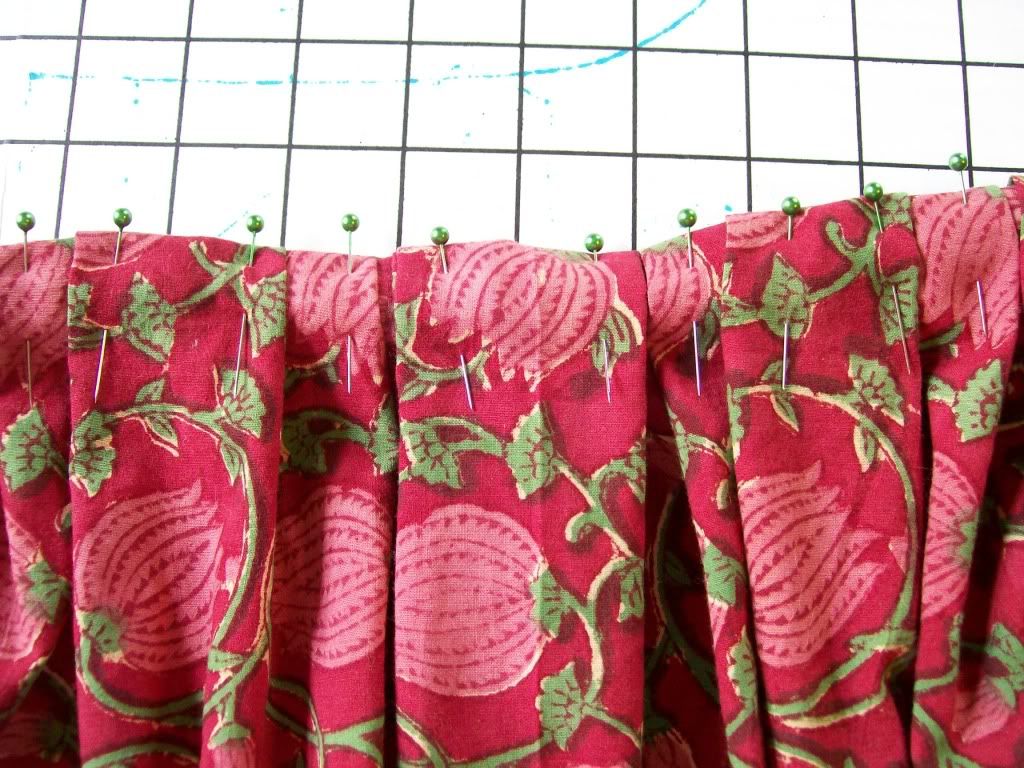
To attach them to the skirt, Jenni box-pleated them. She did so by eye, as many people do, using lots of pins. Here is a close-up photo:


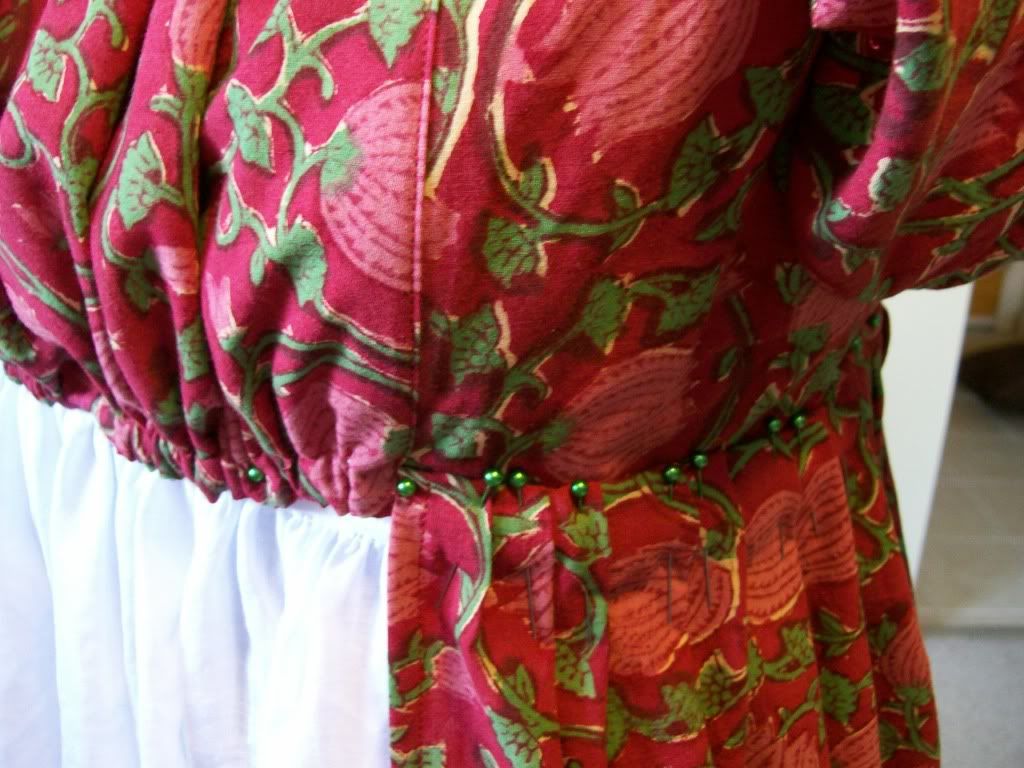
Then she placed the pleated skirt on the outside of the bodice, and test-pinned it.


She then re-pinned it to the inside of the skirt. The pins set horizontally give you some idea of the depth to which the skirt is set. Then she top-stitched the skirt on to the bodice.


The Petticoat: A Separate Dress Diary
Because an open robe is just that -- open -- an outer petticoat must be worn with it. Jenni designed a white linen one for Laura.

The petticoat dress diary lives on her blog. A note: we are unsure at this point if petticoats worn beneath mid-1790s robes would have had the straps we used -- the underpetticoats certainly could be done this way. However, given the raised waistline, the straps would make sense, for without them, unless one boned the waistline or tied it unreasonably tightly, or pinned it tightly all the way around to the stays, the petticoat would have kept falling down. As for the placement of the placket at the back, this is simply the solution for now.

The Final Ensemble

Here is Laura in her robe and petticoat, with proper supporting garments, and a pretty turban. I very much like the portrait of her with her husband.


Here ends the dress diary. Next up, completing the documentation of the feather-light open robe I made for Polly, for which you have seen the first part, in 1795-1797 Printed Indian Muslin Open Robe for Polly, Part 1. I started documentation during its construction, and just as with Laura's robe, am only now finishing it. After that? As complete documentation as I can manage for my own white robe, both pre- and post- alterations...you may find lessons galore in the treatment of bulges and gaposis.

Wednesday, November 03, 2010

The Cowboys Are Worried

Celebrating Hallowe'en and All Saints at The Old Episcopal Burying Ground. Our boys were early wakened from their naps and didn't think much of the proceedings, even getting to carry candles to the little outdoor service. It wasn't until the cupcakes were handed out that Noah even smirked.

At trick or treat time, a different scene. Visiting three neighbors, as promised? Not enough. We traveled to five and the boys chatterboxed the whole way, proud of their rodeo cowboy identities and prouder of being able to say, "I have as much candy as I can hold". They stuffed the front pockets of their overalls until they looked like their tummies had traveled to their chests.

None of those pictures came out, though, for nobody wanted to remain still.

We're all nibbling the proceeds, a candy or two a day.

Had fun making the outfits. The pattern is from Butterick...I think. Fake cowhide for the fabric, and the vests are lined with chambray and so are reversible. We hope they'll want to wear those again, because they're cute!

Thursday, October 14, 2010

Renovation Tidbits, Part Two

One of the windows in worst shape.
 The windows across the front of the house haven't been cared for since, as one of the carpenters put it, Daniel Boone last puttied them.

So with the help of my mother and sometimes Curte, I have scraped all the ages of paint, glazing, putty, and strange old fabric weatherstripping -- tacked on and painted over -- off the windows as well as possible, reglazed and painted the windows, painted the storm windows, doors, and sundry other surfaces, and caulked.

It takes approximately two hours to scrape a window, another hour to glaze it, and after two weeks' cure, another two hours to paint two coats on it and scrape the excess off the panes. If there are six windows and door and door frame and said storm windows and swing also needing paint, and twin boys adding their activity to the mix... you do the math.

It has been a month-long job, and I am not done yet.

Then there is the...

Other Project

One month ago today, we were in the middle of renovating our kitchen. As of this evening, we are still at it. The walls that needed moving are moved and completed even down to the paint, the ceiling is done, the plumbing is in, the wiring mostly done, the lighting in, and tonight Curte was plugging old piping holes with rounds of dowling, preparatory to the arrival of the flooring people tomorrow morning. The old, stained resin pine floor that we loved too well to replace will be painted like it was back in the 1920s, but in Adirondack green this time, rather than olive green.

Perhaps by this time next week the floor will be done and the cabinets and counters can start to go in? Certainly hope so. For my tiny cooking corner in the dining room, enjoyed though it is for its simplicity, is rather hard on the menu...it's stews in the crock pot or sautes in the electric frying pan or something in the microwave, and only one thing at a time can cook, for our 1920s-era wiring out there won't stand for more than one small appliance at a time. The water source is a big bowl of water drawn from the downstairs bath, and dishes are washed in the upstairs bath. That part is not pleasant: I am always reminded of running with scissors when heading up or down the stairs with cooking knives.

Still, it is very good to see this coming together. Perhap afterwards I will give myself the gift of another sewing project to be undertaken in quiet evenings over the winter: shall it be a proper 1795 long fichu (try six feet in length) or a black 1870 dress?

Then too, there are pillow covers and cushions and curtains to be made.

Meantime, it's back to brute labor :}