Showing posts with label sewing circle. Show all posts

Friday, August 12, 2011

Volunteering in 1790s Costume for the Costuming Society of America at Ashland: A Success!

Dramatis personae: Jenni (middle), Polly (right),
me (left). Also, look! My plumes are standing forward,
the way they are meant to be. They soon swung backward,
the bums.
This evening the Jane Austen Sewing Society/Bluegrass Regency Society volunteered at the kickoff of the Costume Society of America's Summer Symposium, at Ashland, the Henry Clay Estate.

Polly, Jenni, and I demonstrated trapunto (wadded quilting), goldwork embroidery, working with plumes, and rolled hemming for symposium participants, while they nibbled on hors d'oeuvres and when they weren't touring the Ashland estate house or looking at its costume collection. Jeannie took all the pictures; thank you, Jeannie, you were so sweet to do it, especially as you were not feeling well.


It was such a delight to listen to, learn from, and talk with kindred spirits, people who have made costumes, fashion history, and textiles their life's profession or passionate hobby. They were all such kind, interesting people, so willing to share information about themselves and their work. It was a treat to meet students and their professors, docents and researchers, professional theater costumers, and conservators, to learn about fabric conservation, and oh, so much more, all set in such golden-green beauty. There is nothing like Ashland's grounds on a handsome summer evening.

Thank you, CSA and Ashland, for having us. We so enjoyed helping out and spending time with you, and we hope that the rest of the symposium is a grand success, and that your dinner cruise goes off like a happy dream.

After having a chance to think about it all more, I'll write more, but here are some of the pictures.

The only costume notes for the moment: yes, that's a new hairstyle, one closer to the real deal for 1795, and it features innumerable curls made with a combination of rollers and a good curling iron, and the addition of a massive looped chignon in back, of artificial hair. I still haven't figured out how to get curls to stay on top of my head. Have tried pinning my curls up, etc., etc. and may resort ro adding tiny rows of artificial rouleaux. Still, this style is close to some fashion plates and some prints and portraits, so I am happier with this evening effect than I was with the effect last round.

The bandeau is a strip of buckram wrapped with silk, which is then manipulated with stitches to introduce some pleats and folds,  and then tied in front and pinned with a vintage brooch set with brilliants. The necklace is a double strand of potato-strung freshwater pearls, with ribbon closure.

Finally, no, the plumes did not stay right way round on my head for long. This iteration I just plunged the end of the plume behind the bandeau and into my curls. Last time, if you recall, it had been wired to a thin structured under-bandeau that was hidden behind a soft, wrapped bandeau. Round three experimentation ahead. I am busy reading in magazines of the era trying to glean bits of evidence.


Finally, aftermath :} There's that massive chignon, now let down, and all the curls coming undone after being let out of the bandeau.

The next morning: Jenni of Living with Jane wrote about the event too; please do have a read!

Monday, January 26, 2009

Last Saturday Sewing Circle: Materials for The Inaugural Meeting


We've done it! A group of us are trying out a period sewing circle, to meet on the last Saturday of every other month. At this inaugural meeting, we'll talk about the varied nature of period sewing, think about what each of us would like to make, and I will show a portion of my antique clothing and period-inspired and period reproduction pieces.

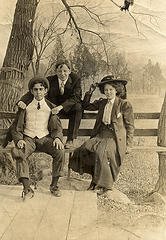
Photo: Pauline in her walking skirt, circa 1911. Photo courtesy Big Brown House.


Period-Inspired Skirts: A Fun Starting Project

Because many period-style skirts need fitting only at waist and sometimes hips, and because they're often made with straight seams, they make a good starting project. Fashionable and wearable they can be, too. Who doesn't like a little swish around the ankles?

Without getting too deeply into fashion history, I can tell you that in years past the term "walking skirt" meant a skirt that was easy to wear for, well, walks and rambles, shopping and informal occasions like snipping flowers. Walking length skirts were normal for working clothes, too, when you expected to become grubby and needed to climb or kneel without the pretty appendage of a tail -- a train -- trailing behind you.

Photo: Dame Nellie Melba, 1909, in a skirt with quite a tail...er, train. From State Library of Queensland, Australia, uploaded to Flickr.

Here's a video from 1904 with many shots of women in skirts of walking length: see how they move! (See also the post on Edwardian Promenade about the clip.)


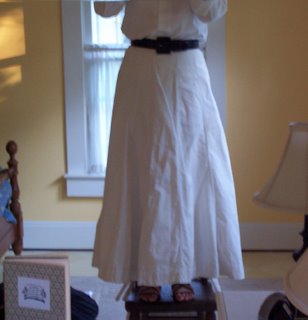
Here's an original walking skirt with felled seams. Functional and pretty! See the blog post "Anatomy of a 1900-1911 Vintage White Heavy Cotton Skirt".

Some Skirt Options for Our Circle

Sense and Sensibility Patterns carries a pattern called the Beatrix skirt, that was inspired by the skirts that Beatrix Potter lived in on her farm. The style dates to 1909 and depending on the fabric used and how you cut the waist and hem, and how you sew the seams can go from outdoorsy and functional to the elegant clinging line of that year, complete with a small train. The skirt is fullish, but is not meant to flare out. Like most skirts of that year, it's composed of multiple gored panels: 9, in this case. The panels help shape the skirt around the body for a smoother line.

Photo: Outdoorsy version of the Beatrix skirt. Photo courtesy Sense and Sensibility patterns.

I've made this skirt several times and have helped friends to make it too, and each time it's a fun process. There was the dressy version, for instance, and now the version that will be incorporated into a lingerie dress. For our purposes, the pattern is especially helpful because Jennie Chancey, the pattern designer, has posted illustrated directions. What I can show is how the pattern can be altered and period techniques used to create different effects.

A 1911 Skirt That Flares More
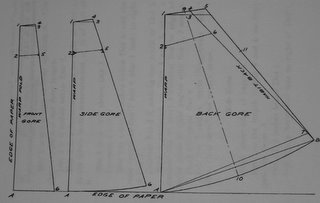
You might also be interested in a plain five-gore dress skirt from 1911. That year skirts flared out around the feet a bit more...the last year long skirts would do so. This pattern for this one comes from a high school textbook of the era called Textbook on Domestic Art and must be drafted. You can download the entire book from Google and print out the pages you need.

The drafting directions are clear, and the process requires little more than large sheets of Kraft paper or newspaper, a yardstick, a pencil and eraser, and the ability to add and subtract. Detailed drafting directions for skirts as a whole, based on a five-gore underskirt (petticoat), start on page 74, with directions specific to the skirt itself starting on page 119. Now, since these patterns are based on proportions, we may have to fiddle with the initial draft a bit if you aren't proportioned like ladies of the era, and most women aren't: the textbook expected this. See my blog post on drafting and using algebra to get the right sweep on an underskirt from a pattern in the same textbook, for instance. It all ended well...

An Narrow 1912 Skirt

If you're willing to read teeny-tiny print and do some drafting, you can draft a narrow skirt, from 1912 from Thornton's International System of Ladies' Garment Cutting, available on the Costumer's Manifesto site. I made a skirt for my friend Denise using one of these patterns, called the "New Style Costume Skirt" and it turned out very nicely. Construction was easy since the skirt was only in two pieces, but if you decide to make this skirt, we'll need to cut the fabric somewhat large and carefully fit it to you because it is snug around the hips.

For directions, see page five in the series of scans and look for the New Style Costume Skirt image and its directions page .

If you wish to try another Thornton's pattern, or any other Edwardian pattern, for that matter, that will be fun too, but since I'll not have made those skirts, we will have to do some fiddling and thinking things out, especially if the pattern is to be drafted.

After We Meet, What Next?

If you use a commercial pattern, you'll obtain the pattern, and if you want to draft one, you can either try it yourself or we can meet and do at least part of it together...if you don't mind small children underfoot.

Then, it's on to cutting out and fitting, and basting...so in my next Sewing Circle post, I'll write about period manuals that I think cover these issues most clearly, along with some superb dress diaries, fully illustrated, that show all this in action!

See you soon, ladies!