Showing posts with label 1880s. Show all posts

Tuesday, December 31, 2013

Original 1880s Embroidery Patterns: More Gifts for You

As promised, here is another set of 1880s embroidery patterns from the crinkly pattern sheet I bought recently.

Just like the first set, they are reproduced in high resolution for you. To use them, click on the images below. Depending on your browser, you can right-click on the image to get the full URL, and then paste it into a fresh window. IE behaves this way. In Chrome, just right click on the image and you can choose to see it full size. Then you can print them out.

As I mentioned last time, most of the designs here are for making little gifts welcome and useful during that period: penwipers for, well, wiping your pen nib clean of ink, covers for boxes or bags to contain cravats, veils, gloves, pin cushions, and even covers for match strikers. What's a match striker? Why, it's a sandpapery surface on which you strike your match to light a stove or lamp, the gas or candles, or the fire. I've a book from the 1930s with a kitty's back rendered in outline and the same phrase, "scratch my back".

By the way, so sorry that the images are showing up here sideways. I had to turn them in MS Paint, and for some reason while they show up fine on my computer, Blogger is setting them all cattywampus.

Here we go!


A match striker. Why doesn't the little girl want to pet her kitty? Perhaps because it has grown really big?


A Christmas version of "A Stitch in Time"; good for a novelty workbag,


Whether the butterfly lives with the needle and thread or not, both are engaging.


Hard to read, but the word says "Cravats". This could decorate a box or bag to contain that once-essential menswear and menswear-inspired item.


Care to keep your feather duster in a bag? Perhaps more sensible to put the dusting rags there. Much nicer than keeping them in an old shopping bag...


Here's an acceptably floral glove box design. Render it in embroidery, or paint perhaps.


Is this a humorous cover for a stained desktop? It would make a fun patch for jeans.


Ah, a doily to hold the shaving equipage, or to adorn the shaving towel.


Hard to read, but this is a pattern for the top of a veils container or bag.


I wonder how the mother, father, or grandparents who received their daughter's handiworked glasses case really felt about it, privately? "Specs" isn't my favorite term of all time. However, the design has its charm.

By the way, I bought this pattern sheet as well as another one from Curtis A. Grace here in Lexington. If you're interested in pattern sheets like this, do contact him. He also has fantastic paper dolls; I've even seen a set in his shop from the 19-teens, and it was large and great fun. He's not too active on Facebook, as you'll see, but if you message him, bet you can reach him.

A happy remainder to the Christmas season to you and yours, and Happy New Year!

Sunday, December 29, 2013

Original 1880s Embroidery Patterns: Made for Gifts Then, A Gift to You Now

Today is, let's see, the fourth day of Christmas. We have no calling birds from Kentucky for you, but I do have a little something to warm this long holiday period. Recently I bought two large sheets of crinkly transfer paper with patterns that date to the 1880s. Such fun they are! Patterns for a laundry bag or laundry book, a penwiper, bits of holly, a Christmas wreath, children playing, flowers with faces.

Come and have peek into little crafty projects for items then very much a part of daily life. Save the patterns and enjoy them!

Here is what one of the full sheets looks like; it's put next to a book to give you a size relationship. The paper is somewhat thicker and sturdier than today's tissue paper. The maker and date are unclear, but the sheet appears to have been produced in New York.

The designs are printed backwards, do you notice?


(Yes, I am rereading Blue at the Mizzen. Just can't let go of Jack Aubrey and Stephen Maturin, and 2014 will probably see me start the series all over again.)

Here are some of the designs below, reproduced in high resolution for you. To use them, click on the images below. Depending on your browser, you can right-click on the image to get the full URL, and then paste it into a fresh window. IE behaves this way. In Chrome, just right click on the image and you can choose to see it full size. Then you can print them out.

A great many designs during this period were reproduced in outline embroidery, with stem stitch and similar outline stitches in turkey red or sometimes yellows or blues.


A design for a handkerchief case.


Designs for a bag to hold buttons, a laundry list book, a penwiper, and a baby's ribbon bag.


A few seasonal designs.


A happy Christmas season to you! We've days and days of festival until the Magi visit on Twelfth Night.

Look for a few more designs to come your way...

Saturday, September 10, 2011

From the Collection: An 1880s Wire Bustle Pad

Earlier this summer the boys, my mother, and I visited a nearby antique store and I came home with a wire bustle pad, a gift from a favorite dealer. He had a collection of long standing that he was slowing purging, and was pleased to find an appreciative home for something he admitted would find love only from a narrow niche of people.

What a treat, and I was delighted. Here it is, in detail and measured for you, so that together we can enjoy its fascinating construction and wonder who might have worn it. An adult garments for end of the 1880s to 1890s, when bustles were falling out of fashion and later, when a bare pad just added a little oomph? Or a young girl? If the latter, we might imagine how she felt to wear such padding, light though it might be. If children then are anything like they are today, I imagine some girls fancied the grownup experience of looking fashionable, if uncomfortable, while others felt it a silly and inconvenient impediment to their fun and movements. I would certainly fall in the latter camp!
Like I have, I think you'll find the construction ingenious. It's also a good example of economy of materials and labor. The materials are high quality and the construction sound and sturdy, but there is stitching and stapling only where absolutely needed. Manufacturing elegance, here, and awareness of labor time spent, but still a secure, quality result. Sure wish my microwave was as sturdy...our less than year-old machine broke, the manufacturer gave us money for replacement, but the first replacement was dented inside its multitude of undented wrappings, and the second has a defective face panel. Quality control went down the tubes there. Sigh.


Materials

The bustle itself is made of wire. It's probably steel wire, though it shows no signs of rust. The wires have some "memory" to them; that is, if you apply a little pressure to them, they resist the pressure rather than denting. The strength of the shape is assisted by the way the structure is made: the wires are woven almost like a very wide window screen (do you feel an idea coming on, bustle lovers?) However, the memory isn't that strong, for there are some small dents in the structure.

Of what the tapes are made, I do not know; they feel like cotton, but I've never felt linen tape and so cannot tell. The tapes themselves are pretty, if discolored. The central part of the width is herringboned, while the edges, to some 1/4 inch, are tabby-woven selvage. The effect is discreetly architectural.

Total weight? An ounce or two.

There are no labels or other manufacturing marks on the bustle.

Construction, So Far as I Can Tell

The bustle appears to have been made as a wire tube, which was then bent into a crescent and a fold introduced into the wide side. Each end was then squashed into a nub perhaps 1/4 inch thick, and capped like this, so far as I can tell:
  • A length of the same tape appears to have been wrapped about the nub. I cannot see it except where the outer covering, described below, has worn away.
  • A length of the same tape was folded. At the end of one long side it was sewn into a seam the width of the bustle nub. The tape was then turned inside out to protect the seam.
  • The nub was inserted into this little pocket.
  • The covering was stapled twice at each end of the forward edge of the tape, where the bustle itself starts. 
The bustle was then attached to a tape belt, like this:
  • A length of tape long enough to go around the waist was cut. 
  • The bustle was laid alongside it, off center, so that the tape belt would buckle at the side! That is accounted for by the fact that one end of the tape is longer than the other, and the short end is cut raw, folded once, and stapled. The other end is raw. The buckle is missing.
  • Another length of tape with a tiny seam allowance on each end was laid underneath the waist tape, so that it doesn't show when the bustle is worn. It's like a facing. It is as long as the distance across the interior edge of bustle where it would sit at the waist, but measured straight across from nub to nub. This means that when worn the bustle wire may not touch the wearer too much. Instead, the tape comes under stress and pulls each end of the bustle closer to the wearer.
  • Both short ends were turned and sewn under.
  • The long edge was sewn to the waist tape at the edge closest to the wearer.
  • This made another, very long pocket. The end of the outer nub wrapping tape was stuck inside, and stapled with one staple close to the nub. I cannot tell for sure, but I don't think the side of that tape is caught in with the facing each seam, and there is no other stitching holding it to the waist tape.
  • The other long edge of the facing was not sewn; you can see in the images that part of it has folded back.
  • In the middle of the facing pocket is another nub of tape, stapled. The edge is broken off and it doesn't stick out of the facing pocket. What it was for I do not know. You can see it in the image where I am holding the waist tape, just below.

I do not believe the metal itself would touch the wearer's waist


The Bustle's Age

An example of this very model of bustle was sold by Augusta Auctions some time ago as part of Lot: 521, March/April 2005 Vintage Clothing & Textile Auction, New Hope, PA, labeled as bustle pads from 1880 to 1890. That bustle pad was in better condition than mine is. If you look at the other examples, you can see some of the variety of bustle pads out there. 


Was It Meant for an Adult or a Child?


I did a little experiment. I carefully wrapped the waist tape to the mannequin. The tapes wrapped with an inch or two to spare. However, the result is just eeeny-weeny, and although the skirt would puff out a little, the bustle horns don't wrap well around the waist; you can see this on the back view, especially. Very out of proportion, sitting so awkwardly that it feels tippy. The horns of the bustle pad don't stretch to wrap the waistline enough so that the tension on the belt helps hold it close, but not too close.

If worn by an adult, the tournure given to the skirt would be narrow and miniscule. just enough for the very end of the 1880s and the 1890s.

Look at the variety of bustles sold in that Augusta Auctions lot. "My" bustle pad is at the far right and is smaller than the others.


However, it might fit a young girl nicely, because the waist and hips would be narrower than an adult and the horns of the bustle wrap naturally and in proportion.

Not being a bustle expert, I just am not sure. I'd want to try it on a properly sized and fitted dress of the era to see. Can anyone illuminate this further?
How It Was Worn

Let's have a look at a few fashions.

Augusta Auctions sold this skating dress from the 1880s in lot 205, November 2009. One might expect smaller padding for this activity, but the tournure produced is still sizeable. The auction page has multiple pictures for you to peruse.


This September, 1890 Godey's fashion plate shows the very last gasp of the bustle era. Perhaps in this year my modest bustle pad might have worked?


Here's a girl's bustle dress from the 1880s, sold by Augusta Auctions, lot 326, April 2006, New Hope, PA. See that little bump on the back? Bustle...

Here is a fashion plate from Godey's, 1874, showing a girl in a bustle dress, with a similar bump-out on the back. Neither bump is extreme, it's just there. Were bustles similar to mine worn for the First Bustle era? I know that adult bustle pads of this sort existed. Whether this make and model was in circulation at that time, I don't know, but the effect in children's wear was very similar. Here below is a Godey's example from February of 1874.


What Can You Do with This Information?

As I examined this little bustle bad, methought, one could take an old window screen or other wire, and do something similar with it, for either a child or an adult. The result would be a modest bustle effect, but light and less uncomfortable than a full tail would be.

Sure hope someone takes this idea and runs with it!

In Other News...

I am rethinking the Madame Cobweb 1869 dress project. For some reason, despite initial enthusiasm, I became sated with the style after researching it during vacation. Since 2008 I have aged some, and what seemed handsome then, now, after years of Regency wear and looking at robust 18th century originals on which the early 1870s inspired themselves, feels prettified, rather child-like, and out of my current mood.

Further, there are some house projects burning to be done: a cushion for the big early 19th century Empire settee in the upstairs hallway, curtains. While I am at Mom's, I could  make at least one of those projects.

Hard to say.We shall see.

Saturday, August 27, 2011

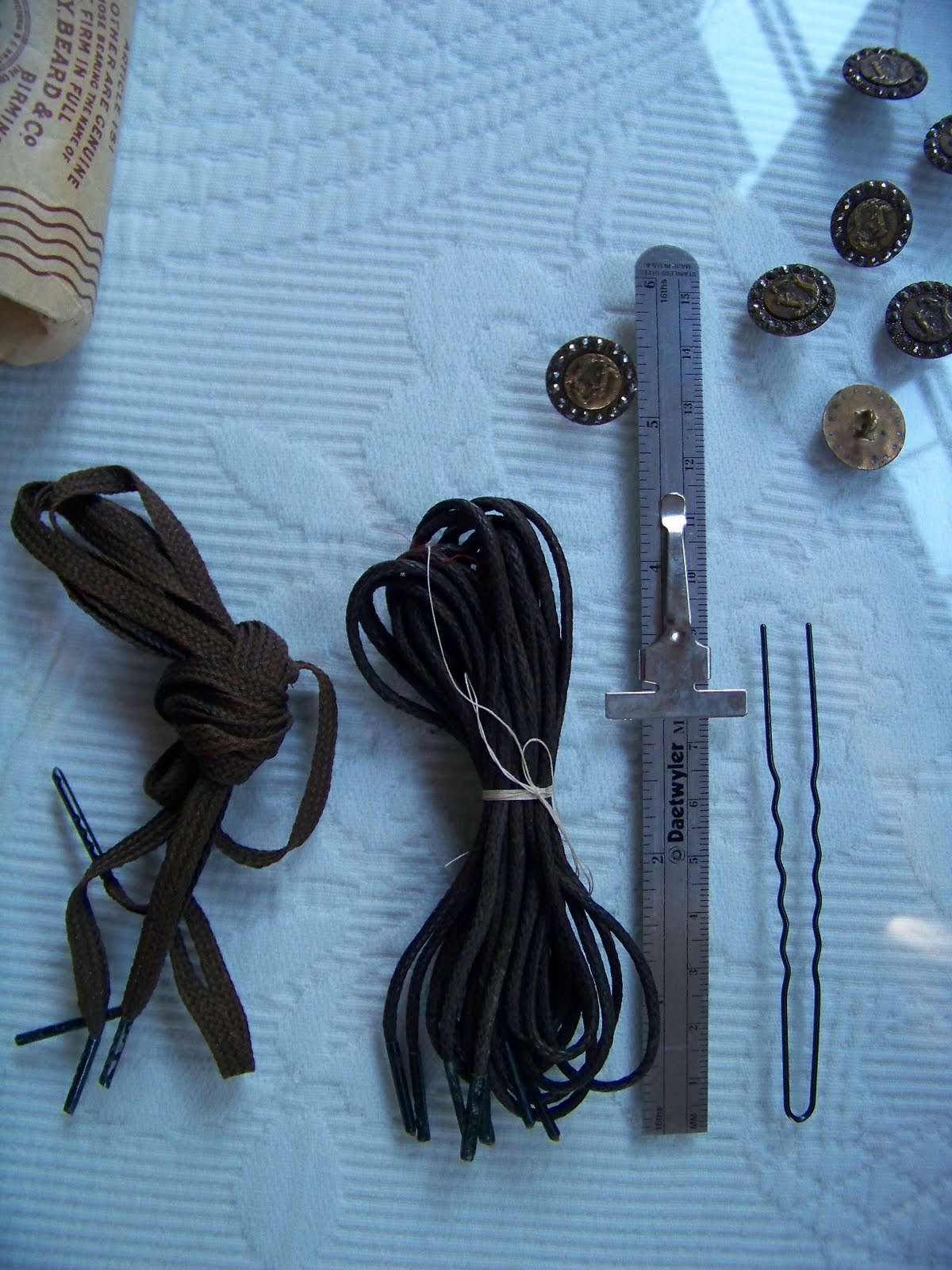
From the Collection: Antique Morally Minded Buttons, and Pins and Laces, Moral or Not

Thought to change gears a little. Over the summer I have been collecting quarters and with this little mad money stash, I've found a few little tidbits of material culture which give us glimpses into women's lives.

As always, please click on the images to see larger versions.

So, what have we here?

Buttons Most Morally Minded
At the top of the collection shown here, are seven small brass buttons. They are studded with cut steel, faceted for a brilliant effect. This is true cut steel, for on the reverse of one of the buttons you can see the rivets, and you can also see the shanks. The quality of the workmanship is very high: consider all the detailing and those minute steel rivets, all packed into a button less than three-quarters of an inch in diameter! I think the design is an illustration of Aesop's fable called The Fox and the Crow, for a fox is up on his hind legs and appears to be reaching towards a bird on a branch.


Here is the tale in full, courtesy of Aesop's Fables.org.

A Fox once saw a Crow fly off with a piece of cheese in its beak and settle on a branch of a tree. "That's for me, as I am a Fox," said Master Reynard, and he walked up to the foot of the tree. "Good-day, Mistress Crow," he cried. "How well you are looking to-day: how glossy your feathers; how bright your eye. I feel sure your voice must surpass that of other birds, just as your figure does; let me hear but one song from you that I may greet you as the Queen of Birds." The Crow lifted up her head and began to caw her best, but the moment she opened her mouth the piece of cheese fell to the ground, only to be snapped up by Master Fox. "That will do," said he. "That was all I wanted. In exchange for your cheese I will give you a piece of advice for the future. Moral of Aesop's Fable: Do not trust flatterers.

From their size and style, I put them in the last quarter of the nineteenth century. They would have looked marvelous on one of the front-buttoning dresses then so fashionable. Was the button maker toying with irony, as he studded a fable about flattery with flashy facets? Or was he clueless? How about the dressmaker? Was she teasing her client or attempting to teach her? Or was mama offering a continual reminder to her daughter through her dress buttons? Or did nobody even bother to look and wonder?

Pins
This was an exciting find: hairpins still in their original brown paper wrapper. The paper is still quite strong, although I am trying not to handle it much. It is crisp and fine-grained, if that makes any sense, but there is no true gloss on the paper.

Kirby, Beard & Co. was a British company of long standing that made pins and needles, razors and much more. See Grace's Guide for the basic facts, and this PDF article, "Gloucestershire Folk Museum and the Mechanisation of the Pin Industry", by Nigel Cox, from the Gloucestershire Society for Industrial Archaeology Journal, 2005.

The pins are the ordinary pins used for eons and still available today. I have pulled out the wrapper gently so that you can read the labeling; like so many pins and needles, they were made in England.


Let's peek inside. I have shown the how the wrapper closes; the hairpins are grouped tightly inside, so tightly that they are almost interlocked. For those of you interested in selling hairpins at a living history event, knowing how things are folded is most helpful.

I am not quite certain and need to ask my friend Curtis Grace, from whom I purchased the pins and laces, but think these are from the attic of a former milliner and her sister. More on them in a moment: it's a tasty tale.


Laces
These laces are still tied and wrapped just as they were found. Like many of the reels of ribbons in that same milliner's attic, some of the laces are tied with cotton thread, of a thickness that reminds me of buttonhole twist.

I am not sure what type of laces these are. The leftmost are flat tapes, loosely braided. The right laces are tubular, and also braided. At their ends both sets of laces are crimped with black-painted metal.

Haven't estimated their length, but they do not seem long enough for corset laces. Boots, more likely.


The Milliner Sisters
Curtis goes to estate sales and has done so for many years. At one of these sales he visited the attic of a lady who, with her sister, had been a milliner. She was a hoarder, oh, was she a hoarder, he laughed. She had stuffed purses with all of her bills, and he found her grocery lists. Then there were the stocks of millinery supplies: rolls of silk ribbon on specially made cardboard tubes. The wide ribbons were wound on the rolls between very thin sheets of paper; I shall show you an example some other time. The narrow ribbons didn't always get this treatment. Some of the larger rolls of ribbon were tied closed with that same thread you see above, and shorter lengths ditto. There were rolls of ribbon from a quarter inch to three and more inches wide, moire, edged, picoted, or printed. Many were stained from their years in the attic, and a few were shredding, being made of weighted silk, but many are still strong.

Now for the fun part. The sisters shared their business, but split at some point, and every little item they owned, Curtis explained, split too, in exact halves. Even ribbons were divided right in half! Whether the split was amicable and the division the decision of two very precise ladies, or a tragic and angry separation, I cannot suppress a smile, these years later. Certainly the items don't retain any sadness, like some items do, preventing me from even handling them. Instead they seem to be happy, sunny things, telling their story to us afresh.

Material Culture and Social History Blogs
Are you interested in reading about material culture and social history? Then I have several more blogs for you that I follow regularly. They are all quite different, but I think you will dip into each one with joy.

At the Sign of the Golden Scissors
Specifically eighteenth century dress. A really wonderful journey into textiles, stays, portraits, and more. American.

Picking for Pleasure: Understanding Antiquing Acquisitions
Examining a wide range of American items through the lens of material culture studies.

Zho Zho's Textile Adventures
Textiles, history of costume, historic houses, fashion, from New Zealand.

Today I leave you with...
...Muffin and Ladybug snoring, apropos to the Cat Days of Summer. Why should the dogs get all the press?


Friday, April 08, 2011

From the Collection: Feather and Horsehair Aigrette

Front of aigrette
Today, something a little different. In preparation for the Jane Austen Festival Ball this July, in Louisville, I've been looking at aigrettes which can be added to turbans. I happen to have one in my collection, and thought you might find it very interesting not only in terms of looks, but also in its construction.

The images are really big, so please click on them to get details. (In fact, if you are on a Windows machine, click again on the big version to see them huge.)

The aigrette is made of a celluloid comb, very flexible, with two gold-painted and curled feathers (species undetermined) and horsehair. Each feather is divided into small sections, each of which is individually curled.)

Construction: the comb has two small central holes in the top. The feathers and horsehair are gathered into a bunch, wound with tiny wire, then fixed with pitch-like glue at the base, then black thread-wrapped, with the thread carried around the glued base, through one hole to the back of the comb, through the other hole, and back round the base of the aigrette again. The thread is carried this way many times through the holes.

The aigrette is worn such that the base is in front. It must be hidden by hair or some other decoration in order not to show the base.

Here is the back of the aigrette. I've set it next to Curtis Grace's business card so you can get an idea of size.
Back of aigrette

And here is another view, in a different light, in case you would like to look at more details.


How old is this aigrette? Curtis Grace, who studied Fashion Design at Parson's in new York and has quite a collection, thinks it late Victorian; he felt it was late 1880s. Aigrettes really didn't go out of fashion after that...you find them constantly in Edwardian and Jazz Age designs.

The aigrette is incredibly delicate and is damaged with but a whiff of air. The comb, merely an eighth of an inch thick, is also delicate.

With these photos, those of you who would like to make aigrettes probably have enough visual information to work with. To get the spiky effect so important to many aigrettes, you can still use horsehair: it is still available for sale for use in the equine industry (tail extensions, anyone?), for violin bows, for hairwork jewelry, and the like. Here is a supplier, M&M Horsehair, just north of here in Ohio. I haven't used them; the link is just here for convenience. Burnt ostrich would also work, although the effect would be a bit different.

However, if anyone needs more information, I'd be glad to try and help.

Saturday, November 21, 2009

Silhouettes for Cards and Decorations for You: Part 3

Here is the last of the 1880s silhouettes for you to copy and use for cards or decorations. Someone cut this one, as they had the others, from a magazine long ago, and I thought you might enjoy it!

As always, click on the image to get it at full size.

Monday, November 09, 2009

Silhouettes for Cards and Decorations for You: Part 2

Here is a second set of 1880s silhouettes for you to copy and use for cards or decorations. Someone cut them from a magazine long ago, and I thought you might enjoy them!

Thursday, November 05, 2009

Silhouettes for Cards and Decorations for You: Part 1

A week or two ago I bought a series of small 1880s silhouettes that had been cut from a magazine. Thinking that copies of them would make pretty cards or small pictures, or even Christmas tree decorations, I photographed them, tried to clean them up a little and am posting them here for you to copy as you will. They are not under copyright as far as I can tell.

As always, please click on each image to get the larger version.

Here is set number 1.

Do enjoy!