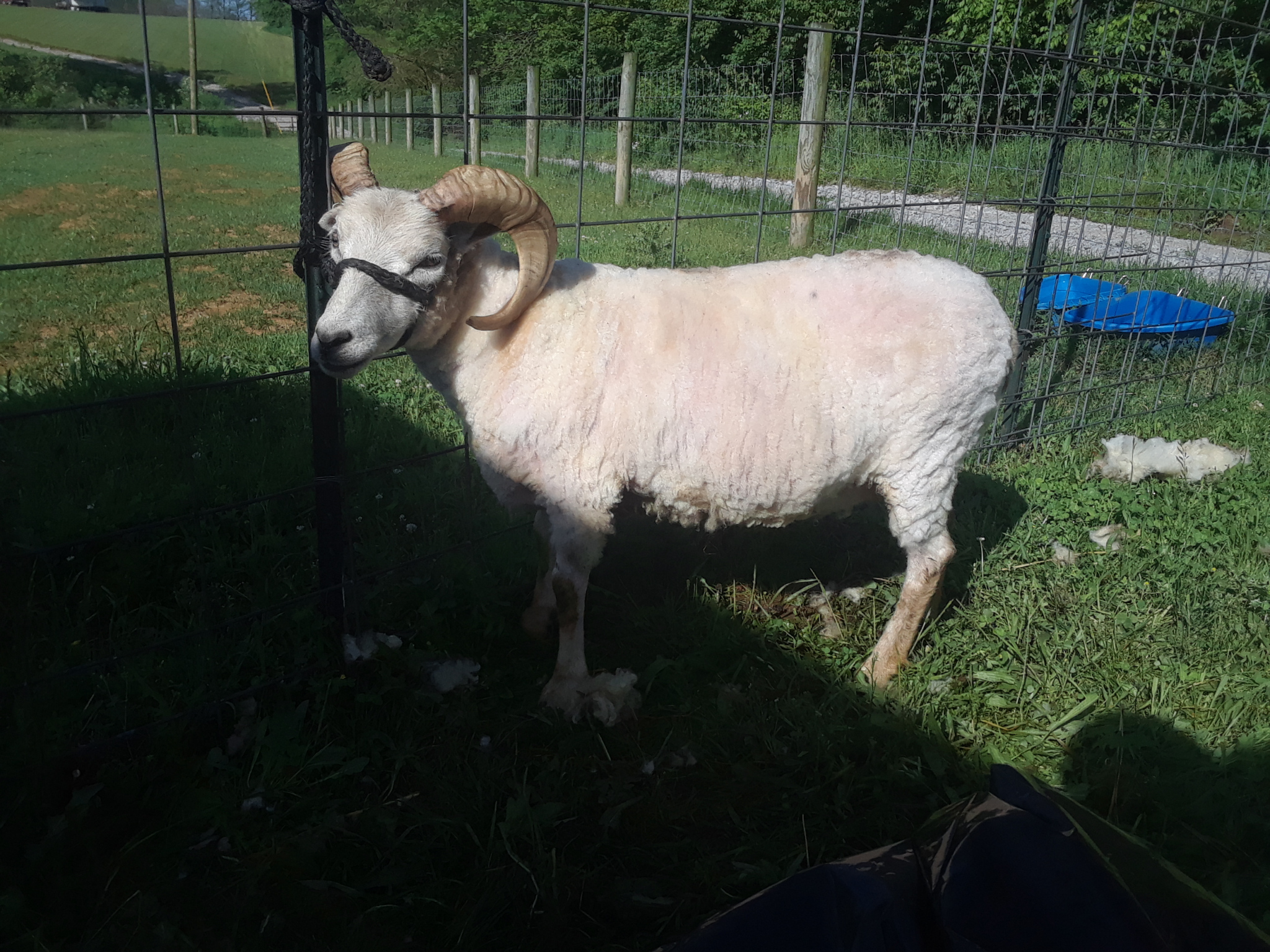
It's sheep-shearing time here in the Bluegrass, and I am helping my friend Sarah to shear sheep, including our Shetlands, Lana and Nina.
Lana, Nina, and Liam at the hay rack, late winter. Lana and Nina live with Liam on my friend Sarah's farm and she took this photo. The sheep in the background are her Soays. Liam is hers, too...and Lana and Liam are always together.
That put me into the wool spinning mood, so I've been using the old Eastern European supported spindle to spin more yarn for the years-long project to make blankets for the twins.
The Eastern European spindle, which was hand-turned on a lathe who knows how long ago.
Given that to date the project has involved shearing the sheep, picking the fleece, scouring the fleece in warm soapy water, drum-carding the wool, and spinning the wool, I measure progress in years. A few years ago I sent several fleeces to two mills to be made into roving, so I could skip the cleaning process, but haven't spun more than a few yards of that.
Now I have several thousand yards, enough to weave a small blanket, and need that much again for the second one.
Here is the spindle-spun wool.
114 yards of hand-spun wool from the spindle
Here is a 185-yard skein spun on the Polish Kromski wheel. The wheel-spun wool is a little more consistent in feel, but not by much.
Comparison with my wheel-spun wool
Given that progress is in fits and starts, we have years ahead. :)
Here I am winding a spindle full of yarn onto the yarn swift my dad and I made years ago. One full revolution is 1 yard of yarn.
Yarn swift from the top...
...and the side.
The swift comes apart into pieces to make storage easier.
Yarn swift in pieces.
Happy springtime, everyone!
I have a post about some transition stays almost ready...
My goodness, it is gray outside. So gray that, unusually for me, I am sitting facing away from the windows, view trained on the warm light of the lamps nearby. Saint Lucia's Day is just past. Winter has settled in here in the Kentucky Bluegrass, and the thick veils and clots of clouds that bring rain and snow that feed the numberless streams and creeks and ponds and the Kentucky River snaking deep beneath its palisades -- or the more realistically foreboding name, gorge -- are here for the next months. Gloriously bright days will be relatively few and valuable.
As valuable as the knitted mitts from my sheep that sit unfinished here beside me. A moment ago I cut a length of yarn to sew up the sides of the rectangle that will make a mitt, and quite suddenly was viscerally aware of the impossibly high value of that yarn.
--- Green, green grass on a Bluegrass farm --- Sheep grazing --- A year's daily shepherding, morning and night --- Shearing --- Fleece skirting --- Picking vegetable matter --- Scouring --- Drying --- More picking --- Separating outer coat from inner coat --- Carding --- Winding into nests --- Spinning --- Plying --- Skeining --- Washing and blocking --- Yarn.
And, other than the mower that trims the grass if needed, every single bit accomplished by pairs of hands and the most ancient of tools:
--- fingers --- shears --- soap and water and tub --- air --- wood and wire hand-carders or hand-cranked drum carder (quite an old tool) --- foot-powered spinning wheel --- time --- patience --- persistence.
Hours and days, days and hours and hours. Months. Years.
Lana and Nina grew the fleece on their backs three summers and winters ago, munching on the grass of my friend Sarah's farm not far away.
Nina, Liam the English gentleman, Neo the honorary Shetland, and skittish Lana October 2020.
Every day, Sarah cares for the sheep, whether it's muddy or parched, icy or foggy, or finger-cramping or beautiful enough to cry and thank God for the peace of it and the sweetness and interest of the sheep. She is patient and loving and the sheep thrive and she knows each one and its character and society. I am lucky to have her as a friend.
Liam at the hay rack. Lana is nearby. November 30, 2020. Read about the drama just past in "Disruptions Due to Snow" on Sarah's blog.
On a nippy morning the next early spring, around about 8:00 a.m. when our breath streams in clouds around us when the rest of the flock leaves the barn for a day in their fields, Sarah and I have the task of separating out ever-fey Lana from her boyfriend Liam and daughter Nina in their stall, and she leaps and evades until by main persuasion with torsos and arms and legs we halter her, so that she could be sheared. The only time each year that she wears anything but her own self. In a month or so her fleece, her skin a hand's width deep under her blond-tipped locks, would start to separate and slowly, imperfectly shed. She needs shearing before that happens, and before the heat of a Kentucky summer makes life far too hot for her under such a blanket.
So the two of us, each with a pair of hand shears, lean or kneel the either side of Lana, haltered to a fence outside and in sight of her flockmates to calm her and begin to shear. She kicks and trembles and we work as softly as we can so as not to nick her so-tender skin. She calls out to her grown baby and pees so that you move quickly to avoid the piercingly nose-wrinkling liquid. We trade places frequently as muscles cramp, and Sarah's mother Peggy talks quietly to Lana and strokes her. Occasionally one of us runs to gulp a bit of tea from our Thermoses. Some of the wool is spoiled by dung and urine, other parts so full of VM (vegetable matter) that I cannot efficiently clean it. That lot goes to the hedgerow for birds and rodents to carry off for their springtime nests. We smell of lanolin and dung and trampled grass.
Sheared, Lana's halter is gently removed and she kicks and wriggles and runs to her family. A good part of the time the flock is non-plussed by the fleeceless stranger, and will butt and carry on until they are convinced and assured that she belongs with them. That can take a while because sheep are so visual, and seems to us humans grossly unfair, unless we should think of the day we wore an unpopular outfit to school and were laughed at and occasionally pushed by the more thoughtless of our classmates, until they tired of the game. In the last years, however, the flock is kinder and Liam and Nina welcome her with raised heads and low bleats and she resumes her life just a few yards from Liam, her life's love and companion, while her daughter pretends she's not Shetland, but Soay, and leaps and climbs and talks with her flockmates until returning to her mama, as an offspring usually will. A flock is made of clans and it is a complex society.
I gather the mounds of yielding, springy brown and blond fleece and stuff it into an old pillowcase. It scents the Tahoe. We go and shed our outer things outdoors, and wash up thoroughly, and lunch together next to the kitchen, watching the flock from a bank of windows that look to the West.
On other mornings it will be one or two more sheep, Nina and Liam, and sometimes one of the other Shetlands. Soay sheep are less likely to be sheared. Some roo, that is, the slowly shedding bits are pulled off lock by lock -- this is what humans did before shears were common.
After that? The fleece is packed into a tightly closed plastic bag and goes into my deep freezer to evade the clothes moths that would entirely spoil it.
Then, when I have energy and time, the oddly pleasant pastime of picking. In springtime Kentucky can be a breezy, windy place. Just outside the back doors at home I sit on a step with the open bag of fleece, scented with lanolin and straw and a bit of dung. Picking up a lock or two in my fingers -- sheep grow their fleece in sets of hairs that tend to stick and curl together -- I pull at the lock, holding it in front of me so that the airs can toss the hairs and release bits of straw and grass and seeds and the occasional dead bug or tad of dung; they fall in a random rain to my lap and the ground and some makes its way, airborne, into the tall trees that rim our little property. Usually it's necessary to pick out individual bits, fingers pinching and pulling. The lock, a bit cleaner now, goes into another bag, ready for scouring, which is a gentle washing, not the rubbing and scrubbing that the word generally implies.
Hundreds of locks later, washing. Drying in limp bunches, like hairy Spanish moss or the wrack of a mummy's wrappings, in the basement. A little disturbing if you come upon it unexpectedly.
Packed again in an airtight bag until there is time to do what most fleece does not need. My dual-coated Shetlands are a crofter's dream, for they offer downy undercoat for airy yarn and long outer hairs good for socks and rugs, all on one small and delightful animal. Yet the undercoat grows in among the outer coat and the two must be pulled apart. This is slow, my friends, and after a time the hands and wrists and arms tire of pulling on the resisting locks of fleece as the tightly integrated parts release their hold on each other. Of course, some down is lost into the hairs and the other way around. A few fiber mills who take small wool batches have specialty equipment for handling this sort of uncommon wool, but the process is expensive and the only mill, a state away, that I could afford closed. This year I sent fleece to another mill, because I simply cannot hand-process it all and the freezer was full to bursting, but it will not be separated. It has been nearly a year, and the roving isn't ready. I fear it's lost.
The sorted wool is bagged again, and again waits for time to hand-card it, or to run it slowly through my hand-cranked carder, a largely wooden machine with two drums lined on their outer surfaces with closely set wires, which arrange the locks into a fluffy batt.
I pull and elongate the carded wool into a fluffy strips, roving, and wind them into nests. Back they go into a bag.
Later, months and months later, as fancy strikes I pull out the newer spinning wheel, a Kromski Minstrel from Poland, a beautiful and versatile machine, and spin the roving, unwound from its nests, into a thinnish yarn. Good for weaving as a "singles" yarn.
Spinning on the Minstrel, early 2020, not long before lockdown.
Again later, I pull out the wooden bobbins of yarn, and ply some of it into two-ply, Aran-size yarn. It's not always that consistent of course, because I am no very accomplished spinner, but it's still pretty wearable stuff.
The yarn rests a bit after plying and then it's out with the homemade yarn swift or skeiner, and the bobbin is unwound from the distance of half a room as I turn the yard-circumference tool to allow the twist to even out, and wind it into a skein. The turns are counted so I know and mark down the yardage.
Then goes the skein, which twists of itself into a braid, into a bag, until I am ready to swish it in some warm water with a tiny bit of soft soap, and to hang it to dry so that the yarn relaxes a little, and sets into a useful state.
And then, and only then, is it ready for knitting.
And so I knit the Pluviose mitts in garter stitch, the yarn now, from a moorit (warm brown) fleece with bleached tips, to a rich German chocolate color.
Pluviose mitts are simply garter stitch, and thus nice and stretchy over the hand.
Let's not knit just now, but nap instead, says Nutmeg. She loves wool and seeks it out to rest upon.
Just now the mitts sit beside me, ready to be sewn with more yarn into their final shape, the leather button ready to be added to each wristband. Then they will be, after a three-year journey, complete and ready to be wrapped in tissue paper to go under my mother's Christmas tree. She will open the parcel Christmas morning, and wear the mitts, I hope, that started as grass a few miles away, to keep out the chill of a Kentucky winter. While Lana and Nina wear their fleece again this year, warm and toasty under it even in the sere fields lined with leafless trees, the damp and chilling -- or bracing, take your pick -- breeze soughing through the branches.
The cycle does not end, the sheeps' lives and the hands' work, so long as we remember to practice the skills that keep the sheep healthy and the yarns ready to envelop and warm us.
Whatever your beliefs, and wherever you are, may you live in Thanksgiving, Patience, and Hope into the new year and the spring, or the harvest, that isn't so very far away.
Note: because of COVID, most of the images of the sheep are from Sarah's blog. We haven't been able to visit one another, which has felt very strange.
Joining an end of yarn to fleece ready to be spun.
Every winter for getting on quite a few years the urge has come to sit and spin. In the Kentucky Bluegrass the days are faded, however blue the sky, or gray and so dim the streetlights sometimes come on, and we seem to orient ourselves towards the windows, or towards the lamps when the windows leak in only a moody, sometimes bitter light.
In that time for some reason handling wool is comforting. Spinning yarn requires attention and care, but the slow, thoughtful movements, the repetitive treadling of the wheel or the flicking of the supported spindle in the hand, and the drawing out of soft, washed fleece, watching as twist runs into the fibers and draws them into a springy, soft yarn, is soothing. It makes wan light, or wet light, or threatening light, or expectant light heavy with the thought of snow feel good and sweet, as illogical as that might seem.
I am wondering. Humans have spent so much of their lives spinning or twining fibers -- millenium after millennium -- to make ropes, strings, baskets, fabrics, those objects that help make life easier. Is the urge, once woken, still built in to our neural networks? Perhaps that's wishful thinking, but it sure does seem that way.
That's what I have been doing, after all the preparations, excitement, and stress of the end of the boys' fall school semester, and the Advent and Christmas seasons.
Pulling out a thin roving made of wool from our Shetland ewes, Lana and Nina.
Until 2018, I had prepared our ewes' fleeces for spinning by hand, by myself, as the boys are now too busy to interest themselves in the process. Even if the girls weigh under 75 pounds apiece, they still produce a great big humongous pile of fleece, two pillowcases stuffed to bursting. The pile would be knee-high if suddenly let out of the bags.
Black sheep, black sheep
Have you any wool?
Yes, sir, yes, sir, three bags full!
Oh, that's much too much --
Though it's very nice;
I'll take two instead
And spin it in a trice.*
In a trice? Erm, no...
(*My own weak doggerel, not part of the original rhyme.)
Each crimpy fragrant (if you like the smell of sheep, and I normally do) lock must be picked of its bits of straw, hay, seeds, and unmentionables. That's a pleasant thing to do outdoors, in the springtime, when it's breezy, because as you pull on the locks the moving airs will pull some of the vegetable matter -- VM -- and carry it away for you, gratis.
Then the fleece must be washed in small batches in several consecutive buckets of steaming hot soapy water, preferably outdoors, and rinsed in more buckets, and dried in creepy looking, drippy clumps in the basement, hung over a wooden rod above the old zinc washing sink. This is slow, wet, dirty work with a dash of danger as I haul boiling water in the teakettle outdoors to heat the bucketfuls of water.
I have a whole post about the process titled "Scouring and Teasing Shetland Fleece" from several years ago, when I first started working with wool. It might entertain you. It did me. I have so much fleece now that I'd never think to rescue such supremely dirty locks as I did then. Instead, I'd leave them out for birds and animals to make nests with.
This is from some years ago, when I first started working with wool. Boy, was that fleece a bit hard to work with...
Then the wool must be separated. This is an extra step, joyously extra, because our ewes give us a twofer. They are dual-coated, which means they are covered next to their skin with a fine, so-soft downy wool a couple of inches long that keeps them warm. Through and over that grow hairs, in spiral locks, up to about six inches long. These hairs remind me of very coarse human hair, and they direct rain and snow down their lengths and off the sheep, keeping the sheep warm and dry-ish.
Nina, will you model your coat for our readers, please? Thank you, sweet girl.
Nina, sporting her winter coat. See that spiral-locked outer coat? That's what makes her a dual-coated Shetland sheep,
an especially lovely and ancient type of Shetland.
Knowing how blustery the Shetland Islands are, a dual coat is Heaven-sent. It's an ancient sort of coat, and not all Shetlands sport it; thankfully there is enough genetic diversity in the breed that it keeps showing up, because it's luscious, or as I said, joyous.
Joyous, anyhow, until your hands ache after taking the umpteenth hundred lock in your hands and pulling each end to separate the long hairs from the down.
Try doing that on an entire ewe's worth of fleece. Now double it, to include Lana's wool. She's dual-coated, too.
Nina says, "I'm so sorry your hands are so sore. Do you have any crunchies? I can gum your fingers for them..." As of last year, she is fatter and bigger than her mother.
Lana -- that's her rump dead ahead, ignoring everyone because it's breakfast time.
She's next to her boyfriend Liam, also a Shetland, from whom she is not often
more than a few yards a way. He does not have a dual coat. That's a sweet Soay sheep, from
islands not too far from the Shetlands even more rugged than they are. My ewes live
with her and the rest of the flock at my friend Sarah's farm.
The hair from the separated wool is good for warp threads for weaving, or, mixed with the down wool, for tough outer garments, and I might try it for an add-in buckle for an 18th century hairdo.
We're not done, however. After separating the wool, there's carding the down coat to ready it for spinning. I have a hand-turned drum carder, so I don't have to use two hand carders and work lock by lock, thank heaven, but it's still a slow manual process to feed in each lock, and then run a full load through twice, and then offload the batt, tear it into three strips, and wind them into "nests" ready to spin.
So that's the process that I followed, and still follow, to some extent, because I actually enjoy some amount of hand-processing. It's hard, elemental work, and very satisfying. However, I found a wool processing mill that had the special equipment for separating fleeces, and now have a large amount of lovely, soft roving. It feels a little like cheating to spin so easily, without all the effort, but it's a nice change. Alas that the mill closed, and the only other one is in New England with a six months' wait! It may be back to hand processing.
I'll be back to finish up the 1890s posts in a bit. Right now, the wheel is in hypnotizing motion...
Nina. Eight pounds. Fuzzy, warm, adorable. The first for Lana. The first for us. The boys' own lamb.
Here she is not long after birth, barely dry and already up and
walking.
This morning as I write a wood thrush is singing outside the open window, the song one of the most beautiful of any American bird. The thrushes are migrating to the northern woods. May his or her trip be safe and successful, and may they nest and bring beautiful babies, like this baby, to add happiness to the world.
Lana is a good mother, protective and loud when she protests us holding her baby. Nina is almost as loud, but up a few octaves. in calling for her mama. Here she is:
Mama sheep tend to check on their lambs when they nurse, and nudge them around with their noses so that the lambs remain near their sides. Sheep wag their tails madly when happy and Sara Dunham of Punkin's Patch up in Cynthiana says that a lamb who is nursing successfully nursing will wag its tail while drinking. No tail wag? He or she may be having trouble latching on.
Now they share a maternity pen with both outdoor and indoor spaces with their relatives, and the lambs, just days old, are bouncing around. Now I understand what gamboling means: springy hops with front legs, back legs, all legs! Sidesteps, mincing, prancing and fidgety dancing. It's adorable and hypnotic.
You can read all about Laura and Chris' new flock babies at Square Peg Farm. You'll see Kelly's just-born lamb and its first steps, and meet all the mamas and their little ones.
Holding Lana before she's sheared. Some of that dual coat is six inches long, and it's almost as dense as felt,
without being felted. Lana's fleece is a crofter's dream: there's wool in there for every purpose, from soft sweater to rug.
Yesterday was shearing day number one at Laura's Square Peg Farm and so the boys and I headed out to help. Leeloo was still on the shearing stand, and the boys packed her shorn wool into bags,and wandered happily around the farm after being asked to please exercise Izzie the Adorable. More on her later.
Lana, my Shetland, was waiting in a fenced-off portion of a pen in the barn, where she and Lily stood gazing at us, as sheep will. Lily appeared patient, as she is a sweet and patient sort. Lana was guardedly quiet. You could tell she felt that Something was going to Happen. Then she figured out that she was to be haltered and that was it. She did Not want to be caught; she's not socialized, so she might be considered almost feral.
As soon as Laura's father entered the pen, she morphed between high-flying ping-pong furball with skinny brown legs to a cocoa streak of lanolin greased lightning in the confined space until Mr. Bullins wrangled her with main strength into her halter. At which point she sat down, wouldn't budge, and had to be carried to the shearing stand. In the mayhem a temporary fence fell, the other pen of waiting sheep saw their chance and within five seconds were out of the barn and skipping around in the back yard. Huzzah, freedom!
Noah and Christopher were playing with Izzie, when all six pounds of her Chihuahua mix spied sheep, loose. Fun! Time to be a big dog. The flock was now grazing in the back yard, so Noah, who had Izzie on a leash, allowed her to approach, but not too close, and she wiggled and barked and jumped and looked big as she could, and the sheep, disgusted, trotted back to the safety and quiet of the barn. They're not afraid of her, but they don't like being yelled at :}
She was one happy dog, and Noah, the shepherd, was one proud boy. Sheep at his bidding, you know.
Shearing took a while. If Laura hadn't had the unenviable bum area, and her mother one side while I had the other, it would have taken hours. As it was, I left a good deal of fleece on Lana in trying not to get near her skin, so she looks perhaps a little lopsided. Laura says in a few weeks you won't be able to tell. Good.
After shearing, I felt Lana's side, just to see. Her tummy gurgled...those multiple stomachs were doing their thing, thankfully...but then suddenly there was a tiny, sharp movement inside. A kick! I am a mama and I know a baby kick when I feel one. Laura's mother tested and the baby kicked for her, too. Alas, no kick for Laura, but she's expecting and that's old hat for right now:)
After giving Lana her oral medicine and shot, not appreciated by the sheep at all, and trimming her hooves, which she might have been happy about later, and at which I was a tiny bit better, we let her race away to her mama, crafty Etta, and buddy outside and went to wash up and hang out on the screen porch with a glass of very enjoyable, timely wine and some manchego and boucheron...on saltines. Actually, excellent cheese on saltines is quite good. It was warm out, the air caressing and teasing, and sprinkling under damp clouds, and the view was marvelous, daffodils and trees and meadow and sheep and barn, and the boys relaxed with us, and life was about as lovely as it gets.
We came home so happy, and singing
Brown sheep, brown sheep, have you any wool, Yes sir, yes sir, one bag full. Part for my master and part for my dame, Part for the little twins who live down the lane, Brown sheep, brown sheep, have you any wool, Yes, sir, yes sir, one bag full.
I have a pillowcase stuffed with Lana's gorgeous chocolate fleece with blond tips.
Noah says he wishes every day could be like that day. Christopher just grins.
Curte says the boys need a dog.
I look at my pillowcase and dream of washing it, carding it, and spinning it, to accumulate until Lana has given enough wool to weave into two moorit Lana blankets, one for each boy.
Thank you Laura, for another memorable day. Thank you, Lana, for being your wild sun-washed brunette self.
+++++
Where is Vernet, you ask? I have a post waiting, but have had to stop embroidering for a bit. Since I stopped, I've had not a single headache, not one migraine. Could eye strain along with work stress be the causes of so much unbelievable pain these last 4-5 years? We may have a hiatus on sewing, then, to test the theory.
Once upon a time there was a Shetland sheep, almost a year old. Her name was Lana, and she had long, tawny wool, almost like hair, and she was beautiful, and I fell in love with her.
Lana was born and lived at Square Peg Farm* nearby, and with the blessing of Laura, a sweet friend and her shepherd, soon she was mine. Our town allowing horses to live inside city limits, but not sheep, and ovines, that is, sheep, being creatures who do not thrive away from their flock, she continued to live at Square Peg, where she is still today.
(*Laura's blog is lots of fun, and you'll meet everyone and learn all about Laura and her husband Chris' adventures in farming. There's only one picture of nature in action that might be inappropriate for young readers.)
She is not alone. She belongs to a delightful flock, of whom Elizabeth is the leader.
As a lamb, she was loved by children and attended 4-H events and so she is as social as they come. She'll actually leave her flock to visit with people and to follow them around. Her happy wagging tail and sweet face melt hearts, and a melted heart usually means a nice big treat handout, so everyone is contented. She is even famous, since Laura and her mother wrote a children's book about her and an incident with some laundry. You'll have to read The Story of the Unique Sheep.
Then there are Lily, a tiny, delicate dark chocolate wonder of a friendly girl, and Toffee, the visiting ram who looks a little lopsided because he lost part of a horn, but who doesn't care a whit and likes to hang out with people, too, looking for handouts and nibbling nearby grass in a friendly way. These three are perfectly willing to become a mini-flock with my boys. The latter couldn't be more delighted. Peek carefully at the below: one boy is dreaming and the other has a joyful grin ear to ear.
Elizabeth, Lily, and Toffee in the background.
Getting close to Lana is not easy. She's as keen for treats as Toffee -- in the lead here -- and Elizabeth -- who seems to run so fast her ears are flattened to her head -- and is that Etta behind her, and Elizabeth's sweet and friendly son Larry afterwards, with Lana off to the side? She's a fey, shy girl though, so I've only touched her once.
Fooooooo-ooood!
That was during shearing last year. Shetlands are small, about knee high, 50-75 pounds. It'll be less sore on your back if you harness your sheep to a stand to shear them, give them their shots, check and trim their hooves, and do an all-over check. Once they know they'll not be ending their life on that stand, they'll, well, stand it, pretty okay. Young Lana thought her life was over, and trembled almost continuously, the day Laura and I sheared her. It probably didn't help that I was petrified of hurting her -- my nerves surely magnified her fear.
Laura shears one side of Lana. I was shearing the other.
It was treat time afterward. Lana, now much smaller -- she's the tiny skinny girl in the far back, circling unsuccessfully while the older, higher-status sheep (like her mother Etta at front left) and the goats and Grace the guard llama get the goods, hung back. She'd been butted some after her shearing. The rest of her flock was not ready to recognize her yet in her new 'do. Getting used to ovine behavior takes a bit of doing. Sweet they are, but they're a little like kids on a playground, and so they have a pecking order.
Ooh, what does Laura-Shepherd have here?
Lana's lamb fleece was so soft, so lovely, and I brought a bit home. Her moorit wool is bleached blond at the tips. Muffin and Ladybug were taken by its tantalizing scent. Not long after that Muffin had a luxurious roll in it.
Looking at the wool, in the basket and on its creator, you might wonder why she's got what looks like long, waving hair while her flock-mates are covered with long, crimpy, wool? That's because Shetlands are a "primitive" breed. On their native islands, their keepers have valued their variety of colors and coats, and the variety wasn't bred out of them. Lana is the very primitive "dual coat" variety, her long outer hair shedding rain easily and the warm super-soft down underneath helping her to laugh at cold and wind and damp. Elizabeth is a large version of the "kindly" Shetland variety, with pretty much one type of nice soft wool, rather long, all over. Lily may represent a third type. She's actually more normal-sized for Shetlands, and she has shortist, super-soft crimpy wool. If you look up Shetland sheep on Google you can find out lots about them.
What next in this story? Does Lana look a little less lean under all that wool, compared to last fall?
Why are we so concerned? We're hoping she'll have a lamb in April!

.jpg)