Tuesday, May 31, 2011

An Even Better Version of Ackermann's Online, in Full

Ackermann's fabric samples, from a month in 1813.
Thanks to Sabine, who located another source for Ackermann's online at Archive.org. Go to archive.org, and in the search box, copy this text string:

Ackermann, Rudolph

Why should we be extra happy at this version? Several excellent reasons:
  • Because the text is searchable. Holy grail, my friends, is fully searchable text. Allows all kinds of interesting research.
    • With text search, it's easy to locate actual samples of real dress fabric. Yes, you heard me. Ackermann's didn't just provide fashion plates, but promoted British textile manufacturers. The image at the top of this post shows dress fabric pasted right into the engraving on the right page. It's from the 1813 volume. If you click the image you can read the accompanying text on the right page.
    • With text search, it's easy to hunt down references to fashion in ads, letters, and other articles.
  • Because you can download the volumes in all kinds of formats.
By the way, the issues make terrific historical reading. Get your viewpoints on the Napoleonic Wars, the War of 1812, the latest music and literature and manufacturing news here!

Saturday, May 28, 2011

Ackermann's Online, in Full

The cover of the first issue. Talk about a long name!
Yes, friends and readers, it's online. From 1809 through, well, you need to go look for yourself. As with Gallery of Fashion, this famous Regency-era journal is at at the Bunka Gakuen University Library Digital Archive of Rare Materials, in Japan. You can find Ackermann's itself here. Do recall that "Ackermann's" is common shorthand for the real title of the journal, which I believe changed over time. When it launched in 1809, it was actually titled very wordily. Click on the photo to the right and you will see.

If you lose the link, here's one easy way to browse to it. On the library homepage, choose "Place" from the left bar, and then from the list of items, select "United Kingdom". The library site may take some time to respond, but when it does, browse to the last page, and select the item that starts with "Repository of Art, Literature, Commerce...". Eh voila.

Because fashions are only a part of what the journal reported on, in the library's Search Results - Images screen, you can hit the "Plates Only" button at the lower right corner, and get just the plates. However, I believe that the journal also published descriptions of the latest fashions. You'll have to hunt for those the old-fashioned way, by reading the table of contents for each issue and going to the pages in question.

I haven't looked much at the journal because for the moment, the 1790s are topmost in my mind, so will be delighted to hear if you all find anything especially helpful.

By the way, for my money, Luxus und der Moden is still one of the best sources, for it does a marvelous job of publishing entire special articles on items such as feathers, fabrics and their sources, production, specifications, and availability, jewelry, hats and headdresses, and more. It's harder work reading the journal since it's in German and in Fraktur typeface, but oh my, the excellence of the information! If Ackermann's publishes these sorts of specialty articles, I'd love to know.

Happy reading, and a good Memorial day weekend to you. Tomorrow we travel to West Liberty, in the mountains, to gather with my husband's extended family and to do what we do each year on this weekend of memory and memorial: visit the family graves scattered in the small cemetaries that dot the hillsides,  clean them and decorate them and discuss family past. This is not a common custom anymore, in suburban and urban America, where most families are scattered thousands of miles apart, but in places where families remain close to their roots, it endures.

Mmm, the honeysuckle is scenting the air. Daddy and the boys have gone to the "train station" (model train shop) and then to lunch at the local pharmacy lunch counter (yes, they do still exist), but they will return soon and my gift of time will be past. Oooh, now I smell horse manure-rich garden mulch; good thing I like it, but I had better get moving. 'Bye!

Wednesday, May 25, 2011

Blogger May Be Hiccuping

Good morning, everyone. The word from friends is that Blogger is having issues, and this morning I had trouble logging in. Therefore, if you leave a comment, or try to and cannot, or for some reason don't get a reply from me, it's likely that Blogger had a hiccup. Goodness, I hope they fix this! First Livejournal had issues, and now here. It's inevitable, I guess, with the mass of users, and the complexities of the systems driving it all, and it is a free service, but still...

Tuesday, May 24, 2011

New Styles of Dresses, 1799, Gallery of Fashion

If you haven't perused the Gallery of Fashion at the Bunka Gakuen Library yet, make haste! There are styles of dresses, headdresses, and accessories with which many of us may be unfamiliar.

Take this image, for example, from 1799. The lady on the right is wearing a button-front dress. Yes, that's right, button front, almost to the natural waist, with a vee neck. Whoa. That's not seen too much and I have never seen such a design in a reproduction dress.

When I look at these plates carefully, what great ideas appear! While I wait for the ribbons for the white voile dress to arrive, and sew a chemise (which will also make a very comfortable nightgown, too), am really studying these plates.

Here's August, 1795. A girl's dress! Look at her mother's cap! Look at the park and house in the background. Long, happy, sigh.


And Ackermann awaits. Good grief...

Sunday, May 22, 2011

News Flash: Gallery of Fashion Is Online!

Gallery of Fashion, October 1794
At this moment I am close to suffering a case of the vapors.

The Gallery of Fashion, volume 1 (Apr. 1794) through volume 9 (Mar. 1803), is online. In huge scans, with all the text. One of the members of the lamodeillustree community on Livejournal made the discovery that Bunka Gakuen University, in Japan, had placed it and other fashion treasures online. Here is the link to the collection at the Bunka Gakuen University Library Digital Archive of Rare Materials. One easy way to find the Gallery of Fashion is to chose "title" from the left navigation bar and then type it in...voile. It's on a short list.

Here for the first time I learned that the Gallery is just fashion, nothing else: no poetry or family advice, cultural notices, or politics. The Gallery had a most interesting way of making itself exclusive: highly priced, it listed its subscribers annually. Here are the first two pages, describing the Gallery's aim in detail.


One comment. Not every scan is crystal clear for some reason. Take the image at the top, from October 1794. If really clear the text under the plate itself would be crisp, and it isn't. Still, many scans are clear, and this is the very first time many of us are going to have seen most of the plates. What wonders await, and what gems the text will give us in the way of names of garments and how they are worn!

Golly, I also noticed other gems in the library. I could be busy for ages here.

Praise ye now the Internet and the generosity of libraries and universities, for they are making literal treasures available to us all. How can we ever thank you? My humble suggestion: support your local libraries and museums!

Friday, May 20, 2011

Exploding 18th Century Food...and Even Shaped Like a Cannonball

No, this is not Zombie-related, but it will be
explosive.
Now that I have your attention :}

This blog is all about experiments. So are other blogs. Usually the experiments aren't the source of explosions, or of giggles, but in the case of Madame Berg's recent experiments with a stuffed 18th century cabbage and boiled hamburgers, dated ditto, you will find both. What a howl!

Perhaps I was punch-drunk after a busy two weeks last evening, but on reading this on the mobile device thingie after lights out last night, I kept falling into giggle fits. The fits kept little Christopher awake and in laughing fits too, because he thought it was funny that Mama was laughing so hard. Poor Curte and Noah: they missed the joke, being asleep already.

Have fun, and happy weekend!

Addendum

I have not forgotten the voile dress. It just lacks the last bit of frill and time for a photo shoot. We have family here this weekend so time is not available.

Sunday, May 15, 2011

A Picnic at William Whitley's

Mr. Whitley's steps. I am wearing my old plain cotton dress,
as better for a rainy picnic than the
new white voile wrapfront
dress.
Laezter Tag haben wir einen Ausflug gemacht nach dem Haus von 1795 nennt William Whitleys. Ich spraeche nun Deutsch weil der Tag ziemlich Deutsch war. Am erstens, Regen, mehr Regen, niedrige Wolken, Nebel, Mittagessen im Regen. Dann, ploetzlich, die Wolken haben beiseite gezogen, und wir hatten Himmelblau rechts oben, so klar wie Krystal, Sonnenschein, and weichen, duftenden Brisen von den Felder neben uns.

That is to say, yesterday we had an outing to the William Whitley house. I express this in German because the day reminded me rather of Germany. At first, rain, more rain, low clouds, mist, lunch in the rain. Then of a sudden the clouds moved aside, and we had skyblue right above us, crystal clear, sunshine, and soft fragrant breezes from the fields around us. For German speakers, please forgive me if my grammar isn't particularly correct, but I am trying and really it is the best language to capture changing skies like those painted on the ceiling of a Baroque cathedral.
Sharon with the tots.
This was the second meeting of the Bluegrass Regency Society. Originally quite a number of us planned to go, but as is the way with busy springtimes, one thing and another, not to mention the threat of icky weather, left three big people and three little people to head out anyway, singing,

Whether the weather be cold, or
whether the weather be hot,
whatever the weather,
we'll weather the weather,
whether we like it or not.

So it was that Sharon, Jenni, and the three tots sheltered under a shelter, a delightful lunch spread out, and wet hems and drenched umbrellas out of sight, and raised our glasses to the answering salute of thunder.
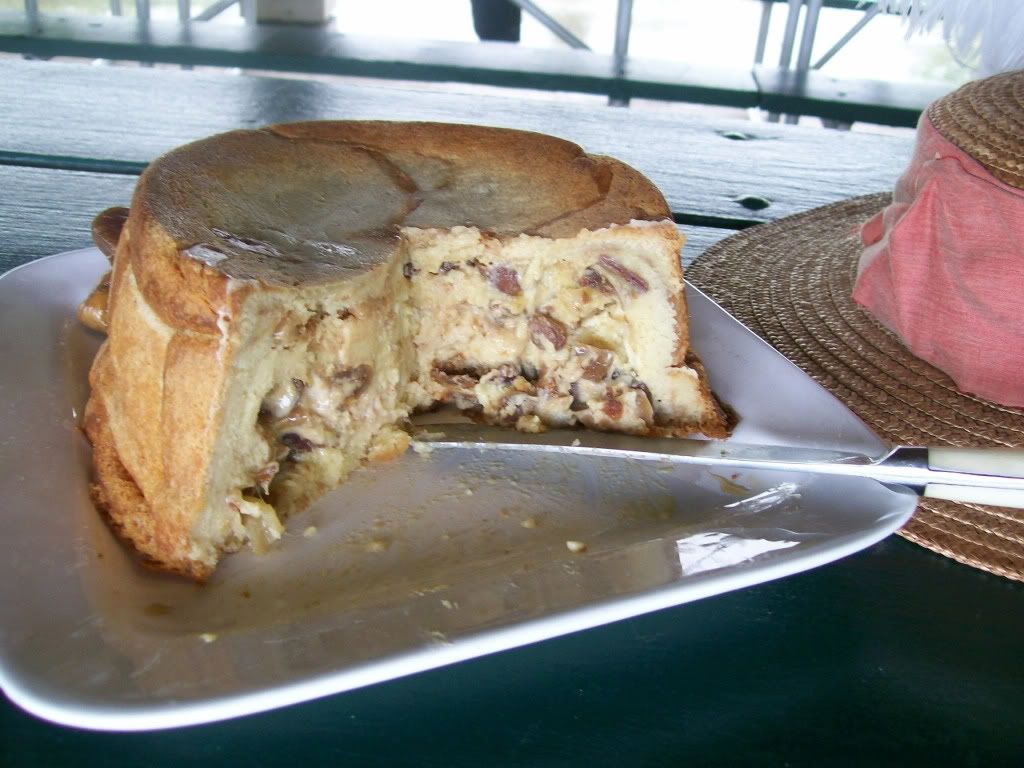
White-pot, the delicious dessert popular for centuries,
this one from a recipe dating to the early 1700s.
Jenni gets the honors for all the preparations, from a Regency-inspired menu to the quoits, and badminton, and ninepins and Three Graces games the weather didn't let us play on the spring grass. Sharon and I did a little cooking and bringing, but not the heavy labor. Let her tell you all about it, especially the white-pot, an ancient dessert now undeservingly forgotten. Think bread pudding, but give that dish chic, and exotic dates and dried fruit, and its own shape, and remove the teeth-grinding, gritty sweetness that Kentucky cooks so often lade it with. A dessert of a high order, and one perhaps with which Mr. Whitley, his wife Esther, and his eight girls and three boys, late of Virginia, might have been familiar.

So Sharon and Jenni and I traded anecdotes and stories, the wee bits gorged on cheese and then ran around yelling "thunder!", and we attempted a soggy photo shoot. Once the skies cleared, we toured the house, the oldest brick structure west of the Alleghany mountains, not too far, from the Cumberland gap, a late Georgian house, perfectly proportioned, a real gentleman's seat, built firmly on a rusticated stone foundation, limestone steps to the very solid door, the handsome checkerboard brick pattern spelling " W W" above that door and "E W" above the back door (now covered), and crowned with very correct dentil moldings and brackets at the roof. Below the rise and the specimen trees shading his property, known as Sportsman's Hill, and within easy view, the first circular horserace track for Mr. Whitley to enjoy a favorite sport.
The front facade of the William Whitley house.
The front and back used to match, until a back
room was added on, and a summer kitchen addition
to the right.
That thick door should give you a hint of something else, too. This house was also a castle and outpost. The American Indians, for whom this land was a hunting ground...and it's rich, rich land too, softly rolling, with excellent grass and soil and a patchwork of woods and meadows, and lots of springs and streams and rivers...weren't happy with the invaders and it was attacked more than twenty times. Mr. and Mrs. Whitley and their 11 children, and servants and guests, sometimes more than thirty people in what was then a four-room+garret dwelling, even if it was beautifully paneled and trimmed and furnished, locked themselves within, the children hiding in secret spaces between the floors, and one or more men positioned in a hidey hole in the garret,  protected by brick and beams, that's still there, where they aimed their rifles like sharpshooters out a scrap of window. Mrs. Whitley was a good shot, too, we understand, even if she called competition shooting man's work and preferred not to do it.

We were not allowed to take pictures inside, so if you'd like to see more pictures and a video of the house, visit the William Whitley House Foundation. If you can, do visit the house itself, for if you want to understand early Kentucky, you will feel right away the mix of refinement, love of sport, and hard, dangerous living that defined the region then and still does to some extent now.

Jenni, her daughter Autumn and I stand
under a lightly dripping roofline.

Costume Notes

Underpinnings

Early Regency gowns often went over shortish stays, and at that period, one of the ways to solve the issue of the gap between the bottom of the stays and the beginning of the petticoat, was to add buttons to the stays and to affix the petticoat to the buttons. Jenni and I are not sure if petticoats were supplied with loops to slip over the buttons, but since Janet Arnold shows a button-and-loop treatment for pulling back a dress bodice, we felt this was at least appropriate technology. So here below in two poor image are the Dorset buttons, fixed midway down the stays, about at dress waistline, and the loops on the petticoat.

There are seven buttons and loops: three at back, one on each side, and one on each front edge of the stays.

Stays note: this pair of shortish, gussetted, strapped stays was made and embroidered by Sarah Jane Meister of Romantic History for herself, and which I bought later when she sold them. They fit perfectly at first but I've lost so much weight that the spring is a little narrow in front. They still are remarkably comfortable, like a combination sports bra and back brace, and if they did not alter my silhouette so much, I'd be tempted to wear them for everyday; they are perfect for standing for long periods. The cut is still a transition cut, with little individual bust definition.

Oh, chemise. The ancient-of-days S&S one that I made during pregnanct. Extra large, too large now, but a superb nightgown. Trimmed with very plain, narrow cotton Valenciennes lace around the neck, which yes, could be done on occasion; I need to provide you with a citation.


The Dress and Accessories

Each time I don Regency-era clothes, I attempt to learn a bit more about appropriate and fitting accessories and how to wear them. The same applied for this day.

Originally I'd planned on the new white voile dress, but knew that Kentucky mud would play havoc with it, so chose a more picnicky dress, a plain printed cotton in tan and white tiny print, the print as close as a roller print as I could come for $2.00 a yard. It's the first dress I ever hand-sewed top to bottom, and my first in Regency style, and is made from the S and S Elegant Ladies' Closet pattern, with some changes due to handsewing. See several posts about the process. It has a minute train; longer would have been better but I did not understand that even a plain, untrimmed dress would have been trained at least a few inches, and made quite long by the ultra-fashionable. It ties in back with a self-fabric thin tie.

For this wearing I discovered that to look best the gathers should concentrate evenly towards the front of the dress. Pulled evenly all around the result is awkward. Consult any portrait and you will see.
Also without the neckerchief, the neckline is actually quite low and reveals cleavage, due to the action of the stays in raising the chestline. Neckerchiefs could be worn in numerous ways. I chose the simplest fashion of covering up without covering the entire neck, by holding the vee-shaped neckerchief (a style sometimes used) along my back, rather like a stole, sliding both front ends over the edge of my shoulders, and then carefully folding and tucking the outside edges into the neckline and arranging things such that the whitework and picot edging showed to advantage. In back, due to the low neckline, Jenni pinned the kerchief inconspicuously so that it didn't ride up. After some hours, the front would gap between neckline and kerchief. Might I pin it there, too?

Sadly, the neckerchief shows poorly in these photos, but you can see the pattern of small dots and repeating small leaf patterns, in my banner image at the top of the blog. The pattern is almost identical to whitework patterns of the period. The neckerchief is, as many garments were then, upcycled. It was once the hem of a child's cotton lawn or batiste dress, beautifully constructed but unsalvageable as a dress or display piece due to many large and unmendable scorches and holes throughout.

The necklace is a stopgap, but, composed of light blue beads knotted on silk and tied with a silk bow, reflects the taste for remarkably large beads that dots the fashion pages at the end of the century.

The earrings I made from sterling wire, on each of which is strung a pear-shaped freshwater pearl and a smaller round freshwater pearl above, then a tiny double loop to provide shine and space before the loop is attached to the lever backs. Lever backs did exist and mine are as close as I can come within my wee budget. Next round I want to add a tiny space between both pearls, but need to locate some more photos of originals. The overall style was very popular. Again, consult portrait miniatures and fashion plates to find them, and see Napoleon and the Empire of Fashion.

The headress is in two parts, hat and turban. The turban is made of my last year's dress sash, of lovely orange and rose shot Indian cotton mixed with metallic gold thread. It's wound once around the head, tied in a half knot at the front to hold it, then passed around again and the ends draped.

Under it, the hair, all of it, it lightly wound in a mid-height twist in the back, the ends held upwards in the hand, and a wide black metal wire comb thrust through it to hold it and the ends allowed to fall back over it. Then bits of hair are pulled out around the head and neck to curl.

Over it for part of the day, last year's hat gypsy hat, the side edges turned down as you saw in my recent hats posting, and also documented in a precis last fall. Yes, there's cheater millinery wire holding down the sides. It's a favorite hat, vintage 1980s almost boater style, and I didn't want to steam it into shape.

Veil: in my right hand. This was to go over the hat, but in the rain was not needed. It's made of filament silk gauze, so fine that a 30" square easily goes through my wedding ring, so light that it blows like cobwebs. I rolled hemmed the perimeter, and want to spot it with embroidered spots someday.

Gloves: opera length would have been most fashionable, but I don't have any yet. These are cotton, and only the decor across the back is inappropriate. Better gloves are on the list.

Ribbon at the waist: had I a longer one, that would have been prettiest, but images show a mid-down the skirt length, and the width is right. It's light plain silk, notched at the ends.

Shawl: This marks the ensemble as belonging the the very end of the 18th century. It's wool and really is from India, as so many were, and is embroidered along the edges and in the corners with the pinecone (paisley) motif. It is not cashmere, but very welcome still on a damp day. It's worn in a common manner, passed around the back and held in the crook of both elbows, a position which immediately gives an appropriate body stance. From there it is easy to pull up around the shoulders. Jenni is wearing her Indian shawl in another popular fashion.

Reticule: of the plainest country sort, and holding my sewing things, camera, and so on. Just an even-striped linen fabric square bag shape with a channel sewn in and satin ribbon drawn through and tied. Like the dress, would not have been carried for a company occasion, but for a picnic, I thought it sensible. Still looking for exact documentation, but know that the construction, if not the fabric, was appropriate.

Stockings: white cotton, clocked, above the knee. Apt to wrinkle at the ankles, just as then. Oh, for silk...

Shoes: typical problem, shoes are. Proper 1790s pointed toes, and the tiny almost-gone heel, but the vamp too low, too wide, and rubber soled, etc.


Hope you've enjoyed the notes!

An Intense Curiousity

I woke this morning in a reflective mood. The whole of last week was crammed with travel for work, with things at home, and with a special outing of the Regency Society, and, given the luxurious gift of lounging by my sweet husband, who went off to Sunday school in the damp with the boys, I am here thinking.

Permulating upon it, as my father-in-law would say, musing upon it, I found a thread that tied all the experiences together. This past week, all week, I was in company with intensely curious people.
  • At week's start, it was the boys. They built and rebuilt with their blocks, they looked at their books and explained pictures to each other. We examined the small creeping things, the young worms, individual grains of soil; I tried to answer dozens squared of questions about how bees get pollen, why squirrels like eating on our deck with cats just on the other side of a window, why a chipmunk dug his hole in my flower bed and destroyed it, why the commode needs to flush, why Noah's knee scrape is red, and why Mama is too.
  • At week's middle, it was me, still trying to master (ha!) the finger and wrist movements and tension that best produce a fine rolled hem in filament silk gauze and wondering how proficient a professional of the 1790s was, what her speed and what different motions, and where did she sit?  Sideways at a double window with a north-western exposure, where few shadows intruded, perhaps? And where I might find more evidence for speed, needle handling and sewing setup.
  • Towards week's end it was infectious disease scientists where I work, presenting cumulative research upon the effectiveness of rabies vaccine given in baits to wild foxes in Europe, raccoons in America, the results of handwashing studies, stories of battles won and battles still engaged, by intensely curious people who have given the gift of their curiousity, at times their own health, and in some cases, their lives, to humankind to protect human and animal health. And a very special meeting with two mentors of mine, infectious disease pathologists of great ability and greater compassion, for whom I worked so happily and whom I still miss very much, more than a dozen years later.
  • Yesterday, it was six curious people ignoring rain and thunder to tour the first brick house west of the Alleghanies, two of them practicing living gracefully in full 1795-1802 ensembles for a few hours.
Intense curiousity. You are here reading because of it. The entire world of costuming is exploding these last few years with the evidence and results of our accumulated eyes, ears, fingers, figures, and experiences. The twins are hugely enjoying their curiousity, and our family with them. My professional world is, too. Let's give thanks for the gift of it...many thanks!

Wednesday, May 11, 2011

Renovating My Sheer 1795 Morning Dress: The Grand Try-On

It's almost an anticlimax, presenting this dress' Grand Try-On, yet here it is. It's...wearable. The ribbons for the sleeves and waist have yet to arrive in the mail, and  -- for Pete Squeaks! -- the missing length of frill is in the side of the front that shows! Guess what I will be doing in the airport later this week, as I make a work trip :} That frill must be done by Saturday, or bust.

As always, please click on the images to see them full size.

Here's a goofy picture of Cinderella soulfully attired in her kitchen. Note the missing piece of frill at the hem, and the experimental, and not successful sleeve ties, one thick and one thin, and the missing waist tie and general air of not being ready yet for the ball.


Let's compare the bodice with the reference image, for that was where the real initial issues were.


  • Placement high on shoulder, check.
  • Enough wrinkles in the sleeves? No. Need to scrunch them the old fashioned way, with water and rubber bands. I had starched the sleeves to work with them, so they are rather stiff in the image. They are heavily gathered at the sleeve heads, so should do fine.
  • Neckline gathers? Almost...I need to arrange the fabric a bit more.
  • Tightness across most of rest of bust? Check.
  • Waistline treatment...can't figure out how a wrapfront would fold back in an arrow shape like that. Will play.
  • Lace at neckline? Working on it.
Still, the bodice and waist fit and look pretty well for a Try-On. The neckline did what I wanted it to do, the hems are airy.

The only thing I am not pleased with is the sleeves. The sleeve ends are too wide. See a typical treatment in fashion plate below. I may gather them almost at the end with a thread, leaving a tiny frill, later to be trimmed just as the neckline is.

Here is the back. At the center back, where the fabric is very, very heavily stroke gathered, the fabric boufs out just enough on its own that I may not need a bumpad of any sort.


The back is a little wrinkled, for I put it on in a hurry, it being almost time for bed.

There's the minute train. Gowns of this era were usually trained, and I went with a minimal one, for this dress is meant mostly for daytime and gardens.

The try-on also exposed, let us say, another issue. On the advice of Jenni over at Living with Jane, I mounted dorset buttons (thanks, Jenni!) on to the stays, and set loops on the petticoat, and hung it from the stays well above waist level. This is something we hear of occasionally as an early solution to the high dress waist and the former natural waistline position of the petticoat.

However, I did not mount the buttons high enough, for the blue embroidery on my stays is showing through. Yarghhh. Another task before Saturday...

A Question about Sleeve Ties

Silly sleeve detail.

A question for those of you who have made Chemise dresses. Gallery of Fashion says that the sleeve bands are "tied" on (June, 1794). The same term recurs in Luxus und der Moden. Yet you can never, ever, see the ties in the fashion plates or in portraits, in front or back views! Are they just tiny tight bows to the inside of the elbow? Here's a typical example below. I'd do a comprehensive search of costumer sites, but am almost out of time and will not have computer access Thursday and Friday. HELP!


There is still a lot to do before I wear the dress to a picnic Saturday. That frill, an interim sleeve and waist solution, cutting a plain handkerchief from transparent silk gauze, and so on. I will not be posting, therefore, until after the picnic.

So here, as a parting gift, Zepherine Drouhin roses exhaling a soft, silky, gentle damask scent. I caught their image yesterday out back. My favorite old-rose variety.

Monday, May 09, 2011

Renovating My Sheer 1795 Morning Dress: Alllllllllmost There

Is it modern textile art?

No, it's my frill.

It's not long enough.

I measured 1.5 times the length of the dress hem, aiming, you see, for a scanty frill.

Then it was quiet hours of rolling hems and rolling seams to connect the 18" sections, for I was working with the last dribs and drabs of my voile, piecing like mad. After that, some relatively speedy whipped gathers (they are fun!).

Last evening, the moment of truth. Would the result be long enough? No. Just inches short.

Grrrrrrrrrrrr.

I may add it later. It's on the portion of the dress covered by by the wrapped front.

Right now, whipping the frill to the hem. Tonight, the grand try-on.

In Other News
  • I should have revised information for you on rolled hems, having refined my method to make it go faster, but still be accurate, and have developed a method to make a finer finish. It involves taking a cue from whipped gathers..instead of folding the initial hem, roll it!
  • Have made a video on whipped gathers. Thery can be relatively speedy and fun. This involves proper preparation of fabric and thread, and holding the needle at just the right angle.
  • Have photos for tips on whipping a frill to a hem.
  • Finally, knowing that my early cap uses rolled seams, I've done these too to join the frill lengths. Works great. Have an idea on how to make one that's strong...using a very thin cord inside to take stress. Could mean rolled seams for a transparent dress. Now I need to see if something like this was actually done!
Christopher after helping. Boredom or peace or
just sniffing the rose scent wafting up from outside?

Wednesday, May 04, 2011

In Which Humble Cotton Becomes a Work of Art: Sabine's Capote

Cotton, oh thou modest fabric, to what heights you can climb? To the tippy top of Everest, it appears.

Sabine used cotton so handily in her latest capote confection, inspired by 1812 French examples in Napoleon and the Empire of Fashion, that I am reminded of an old-fashioned moss rose cake decorated with mounds of coconut-flecked boiled frosting.

See what the capote gains by leaving the cotton edges raw, so that they fray? Look closely: a lacy halo!

Whether I ever have the good fortune to make a similar hat, or not, is debatable. Meanwhile, we can all congratulate her on her success.

Sunday, May 01, 2011

May Day

Today was May Day, warmish, cloudy-ish, damp-ish, but all in all quite nice.

We went a-Maying, picking a bouquet of wildflowers for Grandmother.

We leave the basket at her door, run, and hide.


Suitably surprised, Grandmother enjoys her grandsons as much as her bouquet.

The flowers in their mustard pot. We have here violets, star-of-bethlehem, a sort of pink-tinged wild daisy, a bush honeysuckle, wood sorrel, and grass. Or these are the names I know them by. Do you have others?

In other news, I finished attaching the skirt to my dress.

Took awhile. The front uses a hem stitch, where the gathering is scanty. I wanted a very low-profile look, and overcast, no matter how tiny, seemed overkill, and backstitching left too much of a pseudo piped edge. The sides and back use an overcast stitch, which in the very back, is set between almost every single gather, to set each off nicely so as to create a pretty pleated effect. The stitches there run about 1/16" apart.

Next step? Try-on and hemming, and attaching the bottom frill. Yes Mrs. C., next post I will be in the dress, not Mrs. Mannequin.


How I wish I could see the seamwork, up close, on several real mull dresses of the day!

Happy May Day to you all,

Natalie

Monday, April 25, 2011

Renovating My Sheer 1795 Morning Dress: Adding the Skirt, Part 2

Was sure that I'd be done seaming the skirt to the bodice today, but no. It's going slowly. I am using slanting stitches, mentioned in Costume Close Up and also visible in this extant cranberry dress at Vintage Textile that I have written about before, of attaching the skirt by turning down the top raw edge of the skirt and attaching it to the bodice bottom with slanting stitches.

Slanting stitches connect skirt to bodice.
Because I can make a slanting stitch in the valleys between the skirt gathers, I can control the gathers better, forcing them in place and holding them in position. I also sew through two layers of voile, both skirt and skirt seam allowance, for strength.

So here are things ready to go, at the western windows for good light.

Here I've arranged the gathers carefully at the side back of the skirt, spacing them and stroking them where necessary, and having folded down the raw edge to the depth of the first of two rows of gathers. Then I have pinned them in place. You can see to the left, at the center back, that the gathers haven't been arranged yet.

Here I am using a slanting stitch to catch the bodice and the skirt together in a valley between two gathers. The thread has just come up from the back of the bodice to the front, just above the skirt seamline. I am now pushing the needle, some 1/16" to 1/8" below the seam fold, down through the skirt, the skirt seam allowance, and through the bodice. I will then angle the needle (behind the bodice) to the right and come back up again about 1/8" away, just above the skirt fold. Whereupon I repeat. Every few stitches I catch the thread in the needle to make a little knot, for extra strength.
Note that I am not hanging the skirt from the bodice, so that the stitches are almost just overcast stitches. I would if the voile were stronger, but it's not, so the skirt top overlaps the bottom of the bodice by just over 1/8". That means I can take good strong nips out of all of the fabric with the needle.

Whether this stitch is kosher or not, am not sure, but it looks like what you see on extant garments, both on front and back, and in a pinch can be done right on the person standing in front of you -- as was done by 18th century mantua makers, so...well, it's strong, it works, and it looks fairly right, so there we are. If I decide to hang the skirt from the bodice later, so be!


This process for pleats would be fast and tidy, and was in the two pleated robes I made in 2010. For a gathered skirt, oh my. It would be one thing if the garment were evenly gathered all around, but noooooo. This dress is scantly gathered up front, medium gathered at sides to create a "waist" illusion, and maximally gathered across the center back. Arranging the gathers evenly has been a bear.

I've gotten about a third of the skirt done...

A Morning with Autumn and Jenni

This morning Miss Autumn came to play with the tots, and I set a hemline for Jenni's dress. We had lunch outdoors in a Northumberland-Kentucky gale, as clotted clouds scuttled across the sky, finally giving us some sort of sun, the first in several days.

As always, it was a very good morning, a few hours of friendship and common interest among tots and parents to treasure. Now, Noah may have been given a time out, and all three might have been tired from a very busy Easter Day, and my hemline might have been crooked, but at the end, all three hugged tots each other at once, squashing each other happily, and talking about the next visit, and both Jenni and I had had a very good chat and look at the Napoleon book.

I leave you this evening with the tots all listening to the gentle tick-tock of the old school clock in the upstairs hallway. I started it for a moment so they could watch the pendulum swing -- we'd made pendulums of beads and string moments before. Must get that clock tuned up. I miss the sound that's among my earlier memories.

Saturday, April 23, 2011

Renovating My Sheer 1795 Morning Dress: Adding the Skirt, Part 1

Dress front.
Just a short post to show some progress.

Over the past evening or two I set the gathers into the skirt. That meant
  • dividing the top of the skirt into multiple sections:
    • one section for each side of the front, minimally gathered right at the front, medium gathered at the sides.
    • another section for each side back, medium gathered, and ending at the back seam.
    • A last section, five inches across the back, for the central fifth or so of the fabric, maximally gathered. The gathers here will be carefully stroked.
  • Taking two rows of gathering stitches. For the central back section, each stitch about  a shy1/8" long, for rhe other sections, a little larger. In the last section, just to try it, I used two needles and threads simultaneously, loading up one needleful, leaving the needle in place, then using the second needle to gather up the same amount of stitches in the same spots. It went fast and produced two very even rows.
Then this afternoon, in about 15 minutes' time, I turned over the raw top edge of the skirt to the depth of the first gathered row, and pinned it in place on the dress.

Next steps, arranging the gathers more carefully, and then top-stitching the skirt in place, in an 18th century manner, with little overcast stitches, to the bottom of the bodice.

Here are more pictures:
Beginning to set the skirt.

Pinning the back.

Pulling the gathering strings.


The back.

The Wilmington RailRoad Museum Breaks World Model Train Record

Screen capture of team breaking down the train layout
after the successful record-breaking attempt. Image courtesy
The Seahawk student newspaper, UNC-Wilmington.
at the University of North Carolina, Wilmington.
A picture of the museum facade is at top right.
My Dad is a devoted volunteer at the Wilmington RailRoad Museum in coastal North Carolina. Today, after 3500 hours of volunteer work by a big team, they attempted to break the world record for longest functioning model train...and they did it. Holy cow.

The train was some 900 feet long, which at actual size means about 15 miles long, and to break the record, it had to circle a huge track set up at the University of North Carolina Wilmington  for 40 minutes. At first, when Dad phoned to let me know about the streaming video of the event, he said things were going "lousy". He had designed the control system that drove the train. He's a retired electrical engineer and developer for IBM, and lifetime train nut. The first few breakdowns must have been nerve-wracking.

Still, by 4:00 p.m., they had kept it running and had "smashed" the record, as one observer wrote, although I don't know by how long.

Here is an article from News Channel Three this evening: FIRST ON 3: Wilmington train breaks Guinness World Record.
Dad, I am so happy for you! That's quite an achievement for the museum, and I hope brings lots of visitors.

Friday, April 22, 2011

O Hive Mind, What Do You Think of This Buckle for 1795?

This year for the Jane Austen Festival Ball in Louisville I am going to wear, once again, my 1795-style high-waisted white silk open robe, this time with a silk gauze petticoat over the opaque silk one. Last year I wore a short shot pink and gold Indian cotton sash with it. Here it is, below, worn with a wayward, baaaaaad-behaving fichu. I feel like a Pilgrim :}


This year, I'd like to wear a belt, instead, made of cream ribbon and clasped in front. In my collection, bought from a grab bag full of Kewpie dolls and 1960s earrings, is this cut steel belt buckle. There is a little rust on it, but not much. It's real cut steel, not an imitation, for like real cut steel pieces, each head is riveted to the frame. It's not quite four inches long and is probably late Victorian, meant to be worn with a sash.

Buckle front. Some rust, but not much,

Back of buckle. One side is missing its strap.
How it clasps.
So. Is this buckle too Victorian, or is the the stem and leaf design suitably late 18th-early 19th century? What do you think?

Cut steel was very popular in the late 18th and early 19th centuries. It was popular, in fact, right into the twentieth century. In the recent Napoleon: Empire of Fashion exhibit, cut steel belts and other items, including a necklace, appeared, including a cut-steel butterfly on a Directoire (1790s) evening ensemble. Also, teardrop and leaf shapes were used in 18th century embroidery designs, which bear relation to jewelry designs, along with the round shapes.

Because of the rust and the missing strap, the buckle does not have much instrinsic value, so I feel okay wearing it. If I did wear it, would have to rig something for that missing strap.

I cannot decide whether to wear it, and go back and forth.

Your kind advice, pros and cons, please!

Thursday, April 21, 2011

Napoleon: The Empire of Fashion Catalog: Regency Inspiration Writ Large

A typical page from the hardback catalog. Ladybug
is an 8-pound cat, to give you some idea of the size
of the book. It's nice and BIG!
If you're looking for Regency fashion inspiration directly from the contemporary fashion source -- Paris -- Napoleon & the Empire of Fashion: 1795-1815 is a super sourcebook, or so I would argue.

The volume is large, the many, many photographs full-page and crystal clear, the colors true, except for the seafoam silk gown, which looks grayish for some reason. As you have probably read reviews at Stay-ing Alive,  A Fashionable Frolick, and at Aylwen: Historical Costuming, among others, and of course at Natalie Garbett's blog (she being on the exhibition team), I shall not reprise them here. By the way, this review is not as an affiliate, I am not in any way benefitting from writing it, and have no connection with the exhibition.

One of the central aims of the exhibition is to show how high-fashion women, and a few men, actually appeared on the street, in their boudoirs, with children, or in the ballroom. Because, we learn, the foremost French fashion magazine of the time illustrated its plates from life, we should be getting a Vogue view of high fashion. The mannequins are completely dressed therefore, from carefully rendered hairstyles with good wigs, right down through jewelry and even, on one risque just-post-1800 model, thigh-high chemise and pink stocking garter peeping through the sheer muslin of the lady's dress. The clothes, well cleaned, are fresh. They fit the models beautifully. The curators had to develop custom mannequins, (oh, they are superbly rendered!) for the body shapes of the era were different from our modern shape, with smaller, higher chest cavities and bosom.

No time-stains here to taint our understanding of how color and contrast were used. Bravo, bravo, bravo! I can look at the models over and over, and have -- on the official web site -- and each time learn something new. This is the first time I have gotten a truly good sense of how someone might have looked, well-fitted, well coiffed, fresh, bright, dewy. Again, bravo!

For the first time, I have a good resource for constructing an entire look, not just from paintings and miniatures, but from carefully researched reconstructions. Wow.

Now, what this volume is and is not.
  • Like many exhibitions, this one is thematic, and along with the goal described above, the organizers aim to show how this era marked the birth of modern fashion. Some of the essays therefore make comparisions with modern-day fashion. It's fascinating, and I think their argument is valuable. For younger readers and those with concerns about modesty, I would warn that one essay deals, in part, with adult matter.
  • An example showing how the models are compared
    to fashion plates.
  • This is not a standard catalog. We are not taken on a chronological tour, one page per model, with explanatory data. Instead, the models are scattered among the essays. The captions along with the models and plates are minimal, so not all items a model wears are described or even named, and no dimensions are given. Nor are reproduction items identified. To do so for 50 models would have been a massive job, and I can understand why the team did not attempt it. Still, my detail-oriented mind would wish for this information.
  • The catalog has highly detailed images of scarce items. Many close-up views are given of embroidery and beading and lacework, and hats. Since this information is rare elsewhere (even the V&A books don't have this much), I am thrilled.
  • The catalog is not about chronicling year-by-year changes in fashion history, and it is not about garment construction. You cannot, in many cases, see seamlines. The garments are not rendered in schematic, and as mentioned, there are no dimensions given. If you want year-by-year information, go to fashion plates or to Cunnington's oldie-but-goodie English Women's Clothing in the Nineteenth Century. If you want seamlines and construction, go to Nancy Bradfield and Janet Arnold, etc.
  • This is not a catalog of the dress of all socio-economic levels, but a rendering of fashion as worn by those who could afford to and were interested in it. The essayists explain that the era marked a first democratization of fashion, with access to high fashion spreading through western societies, but the aim here is not to record that spread, but to record fashion at what was acknowledged as its source. 
  • One final note: this is a first edition of the catalog, and the essays are translated from Italian, I believe. There are some grammatical errors and oddities in sentence structure, and in some cases centuries are off, such as 1900 for 1800 (this due, most likely, to the different way the centuries are named in many European languages). I assume that later editions will correct some of these small errors. Again, the reader should not mind that much, and I expect later editions will correct the typos.
A Plea to the Exhibition Team: Even More Photos, or Even Video? Think Teaching Tools

Even if I am able to travel to the exhibition, should it eventually come close to Kentucky, it would still be of great benefit to professional and hobbyist costumers and living historians alike to see more photos of the models. After all, this is a very rare chance to see the costumes pulled together into real and convincing ensembles that show fit and accessories in a lifelike manner.

If the team ever thought of putting out a CD or some other set of images for sale, or a set of lectures in video, there are some of us who would sure appreciate having them for years to come, and my, what a teaching tool at the university or high-school level. If it had been me putting all this effort into researching and dressing these models, I'd be repurposing the information in as many ways as possible :}