Wednesday, August 27, 2008

An Early 1870s Flounced Bustle: Dress Diary

The Bustle: Essential Underpinning for a Dolly Varden Ensemble

Having Dolly Varden dresses on the brain, I decided to make a Dolly Varden ensemble. One essential component is the bustle. This underpinning gives the all-important extended, poufed back.

Photo: the completed bustle...

Unlike the 1880s bustle, which was an aggressive shelf-like structure, the first bustle era silhouette is a large, soft, bunchy pouf. While you can make a bustle for this era using a small conical hoop plus a separate small bustle tied on top, many bustles were constructed in one piece. The one I am almost finished with is one of these: the pattern is TV 108, the Grand Bustle. Like so many seamstresses who have made up a bustle using this pattern, I found it superb.

Image: TV 108, the Grand Bustle, from Truly Victorian.

The below is a dress diary detailing the construction.
I won't go through each step, because the pattern is so clearly written, but will detail spots where I used specific techniques to get the best result or where you have to watch what you're doing.

Cutting Out

The bustle pattern comes in just a few pieces, well matched and well marked. Make sure you place ALL markings on your pattern; since you will be sewing a curved garment, it would be a pain to put the markings on after you seamed up the garment.

A Note on the Sewing Machine

I used an early 20th century Willcox and Gibbs chain stitch sewing machine, electric. The machine produces a fine, perfectly straight, elastic stitch, and the attachments produce high-quality hems, tucks, ruffles, and so on. Further, the design is so cool: it's such a pretty thing. This machine is nearly mint, and was loaned by my sweet friend Johnny: I love it and have named it Laura, because it's elegant and conservative: the W&G never changed its design much. If it works, why alter it?

Image: sewing seams on the Willcox and Gibbs in my mother's back garden

Stitching Flat-Felled Seams

The first steps are to stitch the front pieces together properly.

I used flat-felled seams on this garment, which show on the exterior, like a pair of jeans. They are strong seams since they're composed of two lines of stitching, and the raw edges are entirely covered so they can never fray. They're also smooth: there's no seam allowance sticking out.

Here's how to make them:

Stitch the seam per normal, right sides together. Unless you want to work with very small seams, which is possible but a tad fiddly, use a 1/2 inch seam allowance. Press seam open.

Trim one seam allowance to a scant 1/4 inch.


Press the edge of the remaining seam allowance inwards just over 1/4 inch. I finger pressed it.


Pin neatly in place...

...and if you're picky like me, baste.

Then topstitch along the edge you just turned in. Voila! The completed seam. If you look carefully, you can see the basting just below the top line of stitching.

Note: I could have used one of the Willcox and Gibbs hemmers to do the felling, but chose to stitch it manually. It's not perfect, but it's pretty straight.

Stitching on the Boning Channels

The next steps involve applying the channels in which the boning will be inserted to the back panel.

The pattern calls for 1-inch single-fold bias tape to be used to create the channels. Like at least one other person who has recently made the bustle, I could only find 7/8-inch bias tape, and used it without a problem.

The pattern directions do not say how much of an allowance to top-stitch the boning on with: I used 1/8 of an inch.

Most of the boning channels are sewn to the outside of the bustle. However, one is sewn inside, and its channel intersects some of the channels outside. Remember to start and stop the stitching on this bone so that it doesn't go over the exterior channels!

Photo: boning channel for bone number 7, on the interior of the bustle. Note how the stitching starts and stops over the stitching for the other boning channel (on the outside of the bustle).

Here's the back panel with its channels:


Adding the Ruffles!

After almost all the boning channels were added, it was time to add the ruffles that fluff out the bustle back. That process was fun!

According to Heather McNaughton of Truly Victorian, there are many ways to sew on the ruffles. Among them:
  • You can sew them down right side to right side. Since only the top ruffle's stitching connecting it to the back panel shows, the rest being hidden by the ruffles just above them.
  • You can sew them wrong side to right side (that means that the ruffles are upside down when you sew them on) and flip them down to hide the join.
The latter is what I did. Because I used a 1/2-inch header at the top of each gathered flounce, and hemmed the edge, the header has body to it, and when the flounce is sewn down, the header, now underneath next to the seam, creates a bit of extra body and lift to the flounce. I like that!

To make the flounces, first I seamed all the strips together to make what seemed like a mile of fabric.

Then, I narrow-hemmed each long edge of the flouncing. I used the Willcox and Gibbs' narrow hemmer. It produces a superb 1/8-inch hem. Look at the pictures of the gathered flounces to see the hem.

Photo: miles of flouncing being hemmed.

Note: when using a hemming attachment, the hemmer will often get stuck at vertical seams where strips are joined. To get over that problem, cut a long, steep nick off the edge of the seam allowance joining the strips. This gets rid of the bumpy join so that the hemmer won't get clogged.


Photo: nick cut from seam allowance of a seam joining two flounce strips.

After that, I used the W&G's "Improved Ruffler" attachment to produce the 2:1 ruffling. Again, that was fun!

Here are the ruffler and its original box:


Here the machine is ruffling. Again, miles of ruffles!


Here is the result. You can see the narrow hem on the inside of the ruffle header:


Then I applied the ruffles to the back panel. To make sure I had enough ruffles, and to make sure they were applied straight, I basted ruffling from the strip on, and then cut the ruffle from the rest of the strip only when I had reached the end of the row that ruffle was to be sewn onto. Then I stitched each ruffle down, the line of stitching being just outside (towards the header edge of the fabric) of the gathering stitches, again to keep the maximum amount of gathering fullness: I didn't want to flatten any ruffling! The long stitches are the hand-sewn basting stitches.


Photo: Ruffle sewn wrong side to right side (that means ruffle is upside down until flipped over) the gathering stitches are the chain stitches; the stitching to the back panel looks like a regular stitch, although it's a chain stitch too, just seen from the front side.

Here's the first row of ruffing, completed. Because the ruffle is fairly tightly gathered, the ruffle header is full, and its position underneath the ruffle really helps the ruffle to stand out:


Sewing Bustle Panels Together

Once the ruffles were applied, it was time to sew the panels together to pull together the bustle structure.

The pattern instructions tell you to "catch" the ruffles into the edges of the side seams. To do that neatly, I basted them first. Plus, catching the entire second-to-lowest ruffle to the side seam would prevent proper positioning of where you need to put the final bone channel in (a later step). So, I pulled the latter half out of the way (it will get hand-whipped to the seam as a finishing touch).
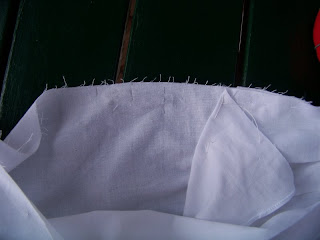

Photo: Basting the second to last ruffle away from the edge that will be seamed. The pencilled lines mark the last ruffle as well as boning channel number 5. Note that had I caught the lower edge of the ruffle in with the seam, I couldn't have sewn the last ruffle on properly.

Because you have all the ruffle layers and boning channel layers and so on at the seam edges when you sew the side seams, it's a good plan to smooth everything into place and pin it so that nothing bunches up when you sew the side seams.


Photo: Stitching one of the side seams. Note how I have the layers of fabric pinned to hold them in place, so they won't creep and get caught in the stitching by mistake.

Here are the front and back of the seamed-up bustle! After these photos were taken, the next steps were to add the final boning channels and to pleat the waist and apply the waistband.

Photo: back of the seamed-up bustle.


Photo: front of the seamed-up bustle. Note that the placket is right at center front.

Adding the Final Boning Channels and Waistband

This was straightforward, with nothing out of the way to worry about.

Adding the Boning

Uh-oh, here is where I had my -- temporary -- Waterloo. As I wrote the folks at Truly Victorian:

Dear folks,

Am so proud of my new bustle, but it's a tad deflated...the bustle, I mean...because the top 4 bones refuse to go in!

Left a 3/4" opening (actually, a little more) per row as directed, but not necessarily at near the outer edge of the rows of boning channels.

So when I go to put in the bones, said bones aren't flexible enough to bend to the degree needed to worm the second end into the channel after the first end is set in: the bone gets into a tight U shape and the fabric gets so tight that nothing goes anywhere. I rather dented bone #1 trying to get it to go in, for example, and have really stressed the bustle stitching there :}

What do I do?

Close up the current openings and open some stitching down near the end of each row? That's rather where the picture has the opening set but at the time, I didn't pay exact attention.

Yipes!!


Heather wrote back:

Yep, sew up the hole you have, and make a new one at an end of the chanel. It's the only way to get them in. Actually, you probably don't even need to sew the old one up. The bone won't slip out, just like you can't get it in. So rip a few stitches out on the end, slip the bone in, and stitch it back up again.

I know there is another pattern out there that has you leave a hole in the middle. But that doesn't work, and people have told me about their trials with the idea.


So, that's what I did. Now the bustle is completed (except for a bit of seam finishing, a hand-sewing project), and I am very, very happy with it.

The Completed Bustle

Here's the front of the bustle:


The bustle fabric isn't particularly stretched tight over the hoops, and that's as it should be, says Heather. She says ease is necessary, so that the hoop lines won't be prominent and liable to show through the outer skirt.

Here's a side view:


Here's a back view:

Phew! Now, on to a petticoat...

Saturday, August 23, 2008

A Brief History of the Dolly Varden Dress Craze

Rosy Dolly, Pretty Dolly

“After a long and patient contemplation of the golden key, and many such backward glances, Gabriel stepped into the road, and stole a look at the upper windows. One of them chanced to be thrown open at the moment, and a roguish face met his; a face lighted up by the loveliest pair of sparkling eyes that ever locksmith looked upon; the face of a pretty, laughing, girl; dimpled and fresh, and healthful—the very impersonation of good-humour and blooming beauty.” (Charles Dickens, Barnaby Rudge)

Here we first meet the progenitor of one of the more well-known fads of the nineteenth century, the 1872 craze for the pretty Dolly Varden. The red-lipped, flirtatious, locksmith’s daughter who attracts men to her like bees, Dolly was probably the most memorable character of Charles Dickens’ Barnaby Rudge, which first appeared in 1841. The novel, Dicken’s first of two historical novels, is set during the anti-popery riots of 1780.

Painting: "Dolly Varden", William Powell Frith,
circa 1842-1849. Tate Gallery, London.
In her cherry-colored hat ribbons and bright polonaise dresses, she was a reader favorite, and a favorite of her creator, too, who kept a portrait of her in his home. I am only guessing, of course, but the London’s Tate Gallery holds a portrait of Dolly Varden flirting with the viewer in her red ribbons, painted by Dickens’ friend William Powell Frith, after the book was published: maybe this is the same painting?

Dickens passed away in 1869, but a few years later, the sale of his property, including his portrait of Dolly Varden, aroused enormous public interest in the character (see p. 261, Cunnington, Cecil Willett, English Women's Clothing in the Nineteenth Century: A Comprehensive Guide with 1,117 Illustrations. Courier Dover Publications, 1990). By early in 1872, the name "Dolly Varden" was being applied to all sorts of things. Of course there was the dress style and beflowered dress fabrics. There was the hat, too, a beribboned forward-tilting straw affair, and a parasol (Fort Wayne Daily Sentinel, April 20, 1872). There were Dolly Varden paper dolls. A New York dry goods store opened and titled itself the “Dolly Varden Store”. It went bankrupt a few years later. (See NYT, The “Dolly Varden Store”: An Interesting Bankruptcy Case—Statement of the Assignee”. January 7, 1876.)

Sheet music cover: a young girl 
wearing a Dolly Varden dress. 
"Dolly Varden". Words by Frank 
W. Green; music by Alfred Lee. 
Philadelphia: Lee & Walker, 
between 1872 and 1875. From 
Keffer Collection of Sheet 
Music, Penn Library, 
Department of Special Collections.

Products galore were named for her. “The Dolly Varden Polka”, and other music, note paper and envelopes (Boston Daily Globe, May 6, 1872), cigars (see http://www.civilization.ca/tresors/cigares/cigarbox027e.html, oh, and cakes, and poetry. More on that later.

The name made its way farther afield, too: A mine in Nevada opened and was named the Dolly Varden; an explorer of the Dakota territories, Julius Chambers, gave the moniker to his canoe and also to a lake; a political party took up the name; and famously a woman accompanying fishermen on expedition spotted a pink-spotted char and compared it to Dolly Varden; the fish has sported the name ever since. There was even a race horse named for her: she ran at Prospect Park, noted the New York Times in October of that year.

Let's not forget the cake. Do see one of two of the earliest recipes I could find online for it, dated 1881, in Emma Whitcomb Babcock's Household Hints (p. 54).

Dolly Varden in 1872 Fashion: Popular, but Perhaps Too Popular

In Barnaby Rudge, Dolly Varden is described as wearing rather colorful, even flashy clothes. Do a search of the Gutenberg.org online text of the story, and you'll see what I mean.

The craze apparently started sometime very early in 1872.

[Author's note, as of 07/22/09. Actually, it appears to have started earlier. Harper's Bazar mentions stylish ladies at the races wearing the new fashion, which, the magazine reported, featured colorful cretonne fabrics: "At the Fordham races some leaders of fashion wore " Dolly Varden" costumes of the gay cretonnes lately described. One worn by a brunette was a buff ground, with large chintz figures of brilliant colors, made with a polonaise trimmed with ecru lace and black velvet; others had black or white grounds, with gay-colored flowers and palm leaves. The polonaise had revers in front, was without drapery behind, and was trimmed with white duchesse lace and Swiss muslin pleatings. Wide-brimmed Leghorn hats were worn with cretonne suits. (Harper's Bazar, July 15, 1871. "New York Fashions.").]

Photo: Dolly Varden style parasol on Corsets and Crinolines site.
From the Portsmouth Times, Saturday, April 13, 1872.
Articles about store openings--debuts of seasonal collections, for example--printed in the Times and small papers alike became chock full of mentions of Dolly Varden fabrics and stylings. For example, the Wednesday, March 29, 1872 issue of the Times describes the following dress prominently displayed at the Lord & Taylor opening:

…(A) Pompadour Dolly Varden of black silk cut in diamond-shaped scallops (sic), these finished with a satin piping of canary and white, with an elegant sash of satin and gros grain, relieved by delicate bouquets of flowers, elicited the admiration of every visitor, being at the same time the most chaste and elegant polonaise at the exhibition. Dolly Varden predominated in all goods—in the flowing robe de chamber as well as in the graceful, jaunty costume that an old lady innocently designated as the “Enoch Arden.” Foulards, challies, silk muslins, grenadines, piques, lawns, prints, were exhibited in profusion and in exquisite taste.” (LORD & TAYLOR'S OPENING.; Brilliant Display of Goods, Crowds of Visitors and Buyers)

“Dolly Varden to the Rescue. ALL the fashion writers inform us that the Dolly Varden style of dress is to be the rage the coming summer. Every- body who has read knows that Dolly Varden, the sweet daughter of a London locksmith named Gabriel who lived in the days of George III…”
For those who hadn’t read the novel, the Portsmouth Times, among other papers, gave them the background information they needed to make a good purchase.

They rather needed to:

NELLY—Well, then, my Dolly Varden and your walking-suit will see the light together.
MARY—You mean thing, you—to have kept it all to yourself. That’s what I call real selfish.
JULIA—What was Dolly Varden?
NELLY—I don’t know—never thought of it. Varden sounds French.
MARY—No it ain’t. It’s one of SHAKESPEARE’S heroines. I asked Uncle George about it, and if it wasn’t in BYRON, or WALTER SCOTT, or somewhere, and he laughed at me. Just as if I should know.”
NELLY—I’ll find out when I go to the milliner and try on that hat. Such a dear cocked up little conceit of a thing, with a bunch of straws and butter-cups in it. You could most eat them.
MARY—They are, I’m afraid, likely to be common, and in ten days between a Grand-Street bonnet and a Broadway one, you won’t be able to find a shred of difference. It’s getting harder and hard every day to be exclusive, ma says so, and declares that the only chance now is for us to import WORTH”.
("The Minor Comedy". NYT, April 21, 1872.)

Ouch. If you read the rest of the article, it’s even ouchier. The Times was having a good poke at the nouveaux riches. Nota bene: Worth was a carriage-trade French couturier, with the patronage of queens and duchesses, Astors and Vanderbilts, but, of Smiths and Jones too. The color of money was all he needed to see, though he didn’t advertise it.

Song sheet Cover: "Dolly Varden". Music by H. Werner, words by F. Wilson. In this drawing the young woman is wearing a rather untrimmed, flowered Dolly Varden polonaise with plain "petticoat-style" underskirt at the seaside, a fashionable venue for wearing this sort of ensemble. Library of Congress.

Music sheet cover. "Dolly Varden Polka" 1872. A fashionable young miss in her Dolly Varden ensemble, giving a good view of the tilted hat. Her flowered dress is obscured by a plain mantle or shawl. Library of Congress.
What did the popularity stem from? Scribner’s Monthly (V 4, Issue 2, p. 248) had its opinion:

"At the mere mention of Barnaby Rudge, the locksmith’s pretty daughter stood before us. Strange that we could have forgotten her,—the sweet, fresh, jaunty English lass, trim, neat and coquettish, with her bright quilted petticoat, and her gown caught up daintily and pinned at the back. The locksmith’s daughter, as we know, was no heroine. She advocated no great public principle, suffered in no noble cause. She was just a good, pure, everyday girl—and that is why we love her. Her name is a character in itself. All Dickens’s names are. It means freshness and spring-time and guileless dressiness. And so Dolly Varden is made the presiding genius of the dry-goods world to-day."

In England, the fashion seems to have been a primarily middle-class phenomenon, carefully eschewed by ”the best people” in the upper echelons of society, as Cunnington put it.

By later in the year, writers stateside were feeling the same way. In "LONG BRANCH.; A Summer Evening at the Sea-Side-- Every-Day Life--Miss Dolly Varden" (July 12, 1872), a column by the Times’ “our own correspondent” commenting tartly on summer life at that popular summertime destination, was finding the fad overwhelming, on the way out, everything but the hat a fashion failure:

“And then, bathing, too, gives them the opportunity of wearing their Dolly Varden hats, what are by no means unbecoming to certain faces. Thank heaven that inexorable ruler—Fashion—has decreed the downfall of every other part of Miss Dolly Varden’s costume. Very few are now to be seen, and somehow or other they are all failures.”

Novelists of the early 1870s picked up on the fad in their stories. In Phemie Frost’s Experiences, our heroine, staying with her more fashionable cousin, sees the latter open her trunk, “that seemed to be overrunning with poppies, marigolds and morning-glories, and, giving something of a jerk, brought up a puffy, short gown of white muslin, blazed all over with great straggling flowers—the morning-glories, poppies, marigolds that I had seen bursting up from the trunk.” (p. 315)

Phoemie’s gut instinct is to find the thing a bit much, but she is won over by the pannier puffs at the back and the idea of wearing a garden. Coaxed and abetted by her cousin, she soon has one of her own:

‘ ”Does the dress suit? For we have no time to throw away,” says she [the cousin].

“Suit,” says I, turning round and round with slow enjoyment of that queenly figure in the glass. “Of course it does. Why, cousin, it is superb; the bunching up is stupendous. Then the pattern—a whole flower garden in full bloom.” ‘
(p 319)

Our Young Folks took the opportunity in August to publish a morality tale about a young lady named, naturally, Dolly, who with such a pretty Dolly Varden dress on, takes off to the fair and acts out like, well, her namesake, with the expected result of any morality tale, she gets into trouble. It's actually a charming little story, with the most charming little sky-blue dress. Do read "Dolly Varden", if you have a chance.

Magazine editors had their fun:

“Apropos of the Dolly Varden style of raiment, so much talked of in the present era, we have seen no description of it so succinct and clear as the following: ‘the starboard sleeve bore a yellow hop-vine in full leaf, and on a red ground, with numbers of gray birds, badly mutilated by the seams, flying hither and thither in wild dismay at the approach of a green and black hunter. An infant class was depicted on the back; and in making up the garment truant scholars were scattered up and down the sides and on the skirt; while a country poultry fair, and a group of hounds hunting, badly demoralized by the gathers, gave the front a remarkable appearance. The left sleeve had on it the alphabet in five different languages. ‘ ” (“Editor’s Drawer”. Harper's New Monthly Magazine. / Volume 45, Issue 267, p. 478.)

There was plenty more humorous comment along those lines, if a search of newspapers is any guide.

By November, the fad was blowing itself out: “How fickle is fashion…poor Dolly, her reign was short, the devotees have all forsaken her. (The Petersburg Index, November 25, 1872.)

The Fashion, Dissected

Dictionaries and other reference sources appear to have forgotten the scope of the fad. Merriam Webster's Encyclopedia of Literature (Springfield, MA: Merriam-Webster, 1995), for example, styles it thus:

“Dolly's memorable costumes led to the naming for her of a style of 19th-century woman's ensemble consisting of a wide-skirted, tight-bodiced print dress worn with a white fichu (light triangular scarf) and a flowered hat with wide, drooping brim. She was also commemorated in the brightly colored Dolly Varden trout.”

As the quotations in the last section intimate, this description is a little simplified. As with many fashion crazes, manufacturers, retailers, and dressmakers applied the term very loosely indeed, likely with the idea of increasing sales volume. Go to a mall or big box store today and you’ll see the same thing: “menswear-inspired” sure covers a lot of ground…

To be Dolly Varden style, a fabric generally, but not always, featured an eighteenth century chintz-like floral pattern on a colored ground; the fabric itself varied from muslins and batistes to silk foulards and wools:

"The Dolly Varden foulards are very fashionable for house wear, and come in rare and beautiful designs, and very gay colors. The edge of flounces on dresses is cut in points or scallops [sic], and bound- with silk a shade darker than the material."(Fort Wayne Daily Sentinel, March 26, 1872)

Here’s the Sentinel again, on April 20th: “Dolly Varden Sateens, Dolly Varden Chintzes, Dolly Varden Percales, Dolly Varden Reps, Dolly Varden Alpacas, ...”

As for the dress? Of all the fashion history sources I’ve read, Cunnington’s book best dissects the look:

“The Dolly Varden, of chintz or cretonne over bright silk petticoat, either plain, flounced, or quilted. Later, for winter, the Dolly Varden may be of fine flannel or cashmere printed in chintz pattern, with black silk, satin, or velveteen petticoat, often quilted or lined with eiderdown.” (p. 262)

Yet for every generalization there’s an exception, and as Cunnington himself had pointed out time after time, nineteenth-century fashionistas threw terms around very loosely. In April, the NYT wrote of another grand store opening:

“An exquisite peach bloom gros grain silk, with Dolly Varden polonaise of the same shade in striped satin, cut in blocks and finished with fringe, combining all the colors of the costume, double sash of silk and wide Spanish lace, competed a toilet that was absolutely perfect. A pearly Dolly Varden, court train, was gracefully paniered over a pale blue silk petticoat [underskirt, not today’s use of the term for slip], rendered still paler by rich falls of Duchesse lace, and finished with salmon colored bows.” (“ARNOLD & CONSTABLE'S OPENING.; Grand Display of Spring and Summer Goods and Styles”. April 4, 1872)

No florals in these ensembles, unless perhaps the lace...

The hat, yes, the hat. Here’s the Times correspondent, writing in March: “..a Dolly Varden hat of white chip [straw], canary colored ribbons, pink and blush roses, coquettishly turned-up brim…” ("LORD & TAYLOR'S OPENING; Brilliant Display of Goods; Crowds of Visitors and Buyers." March 29, 1872)

Let’s look at some fashion plate examples:

This is a Dolly Varden carriage costume from Harper's Bazar, May 11, 1872. (From NYPL Digital Collection, #803909).


Here is a Dolly Varden house dress from Harper's Bazar, March 23, 1872. (From NYPL Digital Collection, #803737).

Please also have a look at the glorious Dolly Varden walking suit in Stella Blum's Victorian Fashions and Costumes from Harper's Bazar, 1867-1898, if you have a copy. If you don't, see the Google Books version.

Sadly, only one of the three fashion plates, the last one, features the fashionable floral fabric, and you must look very carefully at the front view to see the patterning. Certainly florals would something to depict easily in an already very busy fashion plate, but the plates do show just how wide a variety of stylings fit under the Dolly Varden umbrella, or should I say, parasol?

Considered together, the pictures above show that the Dolly Varden fashions were interpreted loosely and drew on trim ideas common during the period. A few elements, however, seem to have been particularly common:
  • Use of 18th century type fabrics: stripes with florals, especially on bodice/polonaise.
  • In many but by no means all cases, underskirt was plain or quilted (the latter to imitate 18th century quilted petticoat convention.
  • Use of a polonaise, although as Cunnington states, early versions of the polonaise in this year could be constructed with a separate bodice, with basques in front and short ones in back, and a separate tunic overskirt, long in front and short and puffy in back.
  • Sleeves ending in 18th century style flounces.
  • Forward-tilting, decorative straw hats.
  • Self-fabric ruching and similar 18th century style trims, although these were pretty universally used on dresses during this time.
In case you’re wondering about polonaise construction:

"Another form of dress was the polonaise, after the looped up dresses of the eighteenth century. It was really a bodice and overskirt combined. The polonaise bodice was similar to the usual form but was continous with its overskirt, which was drawn up in swathes by internal ties. Beneath it, an underskirt was worn which could be trained or not. The polonaise was usually cut like a princess dress, without a waist seam, and often differed from it only in that it was not full length. The underskirt was essential, as it had been for the looped up walking dresses of the 1860s and it often ended in a frill or kilted edging. One form of the early 1870s polonaise costume was the Dolly Varden dress. This consisted of a floral cotton polonaise over a plain, brightly coloured skirt of walking length, and worn with a straw hat, perched forward on the high coiffure. It was a charming, girlish, eighteenth century style costume, beloved of ordinary Englishwomen, and not of Society ladies. Most fashionable 1870s costumes were more mature, sophisticated and decidedly Parisian." (“Fashion in the 1870s and 1880s”. The Ladies' Treasury.)

In Closing, a Little Poetry

Dolly leaves you now on a lyric note:

"Dolly Varden”

By Bret Harte (Francis)

Dear Dolly! who does not recall

The thrilling page that pictured all

Those charms that held our sense in thrall

Just as the artist caught her,

As down that English lane she tripped,

In bowered chintz, hat sideways tipped,

Trim-bodiced, bright-eyed, roguish-lipped,

The locksmith’s pretty daughter?


Sweet fragment of the Master’s art!

O simple faith! O rustic heart!

O maid that hath no counterpart

In life’s dry, dog-eared pages!

Where shall we find thy like? Ah, stay!

Methinks I saw her yesterday

In chintz that flowered, as one might say,

Perennial for ages.


Her father’s modest cot was stone,

Five stories high; in style and tone

Composite, and, I frankly own,

Within its walls revealing

Some certain novel, strange ideas:

A Gothic door with Roman piers,

And floors removed some thousand years,

From their Pompeian ceiling.


The small salon where she received

Was Louis Quatorze, and relieved

By Chinese cabinets, conceived

Grotesquely by the heathen;

The sofas were a classic sight,

The Roman bench (sedilia hight);

The chairs were French in gold and white,

And one Elizabethan.


And she, the goddess of that shrine,

Two ringed fingers placed in mine,

The stones were many carats fine,

And of the purest water,

Then dropped a curtsy, far enough

To fairly fill her cretonne puff

And show the petticoat’s rich stuff

That her fond parent bought her.


Her speech was simple as her dress,

Not French the more, but English less,

She loved; yet sometimes, I confess,

I scarce could comprehend her.

Her manners were quite far from shy.

There was a quiet in her eye

Appalling to the Hugh who’d try

With rudeness to offend her.


“But whence,” I cried, “this masquerade?

Some figure for to-night’s charade,

A Watteau shepherdess or maid?”

She smiled and begged my pardon:

“Why, surely you must know the name,

That woman who was Shakespeare’s flame

Or Byron’s, well, it’s all the same:

Why, Lord! I’m Dolly Varden!”

From http://all-poetry.net/p.php?pdid=8805

And…

There is a man in our town,

He is an awful hard 'un;

He actually refused to buy

His wife a Dolly Varden.

The dame she ripped [sic?],

The man he swore

he'd surely have to end her,

When straightway off the hussy went

Upon a Grecian bender*.

A sight so sad made him so mad,

He tramped down all the garden-

He then cooled down and went to town,

And bought a Dolly Varden.

May 2, 1872, The Decatur Republican (Illinois)


*One tiny note: get the pun? The Grecian bend was a popular stance women took at this time, slightly bent forward. Read about in Cunnington.

________________________________

Addendum, March 21, 2011. How interesting. Just found out that the Wikipedia entry about the Dolly Varden costume links to this article. Neat!

Thursday, August 21, 2008

Edwardian "Lingerie" Dress Diary, Part 4: Skirt Seaming


Last weekend the Edwardian lingerie dress lurched further towards completion: I seamed the skirt. The bodice would have been completed but I hadn't brought the sleeve pattern along with me for my sojourn at my mother's house, so it still lacks sleeves.

As a reminder to readers, I used Jennie Chancey's Sense and Sensibility Beatrix skirt pattern, trained view. I added four inches to the top of each piece to get the Edwardian version of the Empire look. Because linen frays so easily, I used french seams.

Photo: the skirt all seamed except for the final seam that draws it together.

Here is the skirt placed with the bodice. Even with the distortion introduced by the camera lens angle, the high-waisted proportions of the dress are apparent. Here's hoping that this will help pull off the elongated, willowy silhouette I am seeking!

Monday, August 18, 2008

A Midcentury Chemise: Dress Diary

Just ended, a marathon session to make a mid-nineteenth century style chemise. I am wearing the end result as a nightgown and it's very comfortable. The chemise features tucks on the neckband, soon to be ornamented with tatting, and hand-sewn and stroked gathers and flat-felled seams. It's made of a crisp 200-c0unt cotton muslin. I drafted the pattern using the instructions on Elizabeth Stewart Clark's site, a process which took less than an hour all told, and was very straightforward. Made of only five pieces (front, back, two bias sleeves and a neckband), the basic seams and the tucked neckband were sewn and felled in about two hours. I did make two mistakes:
  • I did not sew each sleeve and side seam as a single seam, which means that I have awkward joins in the felled seams at that point.
  • Although I added 3/4 of an inch for three quarter-inch tucks to the 2-inch wide neckband, I didn't account for fabric thickness, and although I wanted the tucks to sit right next to each other, there was still a need for perhaps another quarter inch. Then too, I set the lowest tuck too close to the neckband seam. As a result, parts of the lowest tuck were caught in that seam when I handstitched that this afternoon. The error will be hidden by tatting soon.
Hand-sewing small tight gathering stitches in two rows took about an hour and a half, and arranging the gathers and stroking them perhaps another half hour, and hand backstitching the neckband to the gathers (1/2 inch seam allowance) another hour. To help each gather remain in place, I stroked most of them a second time right before passing a backstitch over each...almost every gather is backstitched in place; that seam is NOT coming out. Trimming the neckband seam and hemming down the band to the inside of the chemise took another two hours, due to another mistake. That neckband was so narrow due to the tucks that it wasn't wide enough to cover the gathers on the inside. I had to cut a facing strip (straight of grain because I wanted to use the selvage) and hem the top long edge to the band and overhand the bottom long edge to the chemise. Yes, I should have cut a bias facing strip, but the process had already taken a lot of time...perhaps the chemise band doesn't lay flat as it should, but for a first chemise for this period, I am happy. Then I hand-stitched the sleeve seam and hand felled it, and hand-hemmed the sleeve edges (another two hours) and the chemise was complete. The machine you see in the picture at the top? That's what I used for the machined seams in this project. It's a vintage Willcox and Gibbs electric chainstitch machine from the first half of the twentieth century. The machine is so pretty and in pristine, bran-span-new, mint condition and very smooth. One does have to think before seaming, since there is a right side and a wrong side to the stitching, and one MUST match stitch length to thread type and fabric weight, and one has less control of speed of stitching than on a treadle, but still, it was a true pleasure to use. Thank you, Miz Johnny, for loaning it to me while I sojourn at my mother's house this week! I will add more pictures tomorrow, but in the meantime you can see them on my Photobucket account at http://s83.photobucket.com/albums/j306/ZipZIpInkspot/

Friday, August 15, 2008

Edwardian "Lingerie" Dress Diary, Part 3: Applying Bodice Trim and Neckline Facing


After some reluctance and delay due to the perceived difficulty of the task, delay that stretched into months, I have at last applied the lace insertion and trim to the Edwardian lingerie dress bodice. After a much shorter delay, I followed up by facing the neckline.

Photo: Bodice with applied insertion, torchone trim, and faced neckline.

The Lace Insertion

The lace insertion process turned out to be both more and less hard than I thought. Setting the position of the wide lace insertion was strightforward: I just followed the shoulder bretelle line for the vertical bands, while the horizontal band followed the high waistline marking. See the XXXXX posting for details.

Once the lace had been positioned, I sewed it to the bodice. This took several steps because the lace is period and was cut by a previous owner from a dress. First I had to cobble together short lace pieces. To do this I either trimmed the edges and whipped them together or seamed them with a narrow seam.

Then I applied the lace to the dress. In most cases this meant turning under the raw side edges, raw because they'd been cut from the dress. In other cases the cuts were so close to the edge of the lace or in fact into the lace itself that all I could do was sew the lace down straight.

After this, I stitched the bodice fronts and backs together with French seams.

This is when I discovered, to my horror, that the lace was of slightly different widths! How that hadn't been apparent before I have no idea, and it was a truly embarassing revelation. Now I had abutting sections of lace, in several places, that were of different widths. I was forced to sew tiny scraps to the sides of the narrower pieces close to where they abut the wider pieces, to give the illusion of matching lace...the scraps could in no way be matched to the already applied lace, so if you look closely, you can see what's been done.

When the dress is more complete, I will remove the bodice fabric from behind the lace insertion and hem down the raw edges.

After the insertion was applied, I hand-backstitched narrow modern Torchon edging lace over the stitching. I took tiny stitches on top, larger ones on the bodice's reverse. On the right side, the stitching doesn't show at all in most places. The edging gives the garment some nice shadow lines.

I chose the Torchon because its coarseness fits well with the large stitching on the insertion lace and the coarseness of the linen bodice fabric. To make it look less dead white, I dipped it in very weak coffee, then rinsed it. The dye didn't take evenly, and gives the result a slightly creamy, aged effect.

Photo: Applying the Torchon lace to the edge of the insertion.

Facing the Neckline

This was simple. Jennie's pattern instructions were clear: cut a 1.5 inch-facing from the bodice fabric, stitch it right sides together to the neckline, turn in the facing an hem it down.

I cut three facing pieces, one front and two backs, using the squared neckline pattern guide, stitched them together, trimmed the seams, stitched to the neckline as directed, and then carefully trimmed the seams so the facing would lie well. Then I pressed open the seam, then turned in the facing and very carefully pressed it closed so that the neckline was smooth.

Photo: Facing added to neckline. Note squared corner of neckline, but rounded edge of hem.

Then by hand I turned in a quarter inch of facing for a hem and hemmed it down, taking small stitches in single threads of fabric so the hemming would not show on the right side of the bodice. To help the hem lay smoothly around the squared neckline corners, I slashed the corners almost to the neckline stitching, and then trimmed the outer edge of the facing from a squared to a rounded shape. That meant that there were no corners to deal with in the hem.

Monday, August 04, 2008

A Mid-Century Underskirt, Photographed and Measured


My friend Denise picked up what appears to be a mid-century underskirt, as petticoats were known then, and I have examined, measured, and photographed it. It's a lovely thing, the hem being ornamented with hand-sewn eyelet embroidery and scallops.

I took measurements and examined it carefully, and then asked the lovely folks on the Elizabeth Stewart Clark board about it. Sure enough, it's a mid-century underskirt! As Elizabeth explained, the embroidery made it a nice underskirt, but not a high-fashion one; it might even have been worn by a working class woman for Sunday best.

I like the idea that just a few feet from where I sit, lies a petticoat that would have graced the top of a crinoline, and rustled starchily under someone's dress.

Photo: view of mid-century underskirt.

Measurements

Waistband width: 1"


Waistband circumference: 26 3/4"

Depth to the piecing or "yoke":
- left of placket: 2 1/2" to 3" for 3.25" length
- right of placket: 1 3/4" to 2" for 6 1/2" length
- middle: varying width, 3 1/2" to 4" for 16 1/2"

Length front and back: 39"

Bottom circumference: ~154 1/2" (38 1/2 scallops)

Photo: Detail of the eyelet embroidery.

Inside seam width:
- piecing or yoke: 1/4"
- panels: 1/8"

Placket:
- 16 1/2" long
- left side hemmed with 1/8" hem
- right side hemmed with 3/4" hem

Tuck: depth varies from 2 to 2 1/2"

Scallops:
- depth: 1 1/2"
- width: 3 1/2"

Construction


The waistband is folded in half, long ends turned under, and hemmed to the top 1/8" of the skirt. There appears to have been a tape sewn to the placket, but tape is in tatters and partially missing, and one one side of placket it's covered up by a very modern, very poorly sewn waistband patch. I think someone might have worn this for a costume at one point.

The skirt is in four panels. It's tightly gathered at top and each gather is nicely stroked: gathering is even all the way around the skirt. The result is a soft dome shape.

Photo: detail of waistband showing the finely stroked gathers, and wear to the fabric.

The top of the skirt features what I at first thought to be a yoke, and perhaps it is, but the pieces are not even: they vary in depth and length. So perhaps it was pieced...with the piecing being set at the top so it wouldn't be so obvious at the bottom of the skirt or get in the way of the embroidery.

The placket is set into the middle of one panel.

The eyelet work is lovingly down, and appears to be by hand since the positioning of the flowers varies a little and each flower hole varies a little, and the sewing is so very neat by not machine-like.

The hand stitching is even and straight, the waistband hemming nearly invisible, the tuck stitching is more like even tacking.

Condition

The cotton fabric is mostly in strong condition, but the underskirt has seen heavy use. There are several tears in the eyelet at the bottom and a few scallops have torn off. There is a mend at one spot: it looks neat but may be modern, although the thread is cotton. Stresses on the placket resulted in a tear down from the end of the placket to the tuck. The waistband is quite worn and someone added a horrible patch to one end to hold it together. There is no button and the unpatched end is rather shredded.

The stitching is in perfect condition.

You can see more photos on my Photobucket account.

The Queen's Corgi's Scones

Her dogs have excellent taste. These are served every day at the Queen's afternoon tea. Do see the recipe on Kalianne's blog, Bygone Beauty. They are going on my August treats list.

Wednesday, July 30, 2008

The Twins Walk, Tumble, and Babble


When the boys walk, they don't exactly watch where they're going. Crash! Tumble! Regroup! Babble about it all. Oh, and make sure Mama is watching...

Tuesday, July 29, 2008

The Top 100 Books List

According to the BBC, the average adult has only read 6 of the top 100 books on their list. How many have you read? Kalianne at Bygone Beauty posted this meme.

Turns out I've read 51 of the books on the list, more than I thought but less than I'd like.

If you'd like to participate in this meme simply copy the list and follow the instructions below. Don't worry if you haven't read many books - the list is only opinion. Be sure to include the books you'd like to read too and those you think should be struck off the list. Feel free to list books not on the list that you deem worthy. Finally, be sure to post a comment so we know where to find you!

1) Look at the list and bold those you have read.
2) Italicize those you intend to read.
3) Underline the books you love.( I had a hard time underlining so I put starred them)
4) Strike out the books you have no intention of ever reading, or were forced to read at school and hated.
5) Reprint this list in your own blog.

The List

1 *Pride and Prejudice - Jane Austen
2 *The Lord of the Rings - JRR Tolkien
3 *Jane Eyre - Charlotte Bronte
4 The Harry Potter Series - JK Rowling (Strike them. I am not sure these will hold up with time. They are already fading from children's memories. Sudden mass popularity doesn't equal long-term reading.)
5 To Kill a Mockingbird - Harper Lee
6 *The Bible
7 Wuthering Heights - Emily Bronte
8 Nineteen Eighty Four - George Orwell
9 His Dark Materials - Philip Pullman
10 Great Expectations - Charles Dickens
11 *Little Women - Louisa M Alcott
12 Tess of the D’Urbervilles - Thomas Hardy
13 Catch 22 - Joseph Heller
14 Complete Works of Shakespeare (many of them)
15 *Rebecca - Daphne Du Maurier
16 *The Hobbit - JRR Tolkien
17 Birdsong - Sebastian Faulks
18 Catcher in the Rye - JD Salinger
19 The Time Traveller’s Wife - Audrey Niffenegger
20 Middlemarch - George Eliot
21 *Gone With The Wind - Margaret Mitchell
22 *The Great Gatsby - F Scott Fitzgerald
23 Bleak House - Charles Dickens
24 War and Peace - Leo Tolstoy
25 The Hitch Hiker’s Guide to the Galaxy - Douglas Adams
26 Brideshead Revisited - Evelyn Waugh
27 Crime and Punishment - Fyodor Dostoyevsky
28 Grapes of Wrath - John Steinbeck
29 *Alice in Wonderland - Lewis Carroll
30 *The Wind in the Willows - Kenneth Grahame
31 Anna Karenina - Leo Tolstoy
32 David Copperfield - Charles Dickens
33 *Chronicles of Narnia - CS Lewis
34 *Emma - Jane Austen
35 Persuasion - Jane Austen
36 *The Lion, The Witch and The Wardrobe - CS Lewis
37 The Kite Runner - Khaled Hosseini
38 Captain Corelli’s Mandolin - Louis De Bernieres
39 Memoirs of a Geisha - Arthur Golden
40 Winnie the Pooh - AA Milne
41 Animal Farm - George Orwell
42 The Da Vinci Code - Dan Brown (strike it: I do not think this will hold up with time)
43 One Hundred Years of Solitude - Gabriel Garcia Marquez
44 A Prayer for Owen Meaney - John Irving
45 The Woman in White - Wilkie Collins
46 Anne of Green Gables - LM Montgomery
47 Far From The Madding Crowd - Thomas Hardy
48 The Handmaid’s Tale - Margaret Atwood
49 Lord of the Flies - William Golding
50 Atonement - Ian McEwan
51 Life of Pi - Yann Martel
52 Dune - Frank Herbert (strike it. Oh please. The Time Machine would be more appropriate.)
53 Cold Comfort Farm - Stella Gibbons
54 Sense and Sensibility - Jane Austen
55 A Suitable Boy - Vikram Seth
56 The Shadow of the Wind - Carlos Ruiz Zafon
57 A Tale of Two Cities - Charles Dickens
58 Brave New World - Aldous Huxley
59 The Curious Incident of the Dog in the Night-time - Mark Haddon
60 Love In The Time Of Cholera - Gabriel Garcia Marquez
61 Of Mice and Men - John Steinbeck
62 Lolita - Vladimir Nabokov
63 The Secret History - Donna Tartt
64 The Lovely Bones - Alice Sebold
65 Count of Monte Cristo- Alexandre Dumas
66 On The Road - Jack Kerouac
67 Jude the Obscure - Thomas Hardy
68 Bridget Jones’s Diary - Helen Fielding (strike it: I do not think this will hold up with time)
69 Midnight’s Children - Salman Rushdie
70 Moby Dick - Herman Melville
71 Oliver Twist - Charles Dickens
72 Dracula - Bram Stoker
73 *The Secret Garden - Frances Hodgson Burnett
74 Notes From A Small Island - Bill Bryson
75 Ulysses - James Joyce
76 The Bell Jar - Sylvia Plath
77 Swallows and Amazons - Arthur Ransome
78 Germinal - Emile Zola
79 Vanity Fair - William Makepeace Thackeray
80 Possession - AS Byatt
81* A Christmas Carol - Charles Dickens
82 Cloud Atlas - David Mitchell
83 The Color Purple - Alice Walker
84 The Remains of the Day- Kazuo Ishiguro
85 Madame Bovary - Gustave Flaubert
86 A Fine Balance - Rohinton Mistry
87 *Charlotte’s Web - EB White
88 The Five People You Meet In Heaven - Mitch Albom
89* Adventures of Sherlock Holmes - Sir Arthur Conan Doyle
90 The Faraway Tree Collection - Enid Blyton
91 Heart of Darkness - Joseph Conrad
92 The Little Prince - Antoine De Saint-Exupery
93 The Wasp Factory - Iain Banks
94 Watership Down - Richard Adams
95 A Confederacy of Dunces - John Kennedy Toole (read part of it: not top drawer. Strike it.)
96 A Town Like Alice - Nevil Shute
97 *The Three Musketeers - Alexandre Dumas
98 *Hamlet - William Shakespeare
99 Charlie and the Chocolate Factory - Roald Dahl (strike it: not top drawer)
100 Les Miserables - Victor Hugo

I didn't strike that many books, not because I feel they should be included, but because I wasn't familiar with them and couldn't comment.

Books I feel should have been included: most are part of the most basic fabric of our Western culture!

1. Homer: The Odyssey
2. Homer: The Iliad
3. Mark Twain: Huckleberry Finn
4. Patrick O'Brian: Aubrey-Maturin series
5. Anthony Trollope: Phineas Finn
6. Nathaniel Hawthorne: The Scarlet Letter
7. John Milton: Paradise Lost
8.
Goethe: Faust
9.
Thomas Malory: Le Morte d'Arthur
10.
Geoffrey Chaucer: Canterbury Tales (I've read parts)

Sunday, July 20, 2008

Scaled Drawings of American Regency Garments Available!


Polly, a delightful friend, and fellow period fashion admirer, had the good fortune to attend a Jane Austen festival in Louisville a week or so ago. There was a fashion show, and many of the reproduction garments shown were based on Jennie's patterns, or Janet Arnold's Patterns of Fashion, or similarly scholarly resources, or from scaled drawings taken of actual garments in museums in the eastern U.S.. Polly thoroughly enjoyed the fashions.

Photo: Scaled drawing of Early Ohio Regency dress from the Ohio Historical Society collection. On The 19th U.S. Regiment of Infantry site.

They have made the scaled drawings available to all, a gift for which we should be truly grateful! There are scaled drawings for a 1795 day dress, three day dresses, and a wedding dress from 1800-1820s. There are also a ca. 1800 brassiere pattern, stays and child's stays, and a full apron. Most of the patterns have detailed photos of the original garments to go along with them. There are photos only of several other dresses and a pretty chemise from about 1820 that's lace trimmed and has a ruffle (!!), and at the fashion show the presenters promised to make more scaled drawings available.

One could make up garments from the drawings, with some work, or tweak Jennie's patterns, and I love the fact that you have so many photos of the exteriors and interiors of the dresses.

The drawings are on the The 19th U.S. Regiment of Infantry reenacting unit site, at http://www.19thus.com/. See the Women's Clothing section at http://www.19thus.com/WomensClothing.html.

Photo: Reenactors at an event in New Orleans, 2005. On The 19th U.S. Regiment of Infantry site. Their ensembles are very nice indeed.

Thursday, July 10, 2008

I've Fallen in Love with a Horse


A horse breed, to be specific. Today I met my first Missouri Fox Trotter horse, a sorrel horse with lots of "chrome", meaning he had a flaxen mane and tail. He was sweet-natured and gentle, obviously enjoyed running up and down the meadow as his rider shot balloons with shotgun and pistol, and skewered iron rings onto his saber, or whacked at polo balls, made nothing of all the people around him, the noise of sabers, shotguns and pistols, and had the most marvelous, smooth motion.

Photo: Foxy's Red Ruby, a mare. See Arkansas Foxtrotters for more about her. This is not an exciting picture, and she is heavier than the horse I saw today, but you get an idea of the general looks.


Where were we? Why, the Ashland Estate Family Festival of Nineteenth Century Kentucky Life. There were two riders showing battle training, and picnicers in crinolines, cows and baby goats, sheared sheep with their proud owners, women demonstrating spinning and weaving, a man with a 1917 generator with big glass fluid-filled batteries running antique saw-blade cutting and sanding machines and a saw, men playing banjos and guitars, and much more. Our boys enjoyed the livestock, and Christopher's eyes gleamed and his dimples shone for half an hour straight over the horses and their riders demonstrating their skills.

Oh, I fell in love with that horse all right, asked about him, and his owner told me his breed, and this evening I looked it up. Sure enough, a popular pleasure horse, with a smooth, diagonal "Fox trot" gait, famous for being gentle and alert, surefooted and thus popular for trail riding, and not overbig. A family horse. The breed comes in all color combinations, too, but I loved the warm reddish color and that golden mane...just breathtaking!

Oh my, someday, just maybe? Perhaps I dream, but dreams are fun, too.

For more about the Missouri Fox Trotter, see their association site.

Wednesday, July 09, 2008

Creating Full Ostrich Plumes


It turns out that usually rich-looking, full and fluffy and curled antique ostrich plumes are not single bird feathers, but sewn-together combinations of multiple feathers.

As stated in the 1928 book The Nu-Way Course in Millinery and Hat Design,

The single plume is used very rarely for a trimming. The full, thick ostrich plume is made up of one feather of which the quill is perfect, built up underneath with less perfect feathers to give the required weight. The feathers are bleached and dyed, then starched, and finally curled.

Further, the 1922 book Millinery says,

Willow plumes were very popular a few years ago. Each tiny feathery fiber is lengthened by having several lengths of the same kind knotted to it, a tedious, fine, hand process. The result is a plume with long, sweeping feathers.


The art of creating these so-full plumes is not lost. See Lynn McMaster's costuming and pattern site for her page on developing nice, thick plumes from several thinner ones, then curling them to taste: Joining, Shaping, and Curling Feathers. This will not create a willow plume, but then, I am not sure many of us would like to spend hours knotting tiny bits of feathers.

Read more about trimming with ostrich feathers from these sewing manuals on the VintageSewing.info site:

Wednesday, June 25, 2008

At the Beach

This week the twins have tasted ocean water, eaten sand, splashed in waves big and small, played with their older cousin, and have been held by relatives galore. And they have been delighted. Being one year old is fun, they say!