Friday, October 28, 2011

Spenceration: The Hive Mind Speaks and We Have a Rough Plan

Start with lapels
and sleeves.

Thank you all for considering the spencer issue...with your help, we have a solution.

Here it is:
  • lapels, from the blue wool spencer, because they look so good, but a little smaller than the 1794 example, so they won't look silly for evening wear
  • sleeveless base, to take care of Kentucky summertime ridiculous heat
  • optional add-in sleeves, from the blue wool spencer, to take care of the cooler seasons
  • optional add-in epaulettes in gold braid to hold up the sleeves
  • trimmed at the cuffs and around the collar with chenille embroidery in a Neoclassic design, to complement the add-in epaulettes, in a faintly military style -- a takeoff on your Museum of London pelisse trimming, Mrs. C :}
  • made of my existing 1.5 yards of periwinkle silk, so that I don't have to spend for fabric
  • Add the "body".
  • sewn with yellow silk sewing thread to add some pop to the seams (see Nineteenth Century Fashion in Detail for an example)
All I have to spend any money on is for chenille embroidery "thread", and some braid, and yellow silk sewing thread, to add some pop to the seams.

Next, Planning the Project Execution

Let's do this right, and have a proper plan:
  1. Examine extant garments, and check written sources in diaries and magazines. This refines understanding of how the garment is worn, constructed, and trimmed.
  2. Search for extant chenille trimmings. I already have a pretty decent idea but want to show you pictures.
  3. Get chenille in soft yellow from Hand Dyed Fibers. Get yellow silk thread (check Mary Corbett's Needle 'n Thread for best source: it could be Hedgehog Handworks.
  4. Design a Neoclassic embroidery pattern.
  5. Find braid or use chenille to make it.
  6. Work up toile in muslin and refine fitting over the dress, especially the sleeves.
  7. Take the toile pieces, and draw them on the silk.
  8. Draw the trim design in pencil on the silk. Do not cut the pieces. This is how I understand 18th century embroiderers would have worked.
  9. Stretch the silk in a hoop, and work the embroidery*. I do not have a proper "slate" stretcher such as would be best for such a project, but embroidery hoops galore, so there you are.
  10. Cut the linen lining, cut the pieces.
  11. Construct the body and sleeves.
*Eighteenth Century Embroidery Techniques has a chapter of how-to that can help teach you, and see also Maureen's Vintage Acquisitions blog article titled Using Silk Chenille for an illustrated tip on handling the chenille thread.
So there is my wintertime project: small, portable, but rife with social history research opportunities, and incorporating the chance to bone up again on an old favorite skill, embroidery.  Plus, pretty summery silk, but warm fluffy chenille.
Apply it to collar, fronts, sleeves, as here.

Now that was a pleasant effort as a lunch break during an especially busy work day. So nice to think of something entirely different from work-work, housework, house projects, and children.

Wednesday, October 26, 2011

Spenceration

I need a spencer. Okay, I don't "need" a spencer, but as I develop at 1790s-early 1800s set of garments, a spencer, or a garment with some spencer-like features, would be a next likely project candidate.

Done well, it could be convertible, used in multiple situations:
  • if a lapelled spencer, with my little white wrap-front dress as morning dress; then with a matching skirt, and a high linen stock, and a hat, as a habit; with the informal cotton cream print dress as a walking-in-the fields ensemble;
  • with the wrap-front dress again as morning dress, then retrimmed for afternoon or evening.

A spencer has the advantage of using little fabric and being a small, portable project just right for doing a seam or two as I feel like it. Here at home we have so many important house projects going on that I while I'd like to be working on something as a change of pace in the evening from reading, and as a brain-freshener, the project needs to be one that requires little in the way of especial energy, and next to nothing in the way of expense.

Herewith, a few ideas, all from the full span of Gallery of Fashion.

Option 1: a blue wool spencer.

March 1794, Gallery of Fashion. Morning dress
Figure XLVI (on the right). ...Petticoat of worked muslin...Spencer of dark blue cloth, edged with scarlet. Ruff of white lace round the neck. Plain muslin handkerchief. York tan gloves.

This spencer will have been of wool. A pattern for such a spencer is available from Sense and Sensibility. It would be straightforward to work one up and then later make a matching skirt. I would have to purchase wool, however, and could not wear it in summertime. Mmm, no. A project for another year...

Option 2, a green cross-over front spencer.

April 1798, Gallery of Fashion, morning dress
...Petticoat of white muslin, with an embroidered border. Spencer-corset of green satin, with plaitings in the front, and plaitings with a gold trimming at the wrists. Yellow sash, with gold tassels, tied on the left side. Triangular gold earrings. Four small gold chains round the neck. Yellow shoes, trimmed with blue fringe.

Here's a handsome spencer, of a color that can be worn year round. I cannot admire the "Minerva bonnet", but the "spencer-corset"! (Interesting terminology.) The effect is handsome and understated, and that Regency green just sings, doesn't it? To make it, it is nothing but the top from a wrap-front dress with some pleatings on it, and tight sleeves. The sash, a nice length of my silk, painted or dyed, with silk floss tassels.

Another look:

Still, with long sleeves, this one doesn't really work for very hot summertime wear -- which is when I tend to dress, anyhow, and it cannot convert to a habit style, for a more rugged look. Hmmm. Must think. Is this the one anyway, despite the limitations? Or does that wait, too?

The "Body" Option

What about another option, the "body", a sleeveless bodice? Even less fabric is needed, and but a bare few seams, and it is easy to wear in the summer to give a blast of color to the ubiquitous white dress.

Why yes, I think I can see that easily. I would need less than a yard of fabric, and gee, I have some lovely periwinkle silk, just waiting in the stash, left over from a shift dress I made to wear to a wedding some years ago.

July, 1795, Gallery of Fashion, morning dress
...Round gown of embroidered muslin, flounced at the bottom. Short full sleeves, drawn in the middle of the arm. Body of lilac taffeta. Yellow handkerchief, crossed in the front, and tied behind.
The yellow handkerchief adds yet more color. Let's borrow her friend's hat though, shall we? Her own reminds me of a corona of straw.

To make it, the pattern from my cotton dress for the back, and a wrap front, which will look the best with the underlying dress.

As for convertability, as you will see in the example below, the "body" can be worn for evening dress as well, when it is trimmed a little more.


February 1796, Gallery of Fashion, afternoon dress
...Muslin petticoat, trimmed at the bottom with blue satin in vandyke scallops; short full sleeves of muslin, trimmed with blonde. Body of blue satin, trimmed round the neck with a double plaiting of blonde, and on the back with a chain; epaulettes of the same, looped with a spring chain and tassels of gold.

This one is funky. Perhaps originally the bodice and sleeves were sewn attached to one another, but it could be easily treated as a separate body, with lace tacked on. The full sleeves of my dress could be pulled up with braided braid and tassels, and the ends tacked with lace as well. The chain in back, more braided braid, set with small buttons at each end, and again, tacked on as needed.


For right now, this tiny garment of four seams might just be the thing.  Mmm, I see too that I could do plaitings to the front of the periwinkle body, then make removable sleeves that tack in, as was so often done, and voila, have a periwinkle spencer. The ultimate in convertibility, for it would go from sleeveless undress to sleeveless evening wear to sleeved daywear. Wow. Really, how can you beat that? The next question, will that fabric eke out?

Yet...

The Half-Jacket Option

Here is a handsome summertime option. Jackets never fully went away; in a few issues previous to the plate below, there is a Hungarian fur-trimmed jacket, for example.

In this case, the jacket...a jacket because it has skirts -- or what we might call a peplum today -- is sleeveless. I like this one especially because it's in black gauze, and so it let's the dress show through, and is as light as light. Don't you enjoy the seaside view, as well? I think it's an effective picture.


October 1800, Gallery of Fashion, morning dress
...Round gown of white muslin, short full sleeves, tied in the middle with a coquelicot riband. Half jacket of black gauze, trimmed with broad black lace...yellow gloves.

To make this one, I would use the pattern from the bodice from my cream robe, which has the same back. We cannot see the front, but I would do a wrap front, using the pattern from my little white dress. The peplum? I'd drape that to see what would work best. I already have some sheer black cotton, rescued from a cutter garment, a gift from a friend, and black lace, ditto.

Because of the lace, the jacket could work as well for afternoon or evening as morning, especially if dressed up with jewelry. It is a fussier design, but sweet.

Mmmm. What to do? Which would you choose?

Thursday, October 20, 2011

Croup

Two weeks of it, and counting. First the boys, with seal-like coughs, flushed faces, fevers, then colds, and throughout, lethargy and pain in the chest. Now both parents, ditto, excepting a trade for the terrifying cough with a sort of laryngitis.

Are we blessed to live in the days of modern medicine. This year 2011 may be spilling with every kind of sadness, tragedy, carnage, and venom, but we understand what germs are, do not bleed our already weakened patients, or apply blisters or other heroic treatments. Some of us, anyhow, can nurse each other with plentiful steam baths, plenty of clean air, good food, carefully controlled temperatures, real rest, isolation from further germs.

Thank God.

If you wish to know what croup used to portend, read William Buchan's notes on croup in his 1790 book, Domestic Medicine, pages 557-559.

In other news, lately this blog has received two very lovely awards; more on them anon, when I have time and energy to write.

Monday, October 10, 2011

The Cotton Is Ripe and Bursting from the Bolls

The first cotton boll bursts open.
Here in Kentucky, we grow cotton on the back 40 and it's ripe now. The bolls, like enormous acorns minus the caps, become too full to hold their contents, and burst one by one into puffy white quatrefoils. It's quite a sight.

Okay, only kidding, sort of. Yes, we are growing cotton, but in two large pots in the back garden, so our crop is minute, a jar full of fresh, soft cotton balls, perhaps, and enough seed for a short row next year in Mamaw and Papaw's much larger garden on a real back 40 acres.  Curte was keen to show the boys two iconic crops from Georgia, where we both used to live, so we have both cotton and peanuts back there.

It turns out his grandfather did grow cotton, for real, here in this state, where I never knew it to be farmed. It was for home use, I understand. Now, I knew his Mamaw (grandmother) made their clothes -- I have her treadle Singer machine -- but did she spin, too? Unsure. She was a big quilter so I am betting the crop was more for sale and for batting to fill quilts and pillow or mattress ticks. Must ask.

So is the cotton a veritable sight? It is, in veritas. The plants themselves are all shriveled and stalky and unattractive, and their rough leaves harsh on the skin, but those bolls and the pure, pure, pure cotton, its surface faintly sheened, a wee bit like silk in a mellow yellow October light, all balled up inside. Come see!

Look for two cotton bolls in this blurry photo.

Here in the garden, almost all of summer's flowers are cut or pulled, the leaf mould underneath working its way into the ground, and black walnut leaves are fluttering down by the hundreds every few minutes. Our tree will be bare too soon. The walnuts come carronading too from the branches, their great size and density enough to raise a bump on a person's head, or to really injure a small child. The boys may not play back there without their helmets.

But here's a cotton stalk, bearing two bulbous bolls, acorn-shaped, as I wrote earlier.

See the quatrefoil pattern?

Here is the brother boll, burst, cupped in my hand so that you can see it is indeed big. The four-sided husk, when it opens, pulls the cotton into four separate puffs. Let's pull one out, shall we?

A gentle tug to release the cotton puff.

Here we go; I just take the top of a puff in my fingers and a light pull is enough to get it out of the smooth inside of the boll husk...

The husk's inside: smooth.

...which is sorry, I am sure, to lose part of itself. I will take the rest before the next rain. Do you see the faint glow on the fibers? Detect their whiteness, note that the fibers are all balled up, truly balled up inside, not lying all flattened and ready to spin, no, not by a long way.

Stretching the puff.

Here, let me stretch out that puff for you to inspect. You see, some fibers when I pull them, show that they have grown parallel to one another, but not all do. I must inspect other puffs to see what they do. However, this puff that I now hold in my hand, late this evening, under the lamp, why, part of it looks just like a pharmacy cotton ball, it's that tangled, but other bits are in parallel groupings, like wool roving, really, only the fibers are so short, that when I pull on each end, the roving readily narrows and thins. I have yet to measure the length of an individual fiber to understand the staple -- the fiber length which will help to define how the cotton will behave when woven -- must do that tomorrow.

The puff is lumpy, so I tease apart the fibers, and they give me some resistance; they do not like to come away from their seeds. Here's one. It's big and greenish and roughly a triangular shape, each edge rounded, and as long as my pinky finger nail, perhaps 3/8" inch. The fibers appear to originate with the seeds? For they grow on it and the close ones are too tightly on there for me to even rub them off, and they grow on it like hair on a head.

A cotton seed.

I find some seven seeds in just one puff; thus if there are four puffs per boll, that's 28 seeds. Five or so bolls per plant, and we have four, and yes, I can grow a short row next year, which we will do, I think. Although it's important to be careful. Cotton is a heavy feeder and quickly depletes soil of its richness.

Meantime, we have the softest, cleanest cotton balls imaginable; perfect for little boys' boo boos!

In Other News

Yes, I will report on the Edwardian skirt again soon. The last weeks have been full of family things and work work work and a hunt for a new sofa as well as good upholstery fabric to cover my Great Aunt Marion's chaise longue. Matelasse, perhaps? Or an Italian-made chenille stripe in a natural? Mmmm...

Monday, October 03, 2011

The Long Day of the Second Keeper of the Robes

Portrait miniature on ivory of Fanny Burney
by John Bogle, circa 1783.
Image from Artnet.com.
Lest you should be tempted to complain of your own long hours, hear now how Fanny Burney spent each day from mid-1786 until 1790, when her health began to fail...


MONDAY, JULY 24TH. Let me endeavor to give you, more connectedly, a concise abstract of the general method of passing the day, that then I may only write what varies, and occurs occasionally. I rise at six o'clock, dress in a morning gown and cap, and wait my first summons*, which is at all times from seven to near eight, but commonly in the exact half hour between them. The Queen never sends for me till her hair is dressed. This, in a morning, is always done by her wardrobe-woman, Mrs. Thielky, a German, but who speaks English perfectly well. Mrs.Schwellenberg*, since the first week, has never come down in a morning at all. The Queen's dress is finished by Mrs. Thielky and myself. No maid ever enters the room while the Queen is in it. Mrs. Thielky hands the things to me, and I put them on. 'T is fortunate for me I have not the handing them ! I should never know which to take first, embarrassed as I am, and should run a prodigious risk of giving the gown before the hoop, and the fan before the neck-kerchief.

By eight o'clock, or a little after, for she is extremely expeditious, she is dressed. She then goes out to join the King, and be joined by the Princesses*, and they all proceed to the King's chapel in the Castle, to prayers, attended by the governesses of the Princesses, and the King's equerry. Various others at times attend; but only these indispensably. I then return to my own room to breakfast. I make this meal the most pleasant part of the day; I have a book for my companion, and I allow myself an hour for it. At nine o'clock I send off my breakfast things, and relinquish my book, to make a serious and steady examination of everything I have upon my hands in the way of business in which preparations for dress are always included, not for the present day alone, but for the courtdays, which require a particular dress; for the next arriving birthday of any of the Royal Family, every one of which requires new apparel; for Kew*, where the dress is plainest; and for going on here, where the dress is very pleasant to me, requiring no show nor finery, but merely to be neat, not inelegant, and moderately fashionable.

That over, I have my time at my own disposal till a quarter before twelve, except on Wednesdays and Saturdays, when I have it only to a quarter before eleven. My rummmages and business sometimes occupy me uninterruptedly to those hours. When they do not, I give till ten to necessary letters of duty, ceremony, or long arrears; and now, from ten to the times I have mentioned, I devote to walking. These times mentioned call me to the irksome and quick-returning labors of the toilette. The hour advanced on the Wednesdays and Saturdays is for curling and craping the hair, which it now requires twice a week.*

A quarter before one is the usual time for the Queen to begin dressing for the day. Mrs. Schwellenberg then constantly attends; so do I; Mrs. Thielky, of course, at all times. We help her off with her gown, and on with her powdering things, and then the hairdresser is admitted. She generally reads the newspapers during that operation When she observes that I have run to her but half dressed*, she constantly gives me leave to return and finish as soon as she is seated. If she is grave, and reads steadily on, she dismisses me, whether I am dressed or not; but at all times she never forgets to send me away while she is powdering, with a consideration not to spoil my clothes, that one would not expect belonged to her high station. Neither does she ever detain me without making a point of reading here and there some little paragraph aloud.

When I return, I finish, if anything is undone, my dress, and then take Baretti's Dialogues, my dearest Fredy's Tablet of Memory, or some such disjointed matter, for the few minutes that elapse ere I am again summoned. I find her then always removed to her state dressing-room, if any room in this private mansion can have the epithet of state. There, in a very short time, her dress is finished. She then says she won't detain me, and I hear and see no more of her till bedtime.

It is commonly three o'clock* when I am thus set at large. And I have then two hours quite at my own disposal: but, in the natural course of things, not a moment after! These dear and quiet two hours, my only quite sure and undisturbed time in the whole day, after breakfast is over, I shall henceforward devote to thus talking with my beloved Susan, my Fredy, my other sisters, my dear father, or Miss Cambridge.; with my brothers, cousins, Mrs. Ord, and other friends, in such terms as these two hours will occasionally allow me. Henceforward, I say; for hitherto dejection of spirits, with uncertainty how long my time might last, have made me waste moment after moment as sadly as unprofitably.*

At five, we have dinner*. Mrs. Schwellenberg and I meet in the eating-room. We are commonly tete-a-tete: when there is anybody added, it is from her invitation only. Whatever right my place might afford me of also inviting my friends to the table I have now totally lost, by want of courage and spirits to claim it originally. When we have dined, we go upstairs to her apartment, which is directly over mine. Here we have coffee till the terracing* is over: this is at about eight o'clock. Our tete-a-tete then finishes, and we come down again to the eating-room. There the equerry, whoever he is, comes to tea constantly, and with him any gentleman that the King or Queen may have invited 1m the evening* ; and when tea is over, he conducts them, and goes himself, to the concert-room. This is commonly about nine o'clock.*

From that time, if Mrs. Schwellenberg I never quit her for a minute, till I come to my little supper* at near eleven. Between eleven and twelve my last summons usually takes place, earlier and later occasionally. Twenty minutes is the customary time then spent with the Queen: half an hour, I believe, is seldom exceeded.

I then come back, and after doing whatever I can to forward mv dress for the next morning, I go to bed and to sleep, too, believe me: the early rising, and a long day's attention to new affairs and occupations, cause a fatigue so bodily, that nothing mental stands against it and to sleep I fall the moment I have put out my candle and laid down my head. Such is the day to your F. B. in her new situation at Windsor; such, I mean, is its usual destination, and its intended course. I make it take now and then another channel, but never stray far enough not to return to the original stream after a little meandering about and about it.

Madame d'Arblay, nee Frances (Fanny) Burney, in her lifetime a celebrated author and playwright, is today best remembered as one of most prominent chroniclers of the late eighteenth and early nineteenth centuries in England. The massive repository of journals and letters she left us, written in a toasty warm, lively style and giving minute details of all she experienced, have offered readers almost since her death an unparalleled window into the worlds of the English court, life in Bonaparte's France, and much, much, much more.

In 1786, in her early thirties and unmarried, she was offered the position at the English Court of Second Keeper of the Robes to Queen Charlotte. In bare essence -- minus the honor of service at Court -- she served as a lady's maid; she helped the Queen on and off with her clothes, as many times a day as the Queen needed to change them.

This Court position would offer her a much-sought position of honor, money, rooms and perks and influence, but knew it would exhaust her and leave her little time to write. Reading the above, anyone could see why...she almost keeps the hours of a mother with a month-old baby! I count perhaps a little over six hours' sleep per night?

*Summons by a bell, which she hated as being a sign of a menial position.
*First Keeper of the Robes. Apparently she was ill-tempered and somewhat crude. Nice.
*George the Third and some of his many children
*We learn that the old palace at Kew was the smallish and most favored of King George's homes.
*I believe she means getting her own hair ready.
*"half dressed": Fanny's rooms were relative close to those of the Queen; I wonder how much privacy she had?
*I believe the Queen took 1/2 hour to dress for breakfast and Chapel, then two hours plus for the day, which by our schedules seems to start very late.
*Fanny had not wished to take the position at Court; she did so for the benefit of her family.
*"terracing": As Constance Hill writes, "The 'terracing' refers to King George's well-known custom of walking with his family in procession each evening, when the weather was fine, up and down the Castle Terrace to the gay sounds of a band of music. The King would walk first with the Queen leaning upon his arm, followed by the youthful Princesses, and their attendants bringing up the rear. The public, who gathered eagerly on these occasions to witness the sight, were honoured sometimes by a friendly nod or a gracious curtsey, while the musicians received from the King upon his retiring a profound bow with the words, 'Thank you, gentlemen.'"
*Her "mid-day" meal. Note that it's followed by hours of coffee and then of tea. Caffeinated they were, and I think they all needed it.
*According to Constance Hill in Fanny Burney at the Court of Queen Charlotte, men could never sit down in the presence of the Queen; therefore men could not have dinner with their Majesties. p. 26
*Good grief, concerts just beginning at nine. Those are college hours; nowadays I am getting ready for bed about then.
*We use this term for a late dinner even today.


Wednesday, September 21, 2011

Cue the Solo Cello


Noah and Christopher on the beach, while Daddy, out front, has a swim.

Bye-bye, summertime.

It's fall.

Saturday, September 17, 2011

From the Collection: An Utterly Fabulous Antique Edwardian Formal Skirt

Skirt front.
Do a train and a trumpet silhouette, sheer silk, peekaboo construction of laters of white and colored sheer silks and lace insets, and a shimmery satin fluff at the feet, encrustions  of beaded motifs, and four -- count them! -- four underlaying flounces, make your heart flutter-flutter?


Then I have the formal skirt of your dreams, an Edwardian confection, a tour de force bought some time ago in totally unwearable, and without major reconstruction, unmountable condition, from a dealer liquidating another dealer's estate. The bodice is missing. Most collectors would call this skirt a cutter; I call it a researcher's and pattern maker's dream.


This skirt is a monument to the Edwardian love of luxury, of layers and of the seen, the suggested, and the hidden, of plays of light and shimmer and soft color. It is also an interesting admixture of the classically curved with the linear and almost medieval, some of the patterns on the skirt seeming to herald the beginning of the very modern era.


Skirt Design

Skirt back.
The back of the skirt tells you much about the skirt design. This skirt is shaped like an enormous trumpet. There is so much on the floor that I think the lady who wore it was quite tall, somewhere over 5 feet, five inches, my height. The skirt would have puddled around her feet in any case in the fashionable manner, but not so much as is shown here.


The waistline is shirred all the way around, but most heavily at the back, and as we will learn, would bunch more at the back than is shown, for there are three tiers of interior ties that gather the back together rather like a Natural Form dress of the end of the 1870s.

Further puddle control is a series of long tacks connecting the various layers, holding them together with an inch or so of give, but sewn such that the top layer falls into folds. The entire experience is controlled to maintain the silhouette, but in a flowey manner. Amazingly complex.

The top of the skirt, except the belt, is sheer silk. It shows the a second skirt beneath, of a very pale green silk gauze. Underneath both? Another layer opaque white silk. The skirt from knee down is a light satin, embroidered with cut steel faceted fat bugle beads and glued-on, (yes, glued!) cut steel faceted nailhead beads sans holes, and cut through at sections with lace appliques made of a combination of tape lace with brides and tape lace on net.

Final control over the flow and swish and puddle? Four layers of flounces that help hold the skirt's trumpet shape, that thicken the folding and puddling, that offer swish and a peep of froth. But I hurry myself.

Trim
Here is the front waistline, below. The skirt band suggests a belt, and the hanging applied applique, which functions as a Medievalesque extension to the belt. Note the quatrefoil designs. All the beads and nailheads are cut steel, but in two tones; they vary in the light, too.


The front hem is a happy, or uneasy, depending on your taste, mix of the Medieval, the modern, and the Classical Beaux Arts. The lace joining the upper, sheer part of the skirt to the satin part? Classical. The appliques set at intervals all the way around the skirt? Ditto. The cut-steel patterning, and mix of Medieval quatrfoils and Classical acanthus-esque motifs (the pointed ones), and the very nineteen teens lines and the mirroring curve shapes, like wings or...I don't know what they are called...they have a name: you can seen one hanging from a quatrefoil at the lower right of the image below.


A view of the skirt towards the back shows more motifs, in the central motif -- peer closely now, please -- there is what appears to be an "M". Whether this is symbolic of the owner, the maker, something else, or nothing all, remains a mystery to me.


Back bottom of the skirt.


Furbelows Below

I had to say it: had to. Furbelows are frills, and heavens, there are frills aplenty under this skirt! In order, top to base:
  • Pale green gauze gathered frill, with applied narrow self ruche.
  • White gathered gauze frill, with applied narrow ruche of a gauze ribbon.
  • Satin knife-pleated frill.
  • Deep flounce of light crinoline or some sort of stiffened cotton or linen, tucked.


Each individual element is in itself not difficult, and while good care was taken in the construction, nothing is entirely spot-perfect. It's the sum total that renders it not only an amazing thing to look at, but a dressmaker's tour de force. If only we could see it in movement!


By the way, this is the only time I plan ever to mount the dress, and I had it up less than half an hour, unless I give it to an organization that can conserve it. The top layers are sound, but the underneath is a mess, and the skirt is so heavy that it would soon pull itself apart.

Friday, September 16, 2011

Heads Up: Blogger Has a New Way of Displaying Images

Edited on Thursday, September 29: It appears that the slideshow function was a test, for as of a day or two ago now, when I click images on Blogger blogs, Blogger displays them the regular old way. So much for all that :}

Dear readers,

This evening I discovered that when you click an image in a Blogger blog posting, instead of seeing the original image in larger format, you get a slideshow function in a black screen that lets you look at all the images in your post...in a rather small size.

Like many bloggers, I put smaller-scale images in the main text body, allowing text to flow around them so readers can keep the flow going, and only click on images when they want to look at bigger versions.

This slide show is convenient, but isn't so great for costumers who love to offer their readers really big image versions so they can look at fine details like seams and individual stitches. Terrible for people like me who love blogs that show fine details in giant images!

Don't despair: you can still get those mega images. Here's how.

Towards the bottom left of the slideshow screen the phrase "Image from" appears, followed by a Blogger web address, or part of one. Click that Web address. A new window opens, containing the original image, sized for the window. If you to see the original as big as originally designed, click the image itself and voila. View all the details!

Here's a screen capture of the lower left corner of the slideshow screen with the link I am talking about, below.

Happy viewing,

Natalie

Saturday, September 10, 2011

From the Collection: An 1880s Wire Bustle Pad

Earlier this summer the boys, my mother, and I visited a nearby antique store and I came home with a wire bustle pad, a gift from a favorite dealer. He had a collection of long standing that he was slowing purging, and was pleased to find an appreciative home for something he admitted would find love only from a narrow niche of people.

What a treat, and I was delighted. Here it is, in detail and measured for you, so that together we can enjoy its fascinating construction and wonder who might have worn it. An adult garments for end of the 1880s to 1890s, when bustles were falling out of fashion and later, when a bare pad just added a little oomph? Or a young girl? If the latter, we might imagine how she felt to wear such padding, light though it might be. If children then are anything like they are today, I imagine some girls fancied the grownup experience of looking fashionable, if uncomfortable, while others felt it a silly and inconvenient impediment to their fun and movements. I would certainly fall in the latter camp!
Like I have, I think you'll find the construction ingenious. It's also a good example of economy of materials and labor. The materials are high quality and the construction sound and sturdy, but there is stitching and stapling only where absolutely needed. Manufacturing elegance, here, and awareness of labor time spent, but still a secure, quality result. Sure wish my microwave was as sturdy...our less than year-old machine broke, the manufacturer gave us money for replacement, but the first replacement was dented inside its multitude of undented wrappings, and the second has a defective face panel. Quality control went down the tubes there. Sigh.


Materials

The bustle itself is made of wire. It's probably steel wire, though it shows no signs of rust. The wires have some "memory" to them; that is, if you apply a little pressure to them, they resist the pressure rather than denting. The strength of the shape is assisted by the way the structure is made: the wires are woven almost like a very wide window screen (do you feel an idea coming on, bustle lovers?) However, the memory isn't that strong, for there are some small dents in the structure.

Of what the tapes are made, I do not know; they feel like cotton, but I've never felt linen tape and so cannot tell. The tapes themselves are pretty, if discolored. The central part of the width is herringboned, while the edges, to some 1/4 inch, are tabby-woven selvage. The effect is discreetly architectural.

Total weight? An ounce or two.

There are no labels or other manufacturing marks on the bustle.

Construction, So Far as I Can Tell

The bustle appears to have been made as a wire tube, which was then bent into a crescent and a fold introduced into the wide side. Each end was then squashed into a nub perhaps 1/4 inch thick, and capped like this, so far as I can tell:
  • A length of the same tape appears to have been wrapped about the nub. I cannot see it except where the outer covering, described below, has worn away.
  • A length of the same tape was folded. At the end of one long side it was sewn into a seam the width of the bustle nub. The tape was then turned inside out to protect the seam.
  • The nub was inserted into this little pocket.
  • The covering was stapled twice at each end of the forward edge of the tape, where the bustle itself starts. 
The bustle was then attached to a tape belt, like this:
  • A length of tape long enough to go around the waist was cut. 
  • The bustle was laid alongside it, off center, so that the tape belt would buckle at the side! That is accounted for by the fact that one end of the tape is longer than the other, and the short end is cut raw, folded once, and stapled. The other end is raw. The buckle is missing.
  • Another length of tape with a tiny seam allowance on each end was laid underneath the waist tape, so that it doesn't show when the bustle is worn. It's like a facing. It is as long as the distance across the interior edge of bustle where it would sit at the waist, but measured straight across from nub to nub. This means that when worn the bustle wire may not touch the wearer too much. Instead, the tape comes under stress and pulls each end of the bustle closer to the wearer.
  • Both short ends were turned and sewn under.
  • The long edge was sewn to the waist tape at the edge closest to the wearer.
  • This made another, very long pocket. The end of the outer nub wrapping tape was stuck inside, and stapled with one staple close to the nub. I cannot tell for sure, but I don't think the side of that tape is caught in with the facing each seam, and there is no other stitching holding it to the waist tape.
  • The other long edge of the facing was not sewn; you can see in the images that part of it has folded back.
  • In the middle of the facing pocket is another nub of tape, stapled. The edge is broken off and it doesn't stick out of the facing pocket. What it was for I do not know. You can see it in the image where I am holding the waist tape, just below.

I do not believe the metal itself would touch the wearer's waist


The Bustle's Age

An example of this very model of bustle was sold by Augusta Auctions some time ago as part of Lot: 521, March/April 2005 Vintage Clothing & Textile Auction, New Hope, PA, labeled as bustle pads from 1880 to 1890. That bustle pad was in better condition than mine is. If you look at the other examples, you can see some of the variety of bustle pads out there. 


Was It Meant for an Adult or a Child?


I did a little experiment. I carefully wrapped the waist tape to the mannequin. The tapes wrapped with an inch or two to spare. However, the result is just eeeny-weeny, and although the skirt would puff out a little, the bustle horns don't wrap well around the waist; you can see this on the back view, especially. Very out of proportion, sitting so awkwardly that it feels tippy. The horns of the bustle pad don't stretch to wrap the waistline enough so that the tension on the belt helps hold it close, but not too close.

If worn by an adult, the tournure given to the skirt would be narrow and miniscule. just enough for the very end of the 1880s and the 1890s.

Look at the variety of bustles sold in that Augusta Auctions lot. "My" bustle pad is at the far right and is smaller than the others.


However, it might fit a young girl nicely, because the waist and hips would be narrower than an adult and the horns of the bustle wrap naturally and in proportion.

Not being a bustle expert, I just am not sure. I'd want to try it on a properly sized and fitted dress of the era to see. Can anyone illuminate this further?
How It Was Worn

Let's have a look at a few fashions.

Augusta Auctions sold this skating dress from the 1880s in lot 205, November 2009. One might expect smaller padding for this activity, but the tournure produced is still sizeable. The auction page has multiple pictures for you to peruse.


This September, 1890 Godey's fashion plate shows the very last gasp of the bustle era. Perhaps in this year my modest bustle pad might have worked?


Here's a girl's bustle dress from the 1880s, sold by Augusta Auctions, lot 326, April 2006, New Hope, PA. See that little bump on the back? Bustle...

Here is a fashion plate from Godey's, 1874, showing a girl in a bustle dress, with a similar bump-out on the back. Neither bump is extreme, it's just there. Were bustles similar to mine worn for the First Bustle era? I know that adult bustle pads of this sort existed. Whether this make and model was in circulation at that time, I don't know, but the effect in children's wear was very similar. Here below is a Godey's example from February of 1874.


What Can You Do with This Information?

As I examined this little bustle bad, methought, one could take an old window screen or other wire, and do something similar with it, for either a child or an adult. The result would be a modest bustle effect, but light and less uncomfortable than a full tail would be.

Sure hope someone takes this idea and runs with it!

In Other News...

I am rethinking the Madame Cobweb 1869 dress project. For some reason, despite initial enthusiasm, I became sated with the style after researching it during vacation. Since 2008 I have aged some, and what seemed handsome then, now, after years of Regency wear and looking at robust 18th century originals on which the early 1870s inspired themselves, feels prettified, rather child-like, and out of my current mood.

Further, there are some house projects burning to be done: a cushion for the big early 19th century Empire settee in the upstairs hallway, curtains. While I am at Mom's, I could  make at least one of those projects.

Hard to say.We shall see.

Tuesday, September 06, 2011

Entering the Silly Season: An 1869 Madame Cobweb Dress

The silly season is upon us: time to design for Halloween! Having looked at so many sacques and polonaises these last weeks on Hallie Larkin's blog, I've conceived a sudden desire for floof and pouf, and bethought me of the First Bustle era, and my unfinished Dolly Varden project.

Since Christopher wants to be a cowboy again this year, I think I will accompany him as his mama, Madame Cobweb. Noah will be my black kitty cat -- he wants to be a kitty again this year, at least for the moment. They've grown so that I will need to make new outfits for them again, but those are easy and lots of fun. Madame Cobweb will actually make two appearances, since our tea society is having a Ghost Tea here at the end of October, too.

This dress will not be a Dolly Varden per se*, since those dresses were made up in eye-popping floral prints and date to 1872-1873. No, this will be a charcoal gray dress trimmed with black ruching. The design? The dress on the right in the image at the page top. You can read all about the pattern on page 77 of the January, 1869 issue of Peterson's, but I'll make some bodice changes, to be discussed in another post.

* Curious about the Dolly Varden phenomenon? See some research I did on it in the post A Brief History of the Dolly Varden Dress Craze.

Materials: All from the Stash, and Some Found Time

I have the bustle all ready, and a chemise, and a half-finished petticoat. I have the Truly Victorian patterns for the bodice and underskirt, and the pattern for the overskirt from Peterson's, and the fabric, a length of black cotton bought ages ago, and grey fabric, content unsure, purchased for a song long before the boys were even born. I even have black lace from my friend Curtis Grace and antique steel boning found in a grab bag I've been holding on to for some six years. It will be nice to thin the stash.

Better yet, the gift of time. The tots are getting their chickenpox booster shots in a few weeks, and since I have a chronic condition, have been told to be away from them for a week. Therefore, I'll be over at my mother's and make the costumes up in the evenings (the days are devoted to work, and if I am lucky and can get the fabric, to a curtain project).

Very little handsewing on this one, either...time to pull out the period handcrank to speed the construction, and time to use the pinking sheers to avoid having to finish interior seams. Plus, I've learned a great deal about seams and trims since 2009, and have a couple of damaged garments from the mid to late nineteenth century to refer to when -- it's not a matter of "should", but when :} -- I get stuck.

Anyhow, this will be the last project for this year, and a fun, quick one that results in a dress I can pull out annually for Halloween parties.

Stay tuned :}

Saturday, August 27, 2011

From the Collection: Antique Morally Minded Buttons, and Pins and Laces, Moral or Not

Thought to change gears a little. Over the summer I have been collecting quarters and with this little mad money stash, I've found a few little tidbits of material culture which give us glimpses into women's lives.

As always, please click on the images to see larger versions.

So, what have we here?

Buttons Most Morally Minded
At the top of the collection shown here, are seven small brass buttons. They are studded with cut steel, faceted for a brilliant effect. This is true cut steel, for on the reverse of one of the buttons you can see the rivets, and you can also see the shanks. The quality of the workmanship is very high: consider all the detailing and those minute steel rivets, all packed into a button less than three-quarters of an inch in diameter! I think the design is an illustration of Aesop's fable called The Fox and the Crow, for a fox is up on his hind legs and appears to be reaching towards a bird on a branch.


Here is the tale in full, courtesy of Aesop's Fables.org.

A Fox once saw a Crow fly off with a piece of cheese in its beak and settle on a branch of a tree. "That's for me, as I am a Fox," said Master Reynard, and he walked up to the foot of the tree. "Good-day, Mistress Crow," he cried. "How well you are looking to-day: how glossy your feathers; how bright your eye. I feel sure your voice must surpass that of other birds, just as your figure does; let me hear but one song from you that I may greet you as the Queen of Birds." The Crow lifted up her head and began to caw her best, but the moment she opened her mouth the piece of cheese fell to the ground, only to be snapped up by Master Fox. "That will do," said he. "That was all I wanted. In exchange for your cheese I will give you a piece of advice for the future. Moral of Aesop's Fable: Do not trust flatterers.

From their size and style, I put them in the last quarter of the nineteenth century. They would have looked marvelous on one of the front-buttoning dresses then so fashionable. Was the button maker toying with irony, as he studded a fable about flattery with flashy facets? Or was he clueless? How about the dressmaker? Was she teasing her client or attempting to teach her? Or was mama offering a continual reminder to her daughter through her dress buttons? Or did nobody even bother to look and wonder?

Pins
This was an exciting find: hairpins still in their original brown paper wrapper. The paper is still quite strong, although I am trying not to handle it much. It is crisp and fine-grained, if that makes any sense, but there is no true gloss on the paper.

Kirby, Beard & Co. was a British company of long standing that made pins and needles, razors and much more. See Grace's Guide for the basic facts, and this PDF article, "Gloucestershire Folk Museum and the Mechanisation of the Pin Industry", by Nigel Cox, from the Gloucestershire Society for Industrial Archaeology Journal, 2005.

The pins are the ordinary pins used for eons and still available today. I have pulled out the wrapper gently so that you can read the labeling; like so many pins and needles, they were made in England.


Let's peek inside. I have shown the how the wrapper closes; the hairpins are grouped tightly inside, so tightly that they are almost interlocked. For those of you interested in selling hairpins at a living history event, knowing how things are folded is most helpful.

I am not quite certain and need to ask my friend Curtis Grace, from whom I purchased the pins and laces, but think these are from the attic of a former milliner and her sister. More on them in a moment: it's a tasty tale.


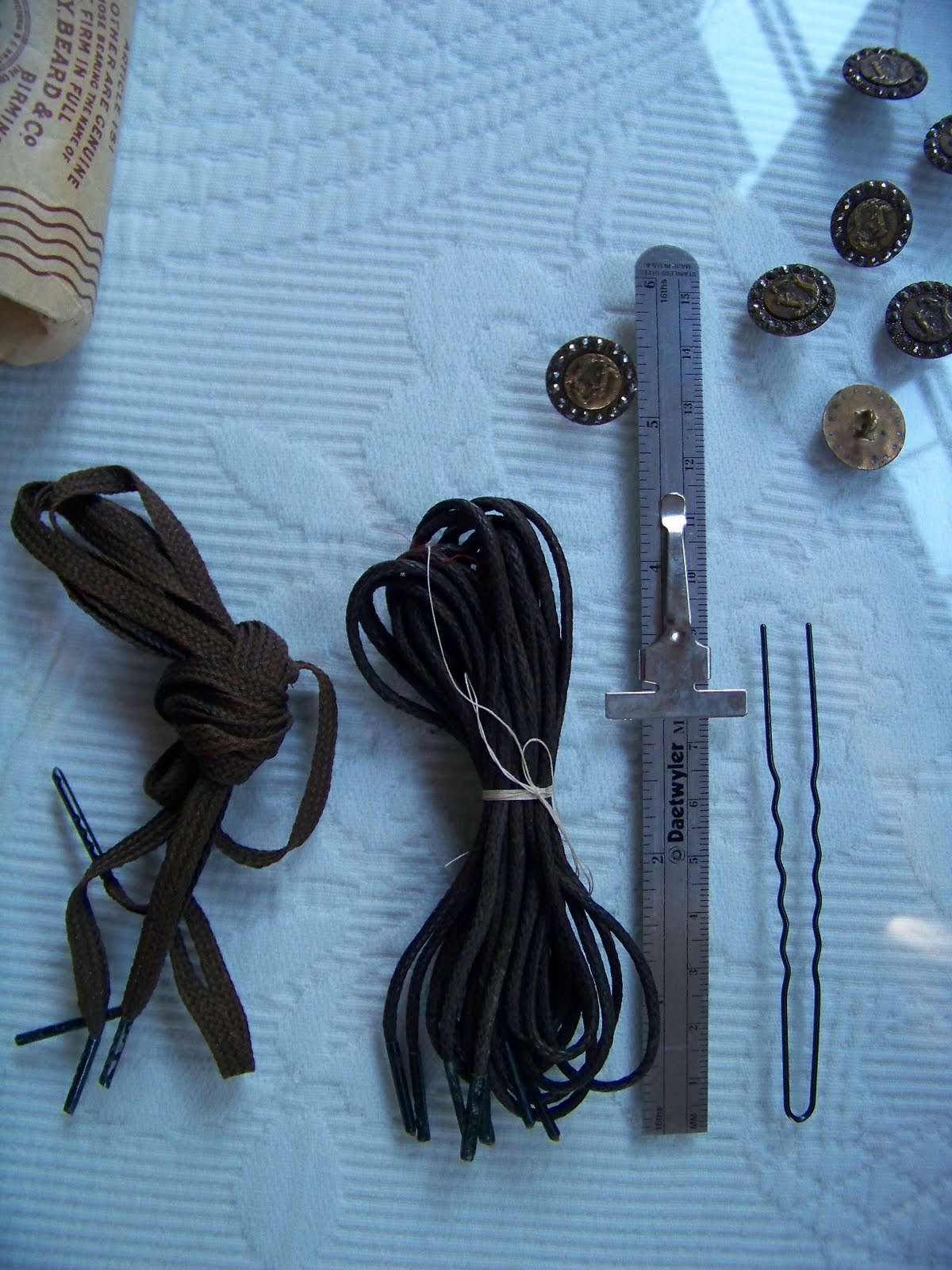
Laces
These laces are still tied and wrapped just as they were found. Like many of the reels of ribbons in that same milliner's attic, some of the laces are tied with cotton thread, of a thickness that reminds me of buttonhole twist.

I am not sure what type of laces these are. The leftmost are flat tapes, loosely braided. The right laces are tubular, and also braided. At their ends both sets of laces are crimped with black-painted metal.

Haven't estimated their length, but they do not seem long enough for corset laces. Boots, more likely.


The Milliner Sisters
Curtis goes to estate sales and has done so for many years. At one of these sales he visited the attic of a lady who, with her sister, had been a milliner. She was a hoarder, oh, was she a hoarder, he laughed. She had stuffed purses with all of her bills, and he found her grocery lists. Then there were the stocks of millinery supplies: rolls of silk ribbon on specially made cardboard tubes. The wide ribbons were wound on the rolls between very thin sheets of paper; I shall show you an example some other time. The narrow ribbons didn't always get this treatment. Some of the larger rolls of ribbon were tied closed with that same thread you see above, and shorter lengths ditto. There were rolls of ribbon from a quarter inch to three and more inches wide, moire, edged, picoted, or printed. Many were stained from their years in the attic, and a few were shredding, being made of weighted silk, but many are still strong.

Now for the fun part. The sisters shared their business, but split at some point, and every little item they owned, Curtis explained, split too, in exact halves. Even ribbons were divided right in half! Whether the split was amicable and the division the decision of two very precise ladies, or a tragic and angry separation, I cannot suppress a smile, these years later. Certainly the items don't retain any sadness, like some items do, preventing me from even handling them. Instead they seem to be happy, sunny things, telling their story to us afresh.

Material Culture and Social History Blogs
Are you interested in reading about material culture and social history? Then I have several more blogs for you that I follow regularly. They are all quite different, but I think you will dip into each one with joy.

At the Sign of the Golden Scissors
Specifically eighteenth century dress. A really wonderful journey into textiles, stays, portraits, and more. American.

Picking for Pleasure: Understanding Antiquing Acquisitions
Examining a wide range of American items through the lens of material culture studies.

Zho Zho's Textile Adventures
Textiles, history of costume, historic houses, fashion, from New Zealand.

Today I leave you with...
...Muffin and Ladybug snoring, apropos to the Cat Days of Summer. Why should the dogs get all the press?