Showing posts with label fashion plate resource. Show all posts

Thursday, March 03, 2011

"New Things in Fashion": Fashion Plate No. 23, August 1795, a "Luxus" Translation

A Translation from Journal des Luxus und der Moden

Now, what you just may have been waiting for...the fashion plates and their descriptions from Luxus. So, what's the news for August? Because of the time lapse from reporting to publishing, the reporter dates his news the second of July. Here is the translation of the introduction to the two fashion plates for the month, and then the first fashion plate and its accompanying description.
Photo: Plate 23, August issue

As always, click on any image to see a larger version.

Page 394

2. Aus Teutschland
* * den 2. Jul. 1795

Zu meinem lezten Berichte vom 10. Jun. habe ich Thnen (???) noch beiliegende zwei Figuren nachzutragen, weil sie zwar keine auffallend neuen Moden enthalten, sondern, eben so wie meine vorigen Zeichnungen, nur Muster, wie unsre eleganten Damen sich anjezt kleiden, liefern.

Die erste Figur, (Taf. 23.) ist eine junge Dame in einer Chemise von Linon, mit kurzen Armeln, woran der Leib under der Schärpe mit gefalteten Spizen garnirt ist. Die Schärpe von blauem Bande ist vorn unter der rechten brust in eine Schliese gebunden davon die Enden herabhängen. Das Halstuch ist unter den Armen durchgezogen und unter den Schultern geknüpft. Um den Hals ein schmales Collier von weissen Spizen; das Haar geschlängelt-

page 395

raus und fliegend; der Aufsas ein Bandeau von weissem Linon mit zwey Schleifen, und Festons von Perlenschnuren, worin ein Puf von blauem Atlas steht, welches nach hinten-zugetheilt ist, vorn ein kleiner Federstuz -- vollenden das eleganten Negligee meiner Dame.

2. From Deutchland
the second of July 1795

To my last report from June 10, I have still the adjacent two Figures to add, because they indeed contain no fine, remarkable new fashions, but rather, as with my previous examples, they furnish only patterns of how our elegant Ladies are now clothing themselves.
The first Figure, (Plate 23), is a young Lady in a Chemise [dress] of linen, with short sleeves, whereof the body under the sash is garnished with folded lace. [See my note, below.] The sash of blue ribbon is tied in a bow right under the right breast, from which the ends hang. The fichu [literally, necktowel] is drawn through under the arms and tied under the shoulders. Around the neck a narrow collar of white lace; the hair curled [geschlaengelt-raus] and flying; the headdress [Aufsaz] a bandeau of white linen with two bows (?) and festoons of pearl strings, wherein a pouf of blue Atlas [satin] stands, which is distributed towards the back, in front a small feather aigrette -- completing the elegant Negligee of my lady.
Here's hoping that translation got things fairly right :} Any corrections or clarifications you wish to add? (March 4 note: thank you again, Sabine! What a kind help you are!)

Let's have a look at the text again, along with image details. First, the dress is made of linen. Not cotton. Many costumers have been leery of linen for chemise dresses, thinking that cotton would be the most fashionable choice. As we learn here, a fine linen was fashionable too,

The dress itself is quite plain: all the effect is in how it's worn and its accessories. The bottom hem is undecorated (see full plate, above) and the sleeve ends are plain (see detail image below). Also look at the neckline. I am fairly sure that the gathering string in the neckline is set down a bit so that you get a bit of ruffled header. If it were lace whipped on or a tucker, the text would say so, given the other fashion plate descriptions I've been reading in the same magazine. In linen this gathering would drape and fold very nicely.

Now, to that bit where the reporter says "whereof the body under the sash is garnished with folded lace". If we look at the plate in detail below, it would appear that there is a gathering of extra fabric just under the sash. Apparently this is at least in part lace? So that there is a sort of peplum effect. A Grecian-ish sort of styling I haven't seen much of elsewhere. Interesting.


Our fashionable lady's morning toilette does not include drawing her neckerchief over her decollettee chemisette-style. You can see this a number of times throughout Luxus, and you can also see it in some Gallery of Fashion plates, too. So, at least as reported in this issue, covering the neck and upper chest was not de rigeur for morning dress/daywear. Instead, the neckerchief, which must be a long one, decorates the shoulders and then is tied in back. In the drawing it appears that the fabric is a square, folded in half into a triangle so that the striped golden edging is doubled. Pretty.

A side note. In some Gallery of Fashion plates, you can see long shawl-like or fichu-like or neckerchief-like contraptions treated rather similarly; those are often ruffled. A further side note: this way of wearing a neckerchief/fichu was to become very popular in the late 1860s to early 1870s. At that period, the thing was labeled a fichu. See Frances Grimble's Reconstruction Fashions for numerous examples.


The sash is of blue ribbon, not particularly wide. I love that it's tied in what may be rosette-style or double bow. Note that the ends of the ribbon are dagged.

Plus, look at her gloves. Can you see the small tucks and/or topstitching over the back of the hand? The gloves are elbow length and not particularly tight. In fact, I'd call them a little baggy, wouldn't you?


We have talked about the pretty lace choker collar already in The 1790s Project: 1795-1800 Fashion Details. I've not seen any costumer try this effect yet.
 

The headdress is especially interesting, as it's multipart. The reporter describes the linen bandeau with its bows -- clearly rosettes -- and then how some blue Atlas fabric is set within it and atop the head, but not covering all the hair.

"Atlas", according to Neues und vollständiges deutsch-englisches Wörterbuch (1808), is satin, of silk, but in Germany also of wool or linen. I assume that the term is more about the satin weave than the fiber used. Here is the full dictionary term, from the dictionary:


2. der Atlass, des-sses, plur. die-sse, from the Persian; satin, made generally of silk, but the Germans say also wollene [woll] and leinene Atlasse [linen Atlas].
das Atlassband, satin-riband.
Atlassen, adj. and adv. of satin. Ein atlassenes Kleid, a satin coat, it (?) what is in imitation of satin. Ein atlassense Band, a satin riband.

The pearl strands are a rather ornate addition, and overkill in my opinion, especially when worn with big hoop earrings.

Look careully at the earrings. There is a small hoop at the earlobe, and then the big hoop is appended to it, or that's the way I read the image. Other fashion plate descriptions for 1795 describe the earrings in some detail and perhaps I will get to a sample for you.

Hope the above was helpful. It was for me! Next time, plate 24 from the same issue.

Resources
Translation resources. I have found that using multiple sources works best, because some words, expressions, and constructions are spelled or used in an archaic way, and some words have simply disappeared from the modern German lexicon. The best resource, though? The kindness of readers. Thank you all so much!

Wednesday, February 16, 2011

The 1790s Project: 1795-1800 Fashion Details

Over the past while, during a hiatus from blogging and sewing, I've been reviewing and refining my understanding of mid to late 1790s fashion, this time looking for fashion details, such as embroidery, and for ensemble details such as hairstyles and accessories. Plus, I've been looking for new sorts of documentation beyond fashion plate images, large portraits, prints, and extant garments.

Photo: detail of portrait miniature of Mrs. Jeremiah Atwater, Metropolitan Museum of Art

Portrait miniatures have proven to be a rich source of detail. Miniatures were the photo keepsakes and memorials of their day, and I suspect were often painted naturalistically so the miniature's owner could see their beloved in their true "likeness". To paint the portrait too fancifully would defeat the purpose of memorialization. This is in contrast to full-length portraits, which art historians have long pointed out did include fanciful and/or symbolic elements. See the exhibition book Thomas Gainsborough and the Modern Woman for a current treatment, in the form of a series of essays, of this subject.

Miniatures were far more common than I had realized. In museums they are often not on view, or are stuck away in cabinets where looking at them is a chore for strong eyes. Nor are they run-of-the-mill items in our fine antiques shops, locally, anyway.

However, recently, what with powerful digital cameras and exploding online collections -- and specialty antiques dealer's sites -- they are far easier to find, and often easy to view in detail. I have examined several hundreds of them over time, and have cataloged a long list of them by level of detail, jewelry worn, hairstyles, and so forth. If you would like to browse several collections, try the examples of American miniatures at the Metropolitan Museum of Art, and miniatures for sale at Antiques and Uncommon Treasure and Aesthetic Engineering Fine Jewels and Antiques (just two among many dealers online).

At the same time, for fun I've been reading and translating several 1795 issues of the German fashion and cultural news magazine, Journal des Luxus und der Moden, which I shall call Luxus here for short. Some 15-20 years ago I studied German seriously, and then let it lapse when, well, when I fell in love with my husband, met through our mutual German teacher, and life moved on. Anyhow, have been aching to pick it back up. Awhile ago I stumbled upon a complete repository of the journal -- what fun! For the last four years I've been wanting to read a 1790s fashion magazine in full, and Nikolaus Heideloff's Gallery of Fashion frustratingly not being available online (with small children, I do not have the luxury to pore over a microfiche at the university nearby), have found Luxus a double luxury.

Photo: sample of the fashion report from the August 1795 issue of Journal des Luxus und der Moden. Note that the author's fashion report actually dates from early July, although the magazine came out in August.

Luxus was a German publication which reports on German fashion but also fashion elsewhere, such as London, along with cultural news. Now, let me here give the standard caveat about styles. Different regions within Europe, Britain, and the U.S. had their own stylistic takes on fashion appropriate to their local culture and geography, but at that date there were fashion norms that did cross national and geographic borders, and fashion-conscious women over the Western world did tend to follow the general norm, at least in outlines. Any examination of portrait miniatures will make this abundantly clear.

Anyhow, when I read the fashion news in Luxus, and look at plates from English fashion magazines, and then look at miniatures, prints, and paintings, I see the general outlines syncing up, while regional and cultural and age and individual and artistic differences make for fascinating analyses. What's delightful about having a full text available, is that we get so much more information about what was hot, and useful details for interpreting the construction of particular ensembles pictured.
 
Here then is an examination of one of these miniatures, in relation to some fashion plates and accompanying text from Luxus, plus a few notes from Gallery of Fashion. I have made some notes about what I believe may be the details we are looking at. Remember that what I write are attempts, essays, at understanding and are by no means the analysis of an expert.

Let's start. As always, click on the image for a larger version.

Mrs. Jeremiah Atwater, circa 1795
A portrait miniature at the Metropolitan Museum of Art


The full portrait. Mrs. Atwater is wearing some elements of what I take to be morning dress, also known as "undress", or "negligee", dress not associated with formal occasions, and some elements, like her open robe, typical of more formal dress.

Let's examine some details.

Mrs. Atwater is wearing a lace collar, which appears to be ruched in a double layer. Just this sort of collar, "Collier" in German, is described in detail in the August issue of Luxus, plate 23, described on pages 394-395. That plate is of a lady in "eleganter Negligee", or an elegant morning toilette.  In the journal the collar is described thus: "Um den Hals ein schmales Collier von weissen Spitzen" (a narrow collar of white lace). From the Luxus text, it's clear that the collar is a separate accessory, not the top part of a chemisette. So it appears to be in Mrs. Atwater's miniature.

Here below is a detail from plate 23 in Luxus.


The July Luxus issue names the plate 23 dress a chemise, of linen. Like Mrs. Atwater's dress, it too has a gathered front and a similar gathered neckline treatment, although the writer does not say the edging is lace. It probably is not, because when the trimming is lace in other plates, the writer tells us so explicitly. See how the collar and the neckline are similar and complement one another. Clever and if the wearer has nice skin, attractive.

In just a year or two after 1795, the use of lace at the neckline would go out of fashion for a bit, as the craze for severely classical plainness took hold.
The earrings here are gold pendants, which appear to be cone shaped and may have a small drop underneath the cone, and there may be more than one cone. It's hard to say. In Luxus and the Gallery of Fashion, gold hoops were most commonly illustrated this year, for instance the lady in plate 23, although there are a few button-style or bead loop styles. Hoops were hot. Gold was hot.

On to more details in Mrs. Atwater's ensemble.

Mrs. Atwater's belt, apparently of fabric close to that of the robe. A center clasp in two connecting halves, apparently of metal, perhaps gold or something mimicing it, and with some sort of vertical decoration, details unclear. The next image tells us something important about the belt.


Mrs. Atwater is wearing a long-sleeved robe over her chemise. It's of the type that does not close in front. There is a gorgeous example in brown silk of this sort of robe, from 1797, in Anne Bissonnette's Ohio and the Western Frontier: 1790-1840 book from Kent State University (and see a video of the exhibition, but sadly, not showing the robe. You have to have the book; as of this writing Kent State does not offer an image archive).

This robe is embroidered in what appear to be blues and pinks or reds along the edge. Some Heideloff fashion plates show this sort of edging, and the Met has a circa 1798 example of a faux robe over what it names a round gown that sports pretty multi-color embroidery. The way the paint is treated in the Atwater miniature, the belt appears to go over the robe to hold it in place. A robe, so far as I can tell from fashion plates, texts, and extant garment descriptions, was worn for more formal occasions. Have a look at the plates and text from the Gallery of Fashion preserved on Cathy Decker's old site, and you will see that robes are described for afternoon or evening dress, while dresses alone, or dresses with shawls or what look like long stoles, are worn instead for morning dress.

Mrs. Atwater is indoors. She is not wearing any headdress; I cannot tell if it's because this is a more formal occasion, or what. Her hair is dressed frizzed in front and with the back hair long, straightish, and "flying", as Luxus puts it, in locks, though it might be looped up in a sort of loose chignon, also a popular style. The Luxus plate 23 wears her hair "geschlangelt-kraus und fliegend", or roughly, "coiled and flying". I had some trouble with the "-kraus" word: the Fraktur typeface German text was printed in back then can be difficult to make out.

Well, thus ends the little analysis. It's not complete, and it leaves some questions, but this is what I love about comparing portrait miniatures with fashion plates, fashion texts, and extant clothing. Each bit of evidence has given us key information about ensembles worn in 1795 that individual types of evidence alone cannot.

Wednesday, May 06, 2009

Antique Garments, Photographed


Multiple photographs of an antique garment that detail the garment's design, construction and interior are precious to costumers. There aren't so many quality good sources out there (more on that in a moment). That's why, whenever a new source pops up, it's cause for celebration.

Stormi Sourter, of Why Not Then, a newish costuming site, plans to photograph her entire collection of antique clothing, and she already has quite a selection up in the Original Garments section. Each set of photographs comes with garment measurements and construction notes, too. What a boon; thank you!

Photo: detail of the interior of the back closure of a circa 1850s plaid bodice

Other Antique Garment Photo Sources

As I mentioned, quality photos -- more than one two per garment, clearly shot and close up -- aren't over-plentiful. The Victoria and Albert Museum has reissued its Costume in Detail volumes, Linda Baumgartner's Costume Close Up covers a set of 18th century garments in magnificent detail, and Your Wardrobe Unlock'd, an online magazine (subscription only), is currently offering several super articles on 1860s' era clothing as part of its Single Pattern Project. Elizabeth Stewart Clark's forum has many threads that deal with the minutae of mid-century clothing construction, but be aware that one must search carefully for threads with photos. By the way, it was on that forum that I learned of Why Not Then. The Fashion Plate and Photo Resources section of this blog catalogs as many online sources as I've been able to discover.

Monday, February 02, 2009

Harper's Bazar Nineteenth Century Fashion: All Online


A red-letter day! Cornell University's HEARTH site put much of Harper's Bazar online...from the magazine's inception in 1867, in fact, until 1900. I am enchanted.

One of the sources for high-style fashion news in America, the magazine's engravings are superb, and the text is full of fashion news, sewing and needlework instructions, fashion plates, articles and poetry, and in every other issue, a full set of patterns, too. Sadly, Cornell has no plans to post the pattern supplements. I wrote to ask them about it and they replied the same day.

Here is a sample of text describing the carriage dresses featured on the July 18, 1868 cover:

1. Dress of blue silk, with tablier simulated by a puffing of the same, edged with narrow black lace, which begins at the waist, and sloping on each side borders the entire bottom of the dress, excepting the front breadth. Two similar rows of puffing, separated by black lace, are set above this on the bottom of the skirt. A row of silk bows, composed of four loops without ends, are set down the middle of the front breadth, in the manner of buttons. Large carriage mantle, with "full slashed sleeves, of black cashmere, lined with rose-colored silk, and trimmed with gold fringe and galloon. Black lace bonnet, with gilt diadem, and red rose and leaves at the side.
Fig. 2. Dress of changeable silk (gorge de pigeon) trimmed with a box-pleated flounce. Black lace mantelet attached to the bonnet. Corsage half low, with white muslin chemise Russe. Sleeves tight, trimmed with three silk folds. Belt edged with a bias fold of silk. Half long gloves of peau de Suede; changeable silk parasol, to match the dress, lined with white gros de Naples, with wide changeable fringe.

You see? Incredible detail.

Some of the plates and patterns in Harper's Bazar are the same as those in De Gracieuse of the Netherlands, and the supplements for that magazine are available online (see my Fashion Plate and Photo Sources list for details). Why are the patterns the same, you might ask? Because Harper's Bazar took much of its content from Die Modenwelt in Berlin, which in turn seems to have copied Paris fashions.* America still leaned heavily on Europe for fashion instruction in those days.

The posted pages are fairly well scanned, although many seem a little dark, and the text is fully searchable, a real boon.

See the magazine index.

* The book Producing Fashion: Commerce, Culture, and Consumers, by Regina Lee Blaszczyk (University of Pennsylvania Press, 2007) states that Die Modenwelt was published across Europe, using the same fashion plates, in some 13 languages. De Gracieuse, I surmise, was one of these.

Tuesday, November 25, 2008

The Past in Review: More Photo Resources


If you're interested in period photographs, do spend some time with the daguerrotypes and photographs of families, couples, houses, military scenes and more offered on these sites:
The images can be so evocative. I caught myself smiling at some of the faces; others I studied in fascination, wondering what lay just outside the bounderies of the photographs.

Photo: Young lady on a bicycle, circa 1890s; Hugh Mangum collection, negative no. 274.

Note: These resources have been added to the Fashion Plate and Photo Resources list.

Wednesday, May 28, 2008

Fashion Plate and Photo Sources...Oh, and Random Patterns, Too

Updated September 9, 2011

The Web is chock full of sources for period fashion plates and period photos. Folks on Elizabeth Stewart Clark, Truly Victorian, H-Costume and Sense and Sensibility have passed several sources around over time, and others I have uncovered myself. Lately Google Books has been offering increasing numbers of volumes of popular women's magazines in full, which is a true blessing since not only do we have the fashion plates, but the descriptions and the other magazine content...what a rich source!

Photo: A 1796 fashion plate from the Collection Maciet, with a handwritten note underneath, "Morning Dress".

I am cataloging these resources here for ease, and am adding to them as chances occur.

Right: detail from La Mode Illustree fashion plate, 1869. Collection Maciet, Bibliotheque des Arts Decoratifs
America's First Look into the Camera: Daguerrotype Portraits and Views, 1839-1864
More than 725 of them, mostly portraits, and mostly by the Mathew Brady studio. Wonderful for fashion research.

Arthur's Home Magazine (on Google Books) (Added October 1, 2009)
Entire volumes of Arthur's Home Magazine, digitized by Google books. Most volumes contain a half year or full year of issues. While more religiously minded than other magazines, Athur's still offered some fashion and needlework information. When you click the link, you will go to the Google search results list for "Arthur's Home Magazine". The search may not have garnered all that's out there, because if there are spelling mistakes or the book was titled with a different word or character, Google will not recognize it.

Belle Assemblee, La (on Google Books) (Added October 1, 2009)
Entire volumes of La Belle Assemblee, digitized by Google books. This is a super source for Regency fashion. When you click the link, you will go to the Google search results list for "Belle Assemblee". The search may not have garnered all that's out there; because the magazine name changed several times and it is entered into Google Books in several ways. Because of this, I could not use the Editions feature in Google Books, so many items farther down in the search results list will not be the magazine.

Bibliotheque des Arts Decoratifs, Collection Maciet
Very large database collection of fashion plates, with the occasional pattern. Marvelous for mid-nineteenth century. Photos zoom to very large size. In French. To view the plates:
  • From horizontal nav bar at top, choose "Recherche simple" (simple search).
  • A form will appear on the left half of the screen.
  • In "Termes de recherche" (search terms) field, enter "mode" (fashion).
  • Under "Type de document" (document type), check "Collection Maciet".
  • Under "Langue" (language), check "Tous" (all).
  • Click "Rechercher" (search) in the lower corner.
  • A database results list will appear. If you don't speak French, the citations will still make sense enough: just check the boxes next to the years in which you are interested.
  • At the bottom of the screen, click "Voir les notices" (view the citations).
  • One or more full citations (depending on the number of citations you chose) will come up in the right screen. To view the fashion plates associated with each, click "Voir les vignettes Maciet" (View the Maciet plates) at the lower right corner of a citation.
  • Thumbnails will load.
  • If you click on a thumbnail, a full-screen dialog box will pop up. It will contain a larger-size image, and along the left side, viewing tools.
    "Zoom avant" = zoom in
    "Zoom arriere" = zoom out
    You can also use the percentage box beneath. Note that it takes time for the images to resolve into their new zoom setting.
    "Selection" gives you a zoom selection tool. On the image, the pointer changes to a box with four arrows. Click and drag to create a selection box to zoom in on a particular portion on the image.
    "Deplacement" is a pan tool. Click and drag the image around.
    "Luminosite" and "Contraste" affect the color, as you might expect.
    "Garder les reglages" (keep the ??) probably means keep the settings
    "Configuration par defaut" (default configuration) returns the image to its original size
    "Impression" (print) allows you to print or save. A new print screen will show up with the image. In the box at bottom it says that you may insert your comments: they will print along with the image. Magnifique!
BFI (British Film Institute): Mitchell and Kenyon Collection: Edwardian Britain on Film
A superb way to see Edwardian clothing (mostly from 1900-1904) in action, as worn by everday people and celebrities. The films are usually just a few minutes long.

Dames a la Mode
Fashion plates. Especially useful for the Regency era. A blog maintained by Tayloropolis.

La Couturiere Parisienne
Fashion plates, patterns, and fashion history from an accomplished fashion historian in Germany.

The Daguerrian Society (this entry added 09/23/08)
A database of over 1,000 images. You may search the database or browse the images by thematically organized galleries.

De Gracieuse 1862-1936 (the Netherlands)
I noted that for 1868, anyway, the fashion plates are replicas of those in Harper's Bazar. Entire magazines have been scanned. Zoom doesn't appear to work, but as of September 2008, if you select an image, and choose "save" from the icons to the right of the image, you get a large enough scan to see details.

Diderot: Encyclopédie, ou Dictionnaire raisonné des sciences, des arts et des métiers
There are a number of versions of Diderot's enormous encyclopedia out there, some translated, some in the original French, and some as images of each page. A quick Google search of the title will get you many of these. My preference is for the Wikimedia Commons and Wikisource version, since it includes both scans and a searchable text version, and the index to all the plates.
Also, see plates related to 18th Century dress from Denis Diderot's Encyclopedia, on the Costumer's Manifesto
Duke Digital Collections (This entry added November 19, 2008)
Earthly Angels: Cartes de Visite
A blog collection. Can be sorted. Sadly, the collection's editor hasn't, perhaps not being able to, included much in the way of information about the images.

Fashion (Category) in Wikimedia
Image archive divided out by category, with sections such as "18th century fashion" and "dressmaking. Warning: some categories are loaded with images, many without text description, and take forever to load. Proceed with care.

Flickr "Pools" of Historic Photographs and Images (added May 13, 2009)
Flickr is stuffed with contributers who love to share antique photos, postcards, and other images. Here are some of their "pools", groupings of photographs by subject. Be forewarned: some pools, such as one labeled "antique photographs" contain pinups and other images that may not be appropriate for young people (I did not include that pool in this list).
Godey's Magazine (on Google Books) and The Lady's Book (Added October 1, 2009)
Entire volumes of Godey's Magazine, and its predecessor, The Lady's Book, digitized by Google books. Most volumes contain a half year or full year of issues, and most are complete with their fashion plates and accompanying descriptions. When you click the link, you will go to the Google search results list for "Godey's Magazine" and "Lady's Book". The search may not have garnered all that's out there, because if there are spelling mistakes or the book was titled with a different word or character, Google will not recognize it. Also, note that some volume years were misstyped in Google; thus the "1886" issue is really for 1836.

Good Housekeeping Magazine (Added October 1, 2009)
  • Scans on HEARTH archive site.
    Run of issues in their entirety from 1885-1950, from Cornell University's HEARTH archive. Each page available as an image, a PDF file, or as searchable text. Scans are not great quality, but content is superb anyway. You can easily search all content from all issues at once.
  • On Google Books.
    Better quality scans than HEARTH resource, but not a complete run of issues.
Harper's Bazar Magazine
All the magazines from inception in 1867 until 1900. Each page available as an image, a PDF file, or as searchable text. Sadly, the pattern supplements aren't included, but a patient person might find a pattern match in De Gracieuse, which carried many of the same plates and patterns. That magazine's supplements have been digitized. See the entry for it in this list. On the Cornell University HEARTH site.

Historical Artwork and Fashion Plates
Includes Peterson's, Demorest's, The Delineator, New Idea, and more, from 1870 to 1918. Includes some Peterson's patterns. Posted on Festyve Attyre.

History of Corsets (in images)
From Wikimedia Commons. I cannot locate an author. Page takes ages to load, but there are tons of images.

Iowa Digital Library: Iowa Women's Archives and the Noble Photographs (This entry added November 19, 2008)
These two collections, part of the much larger Iowa Digital Library, contain fascinating photographs of women in everyday, work, and school settings. Chiefly Belle Epoque era and later. On the homepage, scroll down to choose either of the collections from the list.

Iowa State University Digital Collections: Fashion Plates
"Contains plates of general fashion dating back to the 18th century and continuing through the 20th century. Additional categories within the files include accessories, baby and beach fashions, bridal fashions and portraits, children's and communion clothing, footwear, inaugural gowns, maid uniforms, masquerade costumes, men's fashion, millinery, mourning dresses, negligees and undergarments. There are also magazine issues relating to fashion as well as magazine articles discussing fashion of the Ancient, Medieval, Renaissance, and Modern periods."

LACMA Collections Online: Costume and Textiles
Fashion plates and online exhibits from the Los Angeles County Museum of Art. Large holdings.

Ladies' Companion, The (on Google Books) (Added October 1, 2009)
Entire volumes of The Ladies' Companion, an English woman's magazine, digitized by Google books. There is a very limited amount of fashion information, but enough to be interesting. Most volumes contain a half year or full year of issues, and most are complete with their fashion plates and accompanying descriptions. When you click the link, you will go to the Google search results list for "The Ladies' Companion". The search may not have garnered all that's out there, because if there are spelling mistakes or the book was titled with a different word or character, Google will not recognize it.

Lady's Monthly Museum, The (on Google Books) (Added October 1, 2009)
Entire volumes of The Ladies' Monthly Museum, an English woman's magazine, digitized by Google books. This magazine was published during the Regency and offers some fashion information. Most volumes contain a half year or full year of issues, and most are complete with their fashion plates and accompanying descriptions. When you click the link, you will go to the Google search results list for "The Ladies' Monthly Museum". The search may not have garnered all that's out there, because if there are spelling mistakes or the book was titled with a different word or character, Google will not recognize it.

Los Angeles Public Library: Casey Fashion Plates Index
"The Joseph E. Casey Fashion Plate Collection contains over 6,200 handcolored fashion plates from British and American magazines dating from the 1790s to the 1880s. All of the plates are indexed and digitized for online viewing."

McCord Museum, Canada: Costume and Texiles Collection
Zoomable photographs (one per ensemble) and explication of hundreds of items in their collection. Note that the museum has many other collections online, including photographs, plus fascinating games. A marvelous site.

The Metropolitan Museum of Art's Costume Institute Added January 13, 2009
Their entire collection is online. Not all pieces have photos. Not all photos are that good, and text information is limited. From the index page, choose the Collection Database link. It seems to be easist to find things if you search for a large category of garment, such as "dress" and then sort the results by date.

Mode Histoire
Scans of the fashion plates and patterns from nineteenth century magazines and transcriptions of all the original text that accompanied them. Currently limited to Peterson's 1863, but more to come. I have contributed my 1872 Peterson's to the effort.

New York Public Library
Period Resources Fashion Scans
From Digital Changeling's site. Including Paris Modes from 1909!

Peterson's Magazine (on Google Books) (Added October 1, 2009)
Entire volumes of Peterson's Magazine, digitized by Google books. Most volumes contain a half year or full year of issues, and most are complete with their fashion plates and accompanying descriptions, plus some garment patterns. Warning about the latter: they are not to scale, I hear, even if marked in images, so that you must drape the pattern pieces and alter them to fit you. . When you click the link, you will go to the Google search results list for "Peterson's Magazine". The search may not have garnered all that's out there, because if there are spelling mistakes or the book was titled with a different word or character, Google will not recognize it.

Powerhouse Museum Collection
From the Powerhouse Museum in Sydney, Australia. Photos of actual garments and accessories, including some ensembles with zoom feature. Warning: the accompanying descriptions can be poor and undated. For example, a search for "fichu" returned quite a list of photos of actual fichus, but almost all of the items were undated and information scanty. Further, not all items listed have photos, but you can filter those out. However, the breadth of objects is wide, and if you already know a bit about the type of item you are researching, the images can be of help. There is also an electronic swatchbook of fabrics from a narrow (but fascinating) selection of years.

Royal Lady's Magazine, The (on Google Books) (Added October 1, 2009)
Entire volumes of Peterson's Magazine, digitized by Google books. Most volumes contain a half year or full year of issues, and most are complete with their fashion plates and accompanying descriptions, plus some garment patterns. Warning about the latter: they are not to scale, I hear, even if marked in images, so that you must drape the pattern pieces and alter them to fit you. . When you click the link, you will go to the Google search results list for "Peterson's Magazine". The search may not have garnered all that's out there, because if there are spelling mistakes or the book was titled with a different word or character, Google will not recognize it.

Shorpy Online Photograph Archive Added May 13, 2009
An online archive of thousands of high-resolution photos from the 1850s to 1950s. Our namesake, Shorpy Higginbotham, was a teenage coal miner who lived 100 years ago. Many of the photos have been extracted from the Library of Congress, while others are contributed. The photo quality is extraordinary.

Tidens Toj
A Danish museum exhibition site containing high-quality, zoomable photos of actual garments, and often fashion plates and patterns to go along with them. Covers multiple centuries, but the nineteenth century is very nicely represented.

University of Washington Digital Collections: Fashion Plate Collection
"The database consists of 417 digital images chosen from a larger group of fashion plates"

Victoria and Albert Images: Heideloff Gallery of Fashion plates
A small selection of plates from the famous Gallery of Fashion, published 1794-1800 by Nikolaus Heideloff in London.

Why Not Then: Antique Garments section
Photographs of garments in author Stormi Souter's collection. Multiple photos per garment, with accompanying construction notes and measurements

Tuesday, March 21, 2006

Digitized Collections of 19th and 20th Century Catalogs, Manuscripts and Ephemera

If you are interested in period advertisements, catalogs, magazines, scrapbooks, diaries, and ephemera, do see the digitized collections that Harvard and Duke University have online.

Women Working: 1800-1930, Harvard University Open Collections

As Harvard describes it:

Women Working, 1800 - 1930 focuses on women's role in the United States economy and provides access to digitized historical, manuscript, and image resources selected from Harvard University's library and museum collections. The collection features approximately 500,000 digitized pages and images including:
7,500 pages of manuscripts
3,500 books and pamphlets
1,200 photographs


Includes such representative items as


  • Dorcas Magazine (crocheting and knitting, 19th c), (some issues)
  • Ladies Home Journal, (some issues)
  • Woman's Home Companion, (some issues)
  • Abercrombie and Fitch 1913 Styles catalog,
  • and the diary of Delia Kinglsey, school teacher (1906-1910).

Visit the site! See http://ocp.hul.harvard.edu/ww/

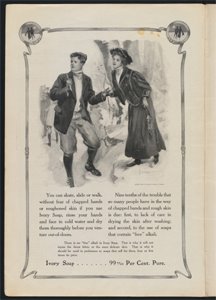
Above: Ivory Soap advertisement from Woman's Home Companion, January 1909, Harvard Digital Collections

Digitized Collections, Duke University

Part of the Rare Book, Manuscript, and Special Collections Library. Includes items such as

  • "9,000 advertising items and publications dating from 1850 to 1920"
  • 19th century sheet music!
  • writings and diaries of African-American and Civil War women

Visit the site! See http://library.duke.edu/specialcollections/collections/digitized/index.html

Super resources for researching and understanding fashion!